
3.5 Inverses and the Invertible Matrix Theorem
The previous section built compositions; this one asks for a specific composition — the one that gets you back. A square matrix is invertible when there is a matrix with and , the identity, so that applying and then , or the other way round, returns every vector to where it started. (For square matrices either equation turns out to force the other, but that is a theorem, not part of the definition.) Section 3.3 already tells you when to expect one. If confuses two inputs, no return trip can know which of them to go back to; if misses a target, no return trip can start from there. Invertible should mean one-to-one and onto — and for a square matrix those were the same condition.
Work with a family, so the interesting case can be approached rather than merely described:
Chapter 4 will recompute its determinant at length; for now take , which section 3.2's area argument already gives you as the cross-product of the columns and .
 Explore in 3D (opens in a new tab)
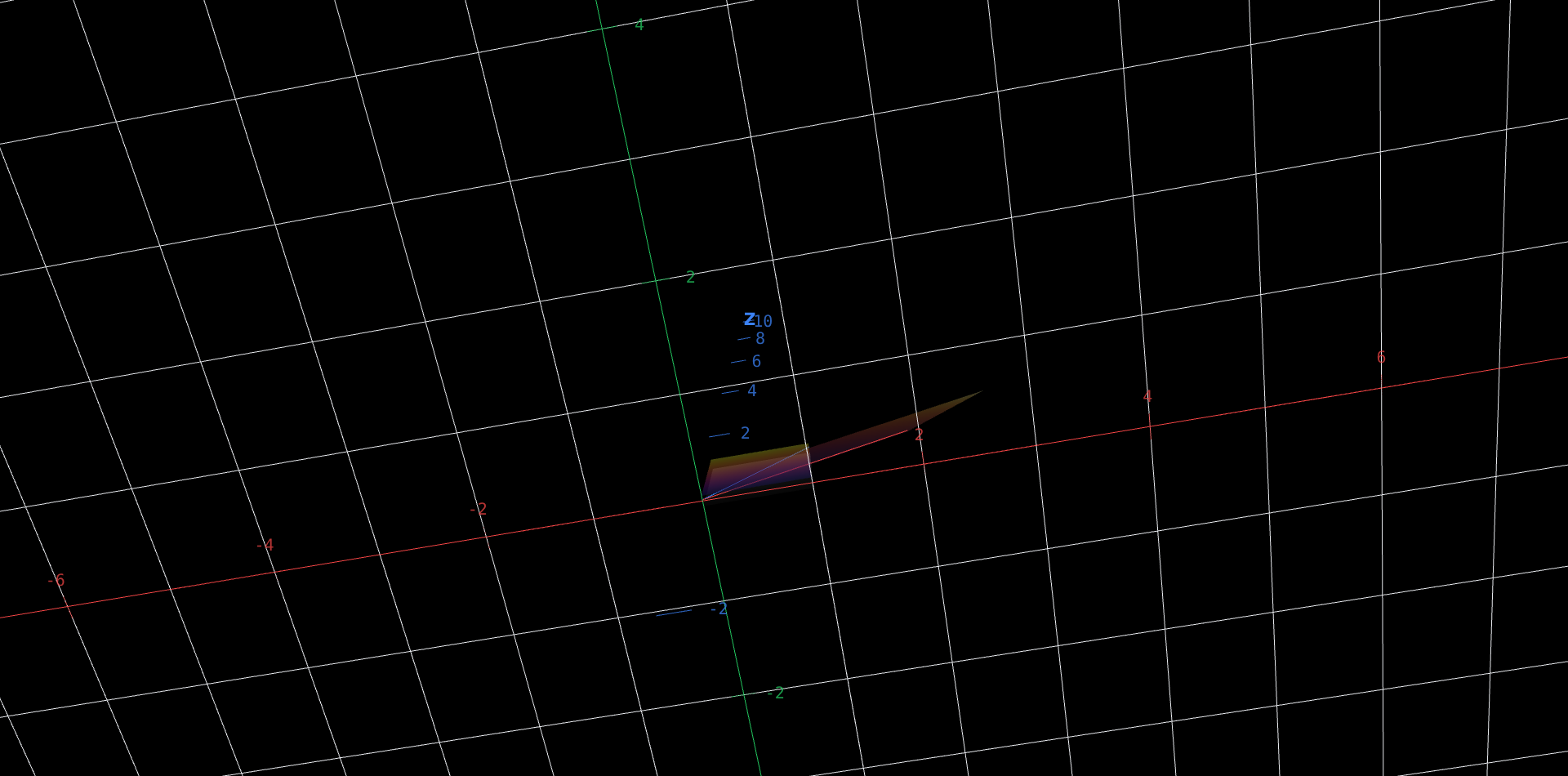
Seen face-on in one upright plane, against a gray horizontal axis and a gray vertical axis with numbered ticks: a light gray outline of the unit square; a colored parallelogram outlined in pale orange, which is that square stretched and sheared by a matrix, with its two edges from the origin drawn over the outline in red and blue; and a third quadrilateral inside the gray outline, which is the parallelogram carried back by the inverse matrix. However the slider is dragged, the third shape exactly fills the gray outline - the round trip always returns what it started with. As the slider approaches its lowest setting the middle parallelogram grows thin and nearly collapses to a line, and the entries of the inverse that undoes it grow large, reaching 20 at the slider's lowest setting; they would grow without bound only if the slider could reach one half.
Explore the figure
- At the default the middle parallelogram is a healthy shape and the returned quadrilateral exactly fills the gray outline. That coincidence is the whole definition: undoes .
- Drag up to . The parallelogram grows — its area is — and the return trip still lands precisely on the square. Nothing about being large makes a transformation hard to reverse.
- Now drag down towards . The parallelogram thins alarmingly; at its area is , a tenth of the square it came from. The return trip still works exactly — but look at what it has to do, stretching that sliver back into a full square.
- Read the slider's lower limit as a warning. It stops at rather than because at the columns are and , the second exactly half the first: the parallelogram has collapsed to a segment, and there is nothing left to carry back.
The formula, and where it breaks
For a matrix the inverse can be written down outright.
The inverse of computed symbolically. Every entry carries the determinant in its denominator — swap the diagonal entries, negate the off-diagonal ones, divide by the determinant. The formula makes the failure case unmissable: at the denominator is zero and there is no matrix to write down. That is not a defect of the formula but a report about the geometry, since a collapsed parallelogram cannot be un-collapsed.
Substituting a particular value makes the shape concrete.
At the determinant is , so the division does nothing and the inverse comes out in whole numbers. This is the matrix the figure is applying when you first open it, and you can check the round trip by hand: it sends the red column back to and the blue column back to — the two basis vectors the square was built from.
Why must a zero determinant rule out an inverse? Because determinants multiply. If existed then , and no number times zero is . The same fact told geometrically: is the factor by which areas scale, so a determinant of zero means every region is flattened to zero area, and no transformation can restore area from nothing.
Everything, all at once
Collect what this chapter and the last have established about a square matrix . Each of the following says the same thing; if any one holds, all of them do.
- is invertible.
- .
- The columns of are linearly independent.
- The columns of span .
- .
- The null space of is , i.e. .
- is one-to-one.
- is onto.
- has exactly one solution for every .
- The reduced row echelon form of is the identity matrix.
This is the Invertible Matrix Theorem, and its content is not that these are ten separate facts about invertibility but that they are one fact wearing ten costumes. You have watched most of them already: independence was a vector failing to escape a plane, rank and nullity were a budget that had to add up, onto and one-to-one were a missed point and a collapsed line, and the determinant was an area running through zero. The theorem's practical use is that you may check whichever condition is cheapest and conclude all the others — and its practical warning is that when one fails, they all fail together, so a matrix is never nearly invertible in some respects and fine in others.
An original work of XYZ Homework, built around interactive XYZ 3D figures. Chapters 1–6 follow the topic sequence of Interactive Linear Algebra (Margalit & Rabinoff, Georgia Tech, GNU FDL). Chapter 0's scope (its topics, their order, and the idea each figure shows) follows the Vectors chapter of Ximera's Linear Algebra: An Interactive Introduction. The prose, worked examples and figures were written for this book, which is not affiliated with or endorsed by the authors of either work. License: CC-BY-NC-SA-4.0.