The previous section treated a matrix as a destination: the square is here, its image is there. But a matrix is also somewhere you can travel gradually. Fix the matrix that sends to — columns and — and blend it with the identity map using a dial :
At this is the identity, leaving every point in place. At it is itself. In between it is a perfectly legitimate linear transformation in its own right — multiplying out gives , the matrix with columns and . The figure animates the whole family.
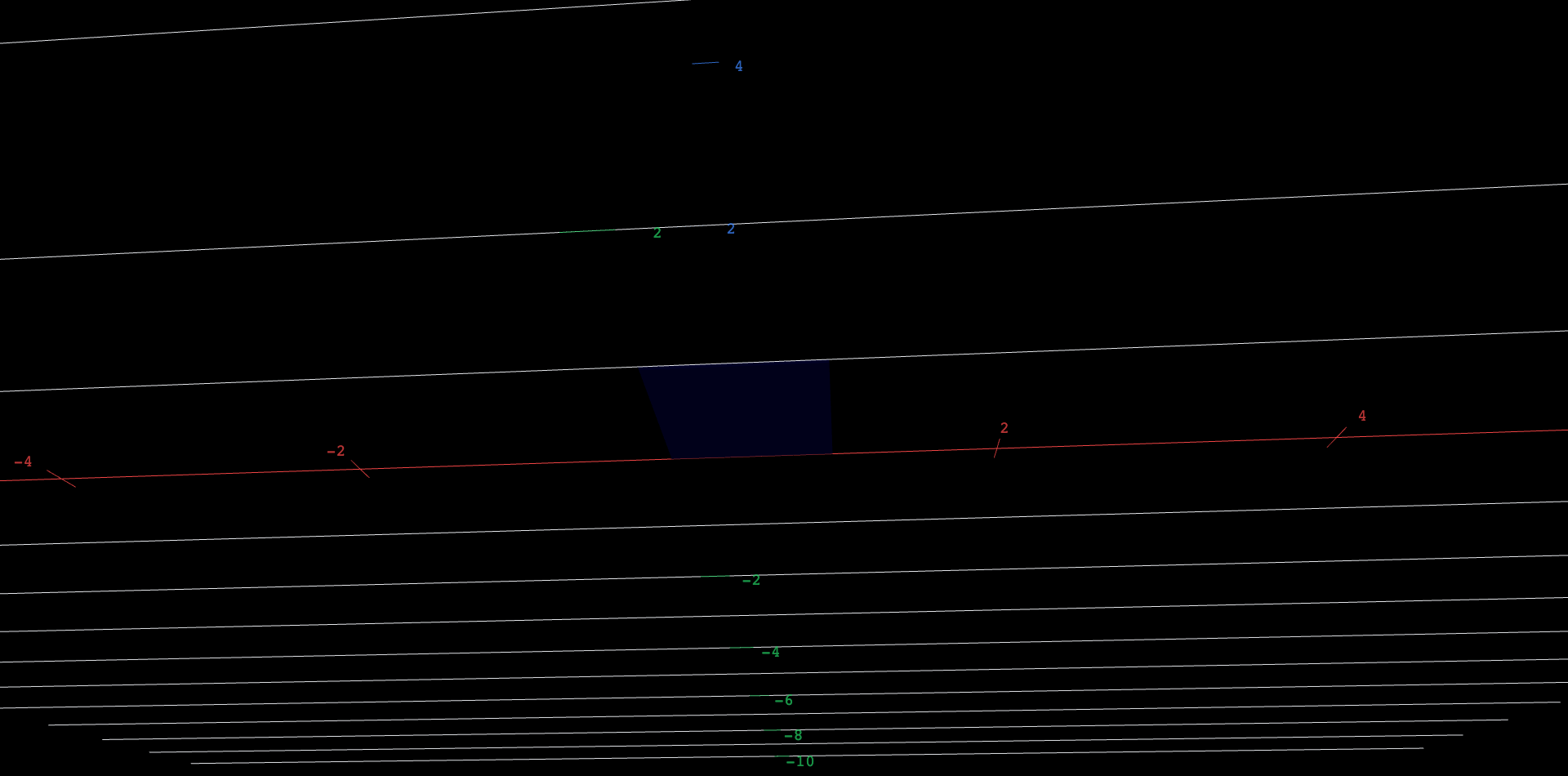
Explore in 3D (opens in a new tab)The unit square carried by the interpolated map , over a faint gray copy of the unit square that never moves. At the colored square sits exactly on the gray one; dragging to deforms it continuously into the image parallelogram of .
Explore the figure
At , confirm the colored square coincides with the gray reference square underneath it.
Drag slowly from to and watch one landmark: the far corner starts at and arrives at the sum of the columns of , which is . Does it travel along a curve or a straight line?
Watch the shape itself near the end of the slide. The parallelogram gets thin — by its two edges, the columns and , point almost the same way. Compare with .
Run back and forth across the last stretch of the slider. Does the square ever collapse to a segment completely, the way the dependent columns did in the previous section — or does it stop just short?
Straight-line motion, and a near collapse
Why straight lines? For a fixed point , its position at dial value is — a weighted average of the start and the destination . As runs from to , that weighted average slides along the segment joining the two, at constant speed. The whole square deforms coherently because every one of its points is running its own straight errand at once.
The thinning is quantitative. For a parallelogram with edge vectors and , the area is — the cross-product formula from geometry. Applied to the columns of , the quantity inside the absolute value is
Area along the morph ✓ Computed · mojocas 0.1.0✓ Agrees with the text Area along the morph, computed exactly by mojocas 0.1.0, and confirmed to agree with the result stated in the text.
The area quantity for the whole family at once: a computer algebra system expands the cross-product formula on the columns of and returns — the same polynomial as above, with and in fraction form.
An original work of XYZ Homework, built around interactive XYZ 3D figures. Its chapter sequence is aligned to Interactive Linear Algebra (Margalit & Rabinoff, Georgia Tech, GNU FDL); this work is original, copies nothing from it, and is not affiliated with or endorsed by its authors. License: CC-BY-NC-SA-4.0.
These eBooks are a prerelease and are not yet certified conformant with WCAG 2.1 AA or ADA Title II. Every page is built against an automated accessibility gate, and the published editions will meet ADA Title II requirements when they release in late September 2026. If something is unusable, please tell us.

 Explore in 3D (opens in a new tab)