
3.3 One-to-One and Onto
A transformation can fail its job in two different ways, and it is worth having names for both before meeting a matrix that manages both at once. is onto when every vector of the target space is for some input — nothing is missed. is one-to-one when different inputs always produce different outputs — nothing is confused. Neither property implies the other in general, and neither is guaranteed.
Take the matrix Chapter 2 finished with, now read as a motion of :
Its rank was and its nullity , and those two numbers are about to be re-read as answers to the two questions above.
 Explore in 3D (opens in a new tab)
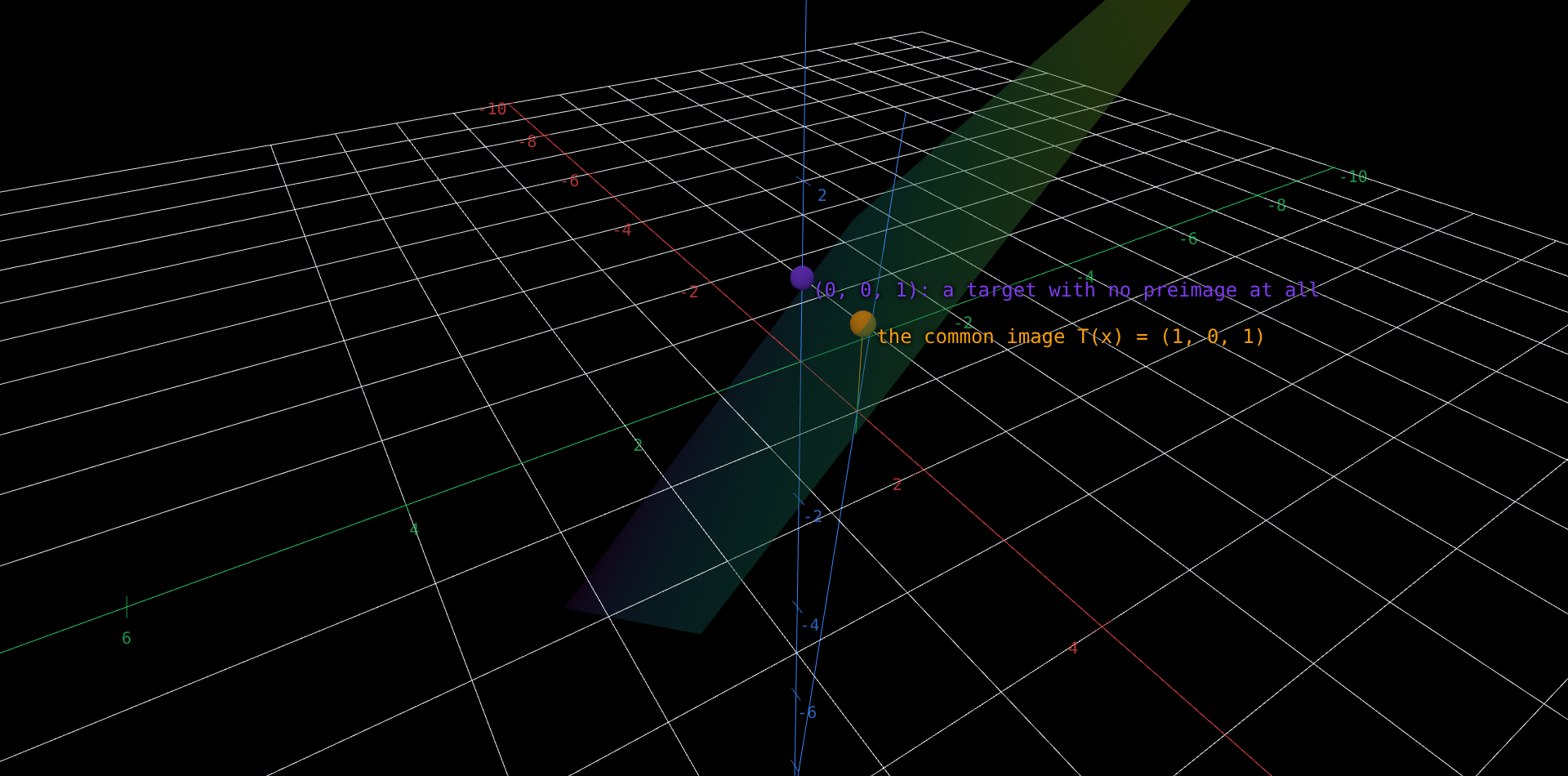
A semi-transparent tilted plane, everything the transformation can produce. A blue straight line runs through space at an angle to the plane, and a short green marker slides along it as a slider is dragged. An amber segment always runs from the green marker to one and the same amber dot lying on the plane: wherever the input slides to, the output does not move. A separate violet dot floats clearly above the plane, marking a target the transformation can never produce, because every output lies in the sheet.
Explore the figure
- Look at the violet point first. It sits clear of the sheet, and since every output of lies in the sheet, no input whatsoever is sent there. That single missed target is enough to say is not onto.
- Drag from to and watch the two ends of the amber segment. The green marker travels a long way; the amber point it lands on does not move at all. Every input on the blue line has the same image.
- Stop at . The input is and the output is . Now stop at : the input is , a genuinely different vector, and the output is again. Two different inputs, one output — is not one-to-one.
- Notice the blue line is not the amber line of the previous chapter but a parallel copy of it, shifted off the origin. Sliding along it changes the input by multiples of , and that is exactly the direction annihilates.
Both failures are one failure
Start with onto. The outputs of are precisely the vectors , which is precisely the column space — the same set section 2.4 called the reach. Here that is a plane, a two-dimensional slice of a three-dimensional target, so almost every vector of is missed. In general, is onto exactly when the column space is everything, which is exactly when equals the number of rows.
Now one-to-one, which has a shortcut worth knowing. Suppose two inputs share an image: . Subtracting and using linearity gives , so their difference lies in the null space. Run it backwards too: if is in the null space then and are different inputs with the same image. So
You never have to compare pairs of inputs; you only have to ask what gets sent to zero. Our has nullity , so it is not one-to-one, and the blue line in the figure is a picture of the failure: it is the set , and every such shifted copy of the null space is a batch of inputs that cannot tell apart.
Here is the part that makes square matrices special. The rank theorem says , the number of columns, and for a square matrix the number of rows is also . Onto wants rank ; one-to-one wants nullity ; and the theorem says those are the same condition. A square matrix is onto if and only if it is one-to-one — not because the two properties are similar, but because there is only one budget and both are asking for all of it.
The determinant of vanishes, and for a square matrix that single number decides both questions at once. A nonzero determinant would mean three independent columns, hence rank and nullity , hence onto and one-to-one. Zero means rank at most , so something is missed and something is confused — which is what the violet point and the blue line respectively show you.
An original work of XYZ Homework, built around interactive XYZ 3D figures. Chapters 1–6 follow the topic sequence of Interactive Linear Algebra (Margalit & Rabinoff, Georgia Tech, GNU FDL). Chapter 0's scope (its topics, their order, and the idea each figure shows) follows the Vectors chapter of Ximera's Linear Algebra: An Interactive Introduction. The prose, worked examples and figures were written for this book, which is not affiliated with or endorsed by the authors of either work. License: CC-BY-NC-SA-4.0.