A matrix with entries moves the point to . One point at a time, that is just arithmetic. The geometry appears when you move every point of a shape at once and look at what arrives. Our shape is the unit square: all points with and .
Follow the two special corners first. The corner is sent to — the first column of the matrix. The corner is sent to — the second column. And a general point of the square, , is sent to : the same combination of the columns that built the point from the corners. The figure below draws the arriving set live, with the four matrix entries on sliders.
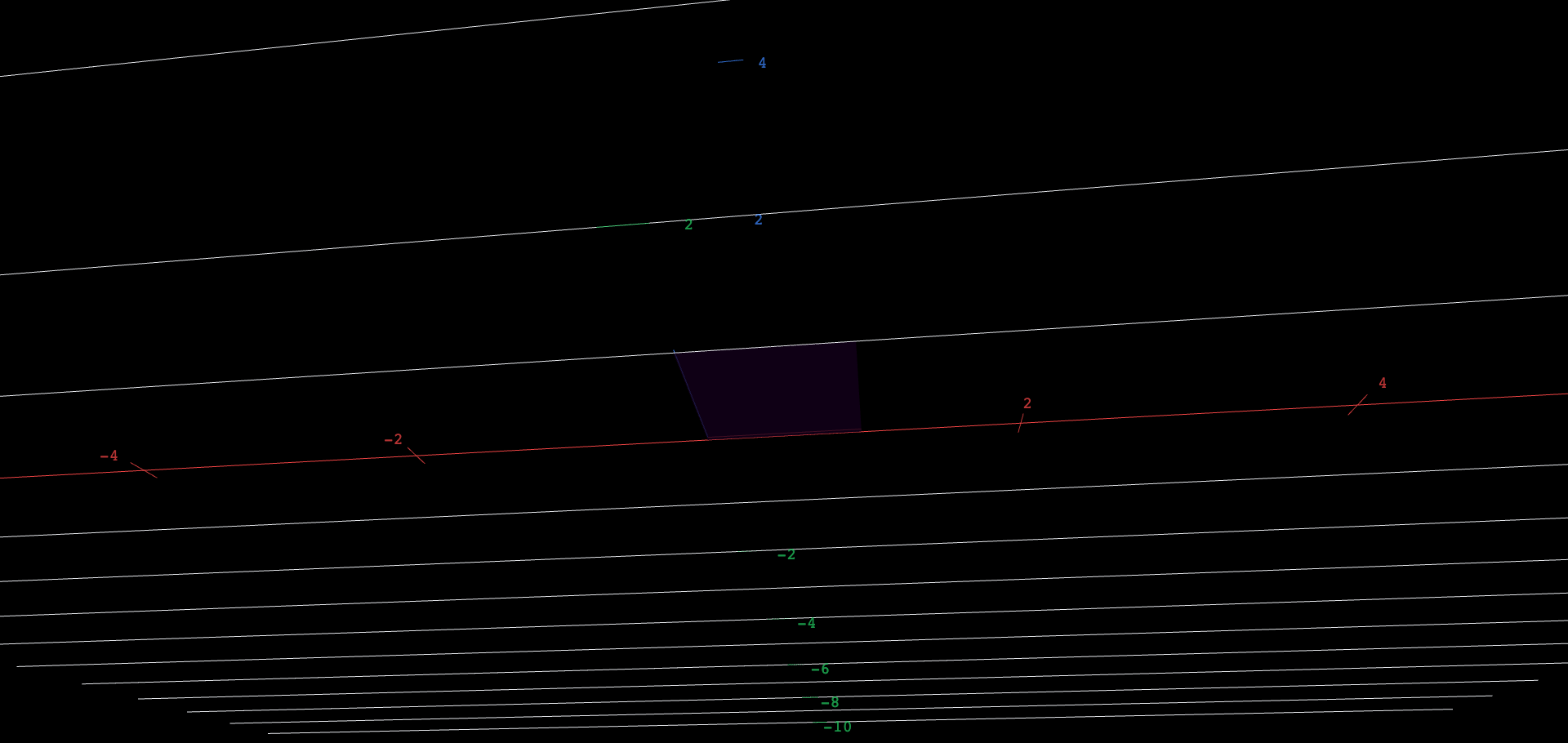
Explore in 3D (opens in a new tab)The image of the unit square under the matrix with entries , drawn flat in the plane. The red edge is the image of — the column — and the blue edge is the image of — the column . The sliders start at the identity: , , , .
Explore the figure
At the identity defaults, the image is the unit square: red edge along the -axis, blue edge along the -axis. Confirm the two colored edges really are the columns and .
Drag to and stop. The red edge has not moved — the first column is untouched — but the blue edge tips over and the square shears into a parallelogram. Every slider controls one coordinate of one edge; convince yourself which.
Predict before you drag: with , , , , where will the far corner land? It must arrive at the sum of the two columns. Set the sliders and check.
Now aim the two columns the same way: , , , , so the blue edge is exactly twice the red edge . What is left of the parallelogram, and why should the last chapter's word dependent come to mind?
The columns are the whole story
The computation behind everything you just saw is one line. Since , and the transformation respects adding and scaling,
The image of the unit square is the set of all combinations with coefficients between and — a parallelogram whose edges from the origin are the two columns. Let the coefficients run over all real numbers instead and you get the image of the entire plane: the span of the columns, in exactly the sense of Chapter 2. When the columns are independent, that span is the whole plane and the square becomes an honest parallelogram; when they are dependent, as in your final exploration step, the span collapses to a line, the parallelogram collapses to a segment, and infinitely many different input points are forced to share each output point.
Area of the image parallelogram ✓ Computed · mojocas 0.1.0✓ Agrees with the text Area of the image parallelogram, computed exactly by mojocas 0.1.0, and confirmed to agree with the result stated in the text.
The area of the parallelogram with edges and — the image of the unit square in the worked example — computed by a computer algebra system: . The next chapter names this number and explains the machine that produced it.
An original work of XYZ Homework, built around interactive XYZ 3D figures. Its chapter sequence is aligned to Interactive Linear Algebra (Margalit & Rabinoff, Georgia Tech, GNU FDL); this work is original, copies nothing from it, and is not affiliated with or endorsed by its authors. License: CC-BY-NC-SA-4.0.
These eBooks are a prerelease and are not yet certified conformant with WCAG 2.1 AA or ADA Title II. Every page is built against an automated accessibility gate, and the published editions will meet ADA Title II requirements when they release in late September 2026. If something is unusable, please tell us.

 Explore in 3D (opens in a new tab)