
1.3 Row Operations Preserve the Solution
Elimination — the algorithm you use to solve systems — rewrites equations aggressively: it scales them, adds them to each other, and throws the originals away. It feels like it ought to be dangerous. Why is it legal to replace an equation with some combination of equations and still claim you are solving the same problem?
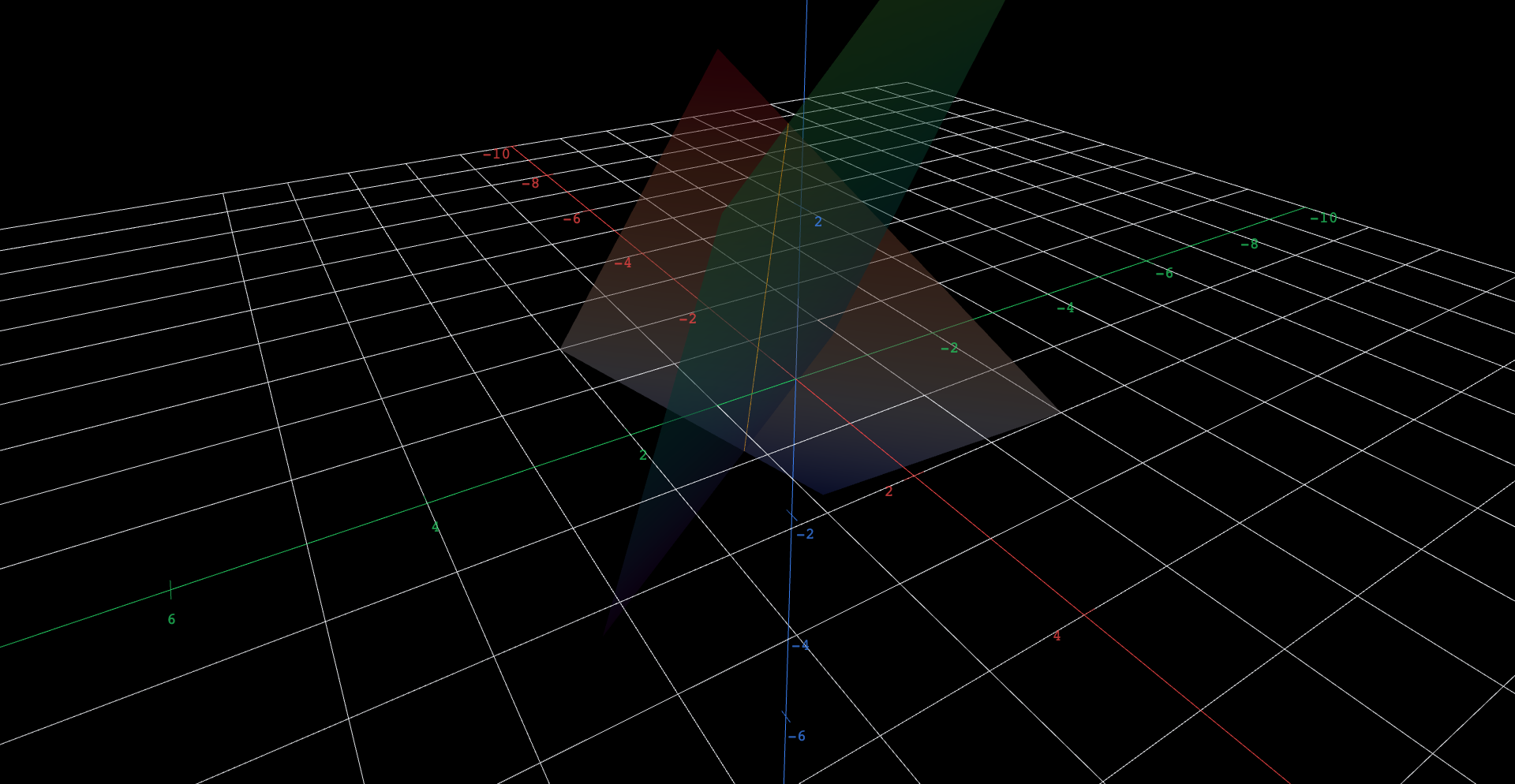
The answer is geometric, and you can watch it. The figure below starts with the system and : two planes crossing along the amber solution line. Hidden in the scene are two more planes. One is built from the sum of the two equations, the other from twice the first minus the second. They are genuinely different planes — different tilts, different appearance — and yet each contains the very same amber line.
 Explore in 3D (opens in a new tab)
Explore the figure
- With only the two original planes visible, orbit until the amber line reads clearly as their intersection.
- Reveal the plane labeled . It is tilted differently from both originals — yet watch how it threads the amber line exactly.
- Hide and look at the pair with . Their intersection is the same line as before. This pair is a legal replacement for the original system.
- Reveal the plane labeled and check it too contains the line. Try viewing it edge-on: notice it does not tilt in the direction at all.
Why combinations are safe
Suppose a point satisfies both and , written in standard form as and . Then it automatically satisfies any combination: adding the equations gives
and forming twice the first minus the second gives
A point on both original planes has no choice but to lie on both new planes. And the reverse holds when we keep one original around: from and you can recover by subtraction, so no solutions sneak in either. Replacing by neither loses nor gains a single point. That is the entire legality of elimination: every row operation is reversible, so the intersection — the thing we are solving for — never moves. What the three operations do to the planes differs, and only one of them can put a new plane on the page. Swapping two equations reorders the same two planes. Multiplying by a nonzero constant leaves a plane exactly where it was, since and have identical solution sets. Adding a multiple of one equation to another is the operation that can produce a plane you did not start with — as does here — though not always: adding zero times changes nothing, and if were already a multiple of the sum could collapse to , which is no plane at all. Reversibility is what does the work in every case; the new plane is a bonus the third operation usually brings.
Look at what the two combination planes accomplish. The plane has no in it: has been eliminated, and the plane is correspondingly slack in the direction. The plane has no . Elimination is not just legal — each step is chosen to produce a plane so simply oriented that you can read information straight off it.
Elimination run all the way to the end by a computer algebra system: the augmented matrix of and — the standard forms and — reduced until each surviving equation is as simply oriented as a plane can be. The rows read and : solve each for its leading variable and the amber line reappears, parameterized by .
An original work of XYZ Homework, built around interactive XYZ 3D figures. Its chapter sequence is aligned to Interactive Linear Algebra (Margalit & Rabinoff, Georgia Tech, GNU FDL); this work is original, copies nothing from it, and is not affiliated with or endorsed by its authors. License: CC-BY-NC-SA-4.0.