
1.2 Three Planes: Point, Line, or Nothing
Add a third equation and the story sharpens. Three planes in space usually pin down a single point: the first two intersect in a line, and the third plane crosses that line in one spot. But "usually" is doing real work in that sentence. This section is about the exceptional cases — and about seeing exactly how special they are.
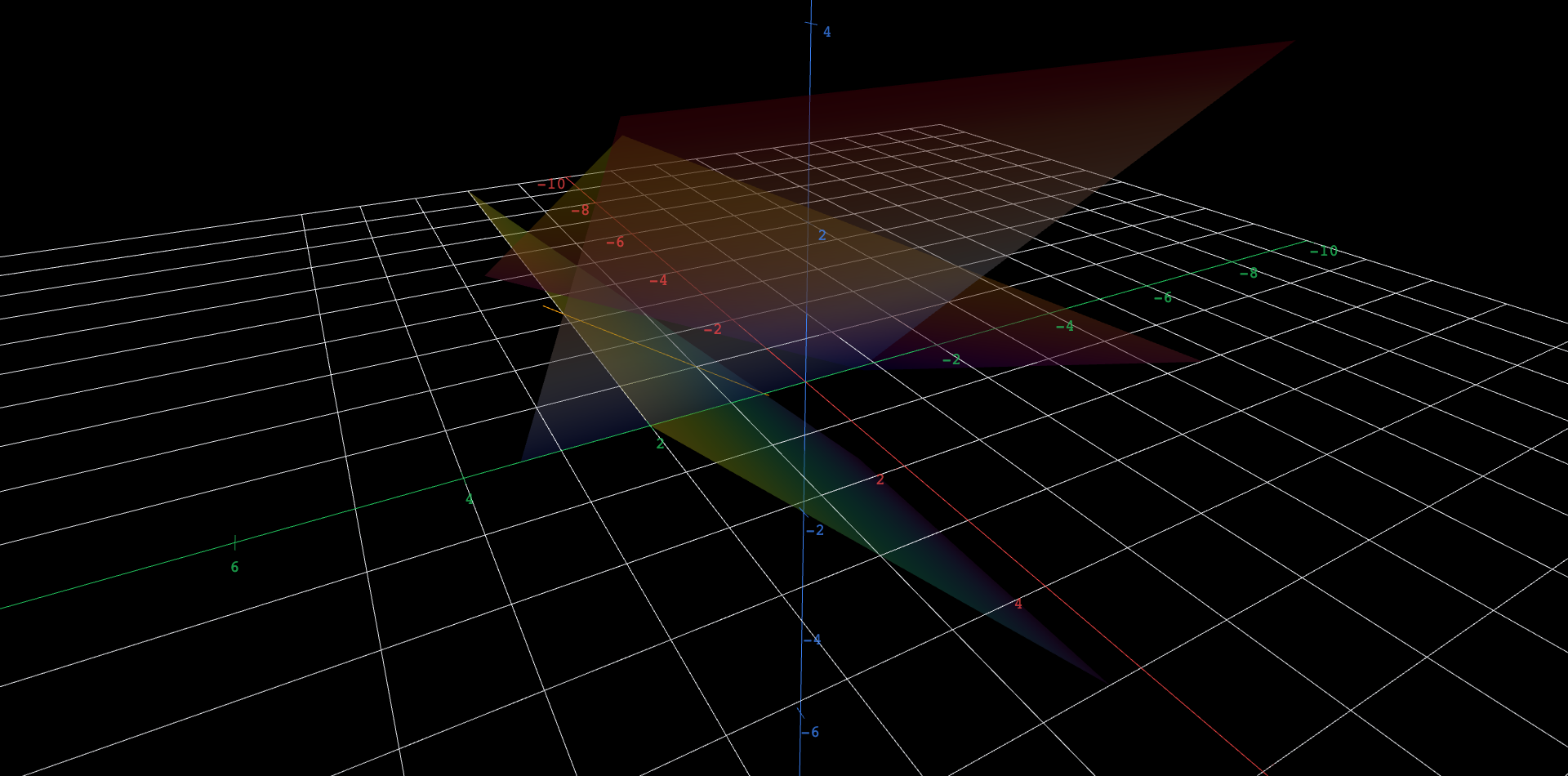
The figure below shows the planes and , whose intersection is the dashed amber line, together with a third plane controlled by the slider . A fourth plane, a tilted replacement for the third, is included but hidden.
 Explore in 3D (opens in a new tab)
Explore the figure
- Start at . Orbit and check each pair of planes: every pair crosses in a line. Now look for a single point on all three planes. Can you find one?
- Drag toward and watch the third plane sweep down onto the amber line. At exactly , what is the solution set of the system — a point, a line, or nothing?
- Push below zero. The moment leaves , where does the third plane sit relative to the amber line?
- Hide the third plane and reveal the hidden tilted variant . Now drag again. Does the system ever lose its solution? What shape is the solution set at each ?
Why the third plane is special
Write the three equations with the unknowns on one side: , then , then . Take half of the first equation plus half of the second: the left side is — exactly the left side of the third equation — while the right side is . So the first two equations already force at every one of their common points. The third equation demands that this same quantity equal . If the demands clash and no point can satisfy all three: the system is inconsistent, even though every pair of planes meets happily. If the third equation is redundant — it adds no new information — and the solution set stays the entire amber line .
The tilted variant behaves differently because its left side, shifted to standard form as , is not a combination of the first two left sides. Three independent conditions in three unknowns cut the solution down to a single point, and sliding merely moves that point.
An original work of XYZ Homework, built around interactive XYZ 3D figures. Its chapter sequence is aligned to Interactive Linear Algebra (Margalit & Rabinoff, Georgia Tech, GNU FDL); this work is original, copies nothing from it, and is not affiliated with or endorsed by its authors. License: CC-BY-NC-SA-4.0.