
1.1 Two Planes, One Line
A single linear equation in three unknowns pins down very little. The equation has infinitely many solutions, and they are not scattered randomly: they form a plane, a flat sheet tilted through space. A second equation, , is a second sheet. A system asks for the points that satisfy both equations at once — the points where the two sheets pass through each other.
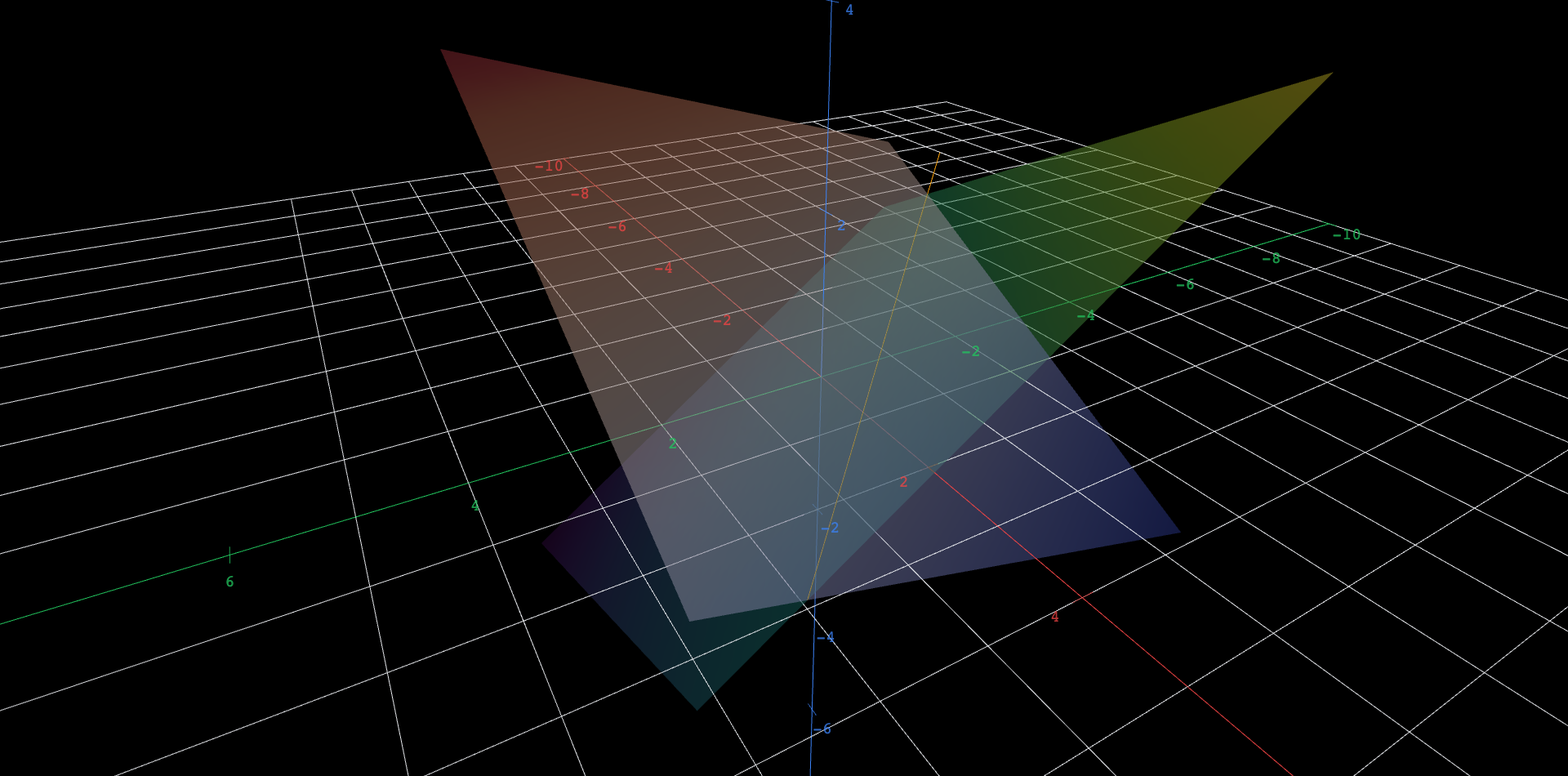
Two flat sheets that are not parallel cannot merely touch. Wherever they meet, they must meet along an entire straight line, and every point of that line is a solution of the system. The figure below draws both planes and their intersection line, with a slider that raises and lowers the second plane.
 Explore in 3D (opens in a new tab)
Explore the figure
- Orbit until you can see both sheets edge-on. Convince yourself the amber line lies inside each plane simultaneously — that is what "solution of both equations" looks like.
- Drag slowly from to . The second plane rises, and the line slides across the first plane. Does the line ever disappear?
- Set and pick any point you like on the amber line. Read off rough coordinates and check them, at least approximately, in both equations.
- Predict: could some value of make the system have no solutions? What would the two planes have to look like for that to happen?
Where the line comes from
We can compute the line you just watched. A point on both planes must give both formulas the same , so
Collecting terms gives : on the intersection, is completely determined by . Choosing as a free parameter and substituting back into the first plane gives the parametric line
Notice that the slider value appears in the formula. That is the algebraic shadow of what you saw: changing does not break the system, it just hands you a different line of solutions. The system stays consistent for every because the two planes tilt differently — their coefficient rows and are not proportional, so the sheets can never be parallel. Inconsistency would require parallel, non-identical planes, and no vertical translation can make these two parallel.
An original work of XYZ Homework, built around interactive XYZ 3D figures. Its chapter sequence is aligned to Interactive Linear Algebra (Margalit & Rabinoff, Georgia Tech, GNU FDL); this work is original, copies nothing from it, and is not affiliated with or endorsed by its authors. License: CC-BY-NC-SA-4.0.