Suppose we have a linear second order homogeneous ODE of the form
(7.2.1)
Suppose that , , and are polynomials. We will try a solution of the form
and solve for the to try to obtain a solution defined in some interval around .
Handling singular points is harder than ordinary points and so we now focus only on ordinary points.
Sometimes a solution may turn out to be a polynomial.
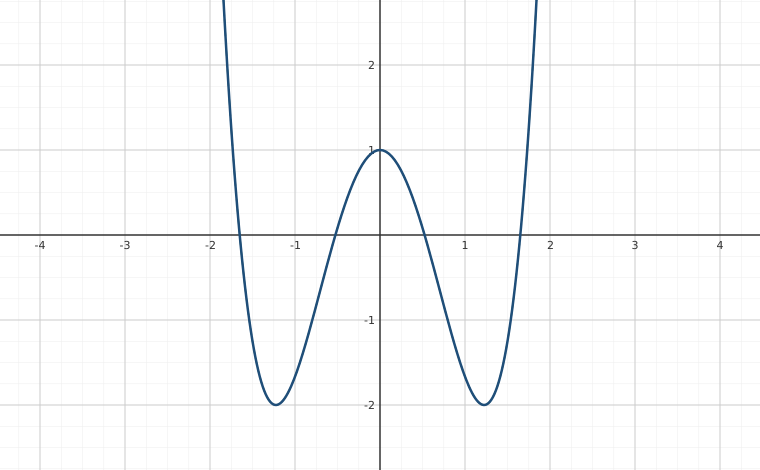
Interactive figureHermite series solution y1, terminating whenever n is an even integerDrag the Hermite order n slider from 0 to 8.
XYZ Graph · viewer build 5edf91b
The even series solution y₁ of Hermite's equation y″ − 2xy′ + 2ny = 0, carried out to x¹⁰, with the book's own n = 4 answer 1 − 4x² + (4/3)x⁴ dashed underneath it. Drag n: on every even integer the recurrence factor (2k − 2n) kills the tail and the curve snaps exactly onto a polynomial — at n = 4 it lands on the dashed reference and hides it — while at n = 3.5 nothing terminates and the two come apart.
Footnotes
[1] Named after the English mathematician Sir George Biddell Airy (1801 – 1892).
[2] Named after the French mathematician Charles Hermite (1822–1901).
These eBooks are a prerelease and are not yet certified conformant with WCAG 2.1 AA or ADA Title II. Every page is built against an automated accessibility gate, and the published editions will meet ADA Title II requirements when they release in late September 2026. If something is unusable, please tell us.