
20.5 Alternating Current versus Direct Current
Learning Objectives
By the end of this section, you will be able to:
- Explain the differences and similarities between AC and DC current.
- Calculate rms voltage, current, and average power.
- Explain why AC current is used for power transmission.
Alternating Current
Most of the examples dealt with so far, and particularly those utilizing batteries, have constant voltage sources. Once the current is established, it is thus also a constant. Direct current (DC) is the flow of electric charge in only one direction. It is the steady state of a constant-voltage circuit. Most well-known applications, however, use a time-varying voltage source. Alternating current (AC) is the flow of electric charge that periodically reverses direction. If the source varies periodically, particularly sinusoidally, the circuit is known as an alternating current circuit. Examples include the commercial and residential power that serves so many of our needs. Figure 20.28 shows graphs of voltage and current versus time for typical DC and AC power. The AC voltages and frequencies commonly used in homes and businesses vary around the world.
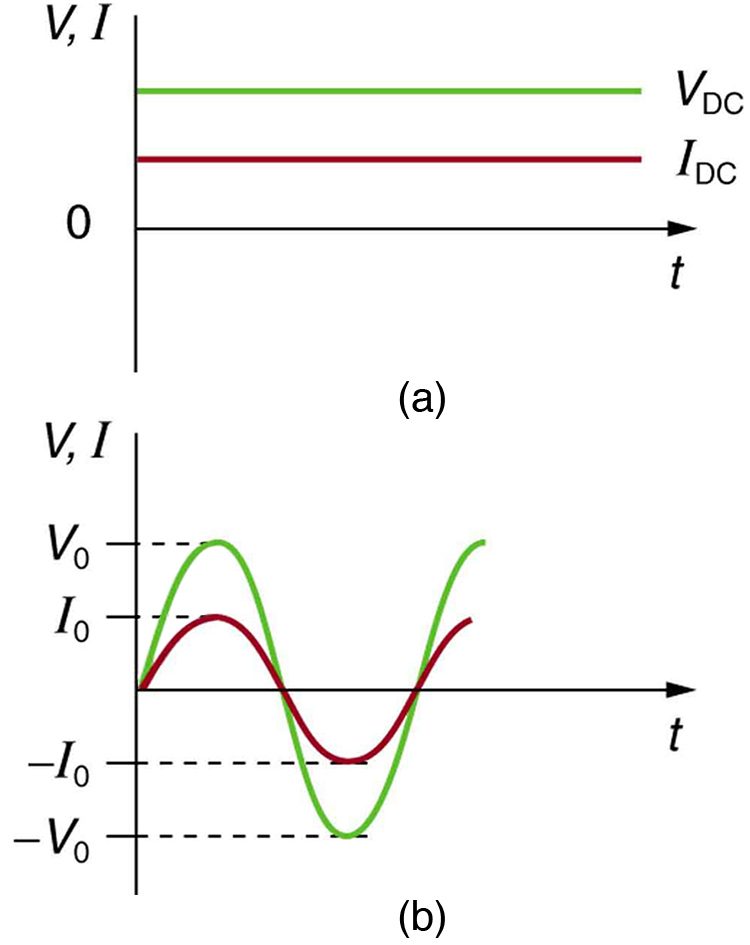
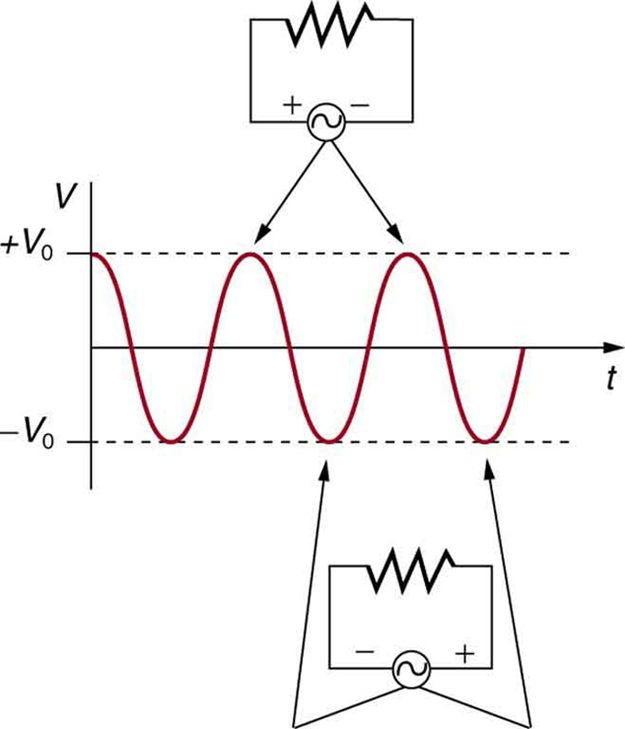
Figure 20.29 shows a schematic of a simple circuit with an AC voltage source. The voltage between the terminals fluctuates as shown, with the AC voltage given by
where is the voltage at time , is the peak voltage, and is the frequency in hertz. For this simple resistance circuit, , and so the AC current is
where is the current at time , and is the peak current. For this example, the voltage and current are said to be in phase, as seen in Figure 20.28(b).
Current in the resistor alternates back and forth just like the driving voltage, since . If the resistor is a fluorescent light bulb, for example, it brightens and dims 120 times per second as the current repeatedly goes through zero. A 120-Hz flicker is too rapid for your eyes to detect, but if you wave your hand back and forth between your face and a fluorescent light, you will see a stroboscopic effect evidencing AC. The fact that the light output fluctuates means that the power is fluctuating. The power supplied is . Using the expressions for and above, we see that the time dependence of power is , as shown in Figure 20.30.
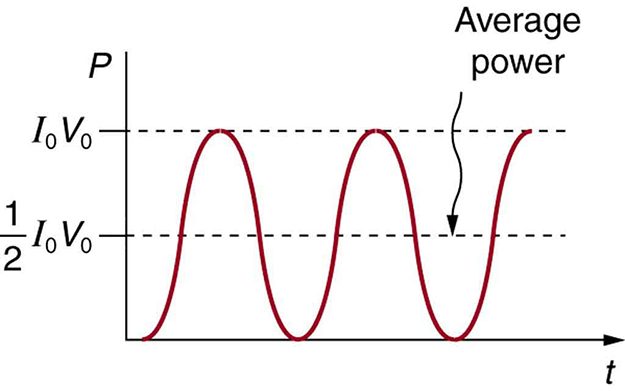
We are most often concerned with average power rather than its fluctuations—that 60-W light bulb in your desk lamp has an average power consumption of 60 W, for example. As illustrated in Figure 20.30, the average power is
This is evident from the graph, since the areas above and below the line are equal, but it can also be proven using trigonometric identities. Similarly, we define an average or rms current and average or rms voltage to be, respectively,
and
where rms stands for root mean square, a particular kind of average. In general, to obtain a root mean square, the particular quantity is squared, its mean (or average) is found, and the square root is taken. This is useful for AC, since the average value is zero. Now,
which gives
as stated above. It is standard practice to quote , , and rather than the peak values. For example, most household electricity is 120 V AC, which means that is 120 V. The common 10-A circuit breaker will interrupt a sustained greater than 10 A. Your 1.0-kW microwave oven consumes , and so on. You can think of these rms and average values as the equivalent DC values for a simple resistive circuit.
To summarize, when dealing with AC, Ohm’s law and the equations for power are completely analogous to those for DC, but rms and average values are used for AC. Thus, for AC, Ohm’s law is written
The various expressions for AC power are
and
Why Use AC for Power Distribution?
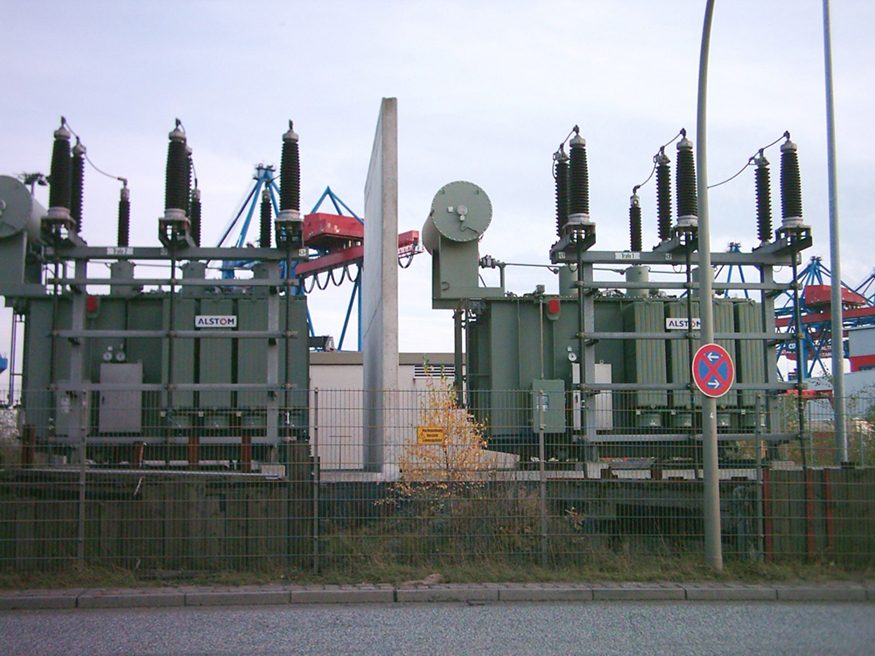
Most large power-distribution systems are AC. Moreover, the power is transmitted at much higher voltages than the 120-V AC (240 V in most parts of the world) we use in homes and on the job. Economies of scale make it cheaper to build a few very large electric power-generation plants than to build numerous small ones. This necessitates sending power long distances, and it is obviously important that energy losses en route be minimized. High voltages can be transmitted with much smaller power losses than low voltages, as we shall see. (See Figure 20.31.) For safety reasons, the voltage at the user is reduced to familiar values. The crucial factor is that it is much easier to increase and decrease AC voltages than DC, so AC is used in most large power distribution systems.
It is widely recognized that high voltages pose greater hazards than low voltages. But, in fact, some high voltages, such as those associated with common static electricity, can be harmless. So it is not voltage alone that determines a hazard. It is not so widely recognized that AC shocks are often more harmful than similar DC shocks. Thomas Edison thought that AC shocks were more harmful and set up a DC power-distribution system in New York City in the late 1800s. There were bitter fights, in particular between Edison and George Westinghouse and Nikola Tesla, who were advocating the use of AC in early power-distribution systems. AC has prevailed largely due to transformers and lower power losses with high-voltage transmission.
Section Summary
- Direct current (DC) is the flow of electric current in only one direction. It refers to systems where the source voltage is constant.
- The voltage source of an alternating current (AC) system puts out , where is the voltage at time , is the peak voltage, and is the frequency in hertz.
- In a simple circuit, and AC current is , where is the current at time , and is the peak current.
- The average AC power is .
- Average (rms) current and average (rms) voltage are and , where rms stands for root mean square.
- Thus, .
- Ohm’s law for AC is .
- Expressions for the average power of an AC circuit are , , and , analogous to the expressions for DC circuits.
Conceptual Questions
Give an example of a use of AC power other than in the household. Similarly, give an example of a use of DC power other than that supplied by batteries.
Why do voltage, current, and power go through zero 120 times per second for 60-Hz AC electricity?
You are riding in a train, gazing into the distance through its window. As close objects streak by, you notice that the nearby fluorescent lights make dashed streaks. Explain.
Problem Exercises
(a) What is the hot resistance of a 25-W light bulb that runs on 120-V AC? (b) If the bulb’s operating temperature is , what is its resistance at ?
Certain heavy industrial equipment uses AC power that has a peak voltage of 679 V. What is the rms voltage?
480 V
A certain circuit breaker trips when the rms current is 15.0 A. What is the corresponding peak current?
Military aircraft use 400-Hz AC power, because it is possible to design lighter-weight equipment at this higher frequency. What is the time for one complete cycle of this power?
2.50 ms
A North American tourist takes his 25.0-W, 120-V AC razor to Europe, finds a special adapter, and plugs it into 240 V AC. Assuming constant resistance, what power does the razor consume as it is ruined?
In this problem, you will verify statements made at the end of the power losses for Example 2. (a) What current is needed to transmit 100 MW of power at a voltage of 25.0 kV? (b) Find the power loss in a transmission line. (c) What percent loss does this represent?
(a) 4.00 kA
(b) 16.0 MW
(c) 16.0%
A small office-building air conditioner operates on 408-V AC and consumes 50.0 kW. (a) What is its effective resistance? (b) What is the cost of running the air conditioner during a hot summer month when it is on 8.00 h per day for 30 days and electricity costs ?
What is the peak power consumption of a 120-V AC microwave oven that draws 10.0 A?
2.40 kW
What is the peak current through a 500-W room heater that operates on 120-V AC power?
Two different electrical devices have the same power consumption, but one is meant to be operated on 120-V AC and the other on 240-V AC. (a) What is the ratio of their resistances? (b) What is the ratio of their currents? (c) Assuming its resistance is unaffected, by what factor will the power increase if a 120-V AC device is connected to 240-V AC?
(a) 4.0
(b) 0.50
(c) 4.0
Nichrome wire is used in some radiative heaters. (a) Find the resistance needed if the average power output is to be 1.00 kW utilizing 120-V AC. (b) What length of Nichrome wire, having a cross-sectional area of , is needed if the operating temperature is ? (c) What power will it draw when first switched on?
Find the time after when the instantaneous voltage of 60-Hz AC first reaches the following values: (a) (b) (c) 0.
(a) 1.39 ms
(b) 4.17 ms
(c) 8.33 ms
(a) At what two times in the first period following does the instantaneous voltage in 60-Hz AC equal ? (b) ?
Adapted from College Physics 2e by OpenStax (openstax.org), licensed under CC BY-NC-SA 4.0. Changes were made. License: CC-BY-NC-SA-4.0.