
20.3 Resistance and Resistivity
Learning Objectives
By the end of this section, you will be able to:
- Explain the concept of resistivity.
- Use resistivity to calculate the resistance of specified configurations of material.
- Use the thermal coefficient of resistivity to calculate the change of resistance with temperature.
Material and Shape Dependence of Resistance
The resistance of an object depends on its shape and the material of which it is composed. The cylindrical resistor in Figure 20.12 is easy to analyze, and, by so doing, we can gain insight into the resistance of more complicated shapes. As you might expect, the cylinder’s electric resistance is directly proportional to its length , similar to the resistance of a pipe to fluid flow. The longer the cylinder, the more collisions charges will make with its atoms. The greater the diameter of the cylinder, the more current it can carry (again similar to the flow of fluid through a pipe). In fact, is inversely proportional to the cylinder’s cross-sectional area .
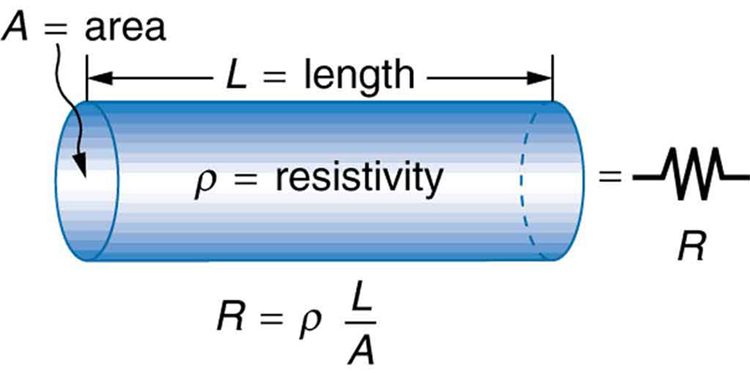
For a given shape, the resistance depends on the material of which the object is composed. Different materials offer different resistance to the flow of charge. We define the resistivity of a substance so that the resistance of an object is directly proportional to . Resistivity is an intrinsic property of a material, independent of its shape or size. The resistance of a uniform cylinder of length , of cross-sectional area , and made of a material with resistivity , is
Table 20.2 gives representative values of . The materials listed in the table are separated into categories of conductors, semiconductors, and insulators, based on broad groupings of resistivities. Conductors have the smallest resistivities, and insulators have the largest; semiconductors have intermediate resistivities. Conductors have varying but large free charge densities, whereas most charges in insulators are bound to atoms and are not free to move. Semiconductors are intermediate, having far fewer free charges than conductors, but having properties that make the number of free charges depend strongly on the type and amount of impurities in the semiconductor. These unique properties of semiconductors are put to use in modern electronics, as will be explored in later chapters.
| Material | Resistivity ( ) |
|---|---|
| Conductors | |
| Silver | |
| Copper | |
| Gold | |
| Aluminum | |
| Tungsten | |
| Iron | |
| Platinum | |
| Steel | |
| Lead | |
| Manganin (Cu, Mn, Ni alloy) | |
| Constantan (Cu, Ni alloy) | |
| Mercury | |
| Nichrome (Ni, Fe, Cr alloy) | |
| Semiconductors1 | |
| Carbon (pure) | |
| Carbon | |
| Germanium (pure) | |
| Germanium | |
| Silicon (pure) | |
| Silicon | |
| Insulators | |
| Amber | |
| Glass | |
| Lucite | |
| Mica | |
| Quartz (fused) | |
| Rubber (hard) | |
| Sulfur | |
| Teflon | |
| Wood |
Temperature Variation of Resistance
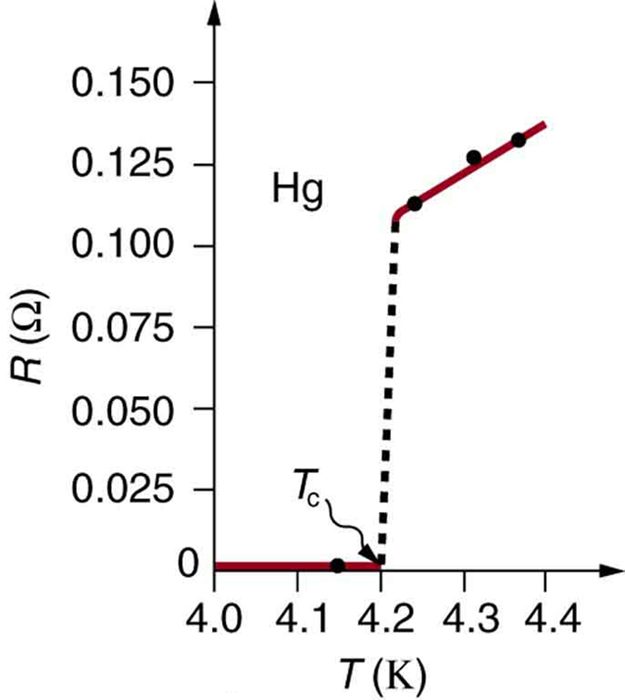
The resistivity of all materials depends on temperature. Some even become superconductors (zero resistivity) at very low temperatures. (See Figure 20.13.) Conversely, the resistivity of conductors increases with increasing temperature. Since the atoms vibrate more rapidly and over larger distances at higher temperatures, the electrons moving through a metal make more collisions, effectively making the resistivity higher. Over relatively small temperature changes (about or less), resistivity varies with temperature change as expressed in the following equation
where is the original resistivity and is the temperature coefficient of resistivity. (See the values of in Table 20.3 below.) For larger temperature changes, may vary or a nonlinear equation may be needed to find . Note that is positive for metals, meaning their resistivity increases with temperature. Some alloys have been developed specifically to have a small temperature dependence. Manganin (which is made of copper, manganese and nickel), for example, has close to zero (to three digits on the scale in Table 20.3), and so its resistivity varies only slightly with temperature. This is useful for making a temperature-independent resistance standard, for example.
| Material | Coefficient (1/°C)2 |
|---|---|
| Conductors | |
| Silver | |
| Copper | |
| Gold | |
| Aluminum | |
| Tungsten | |
| Iron | |
| Platinum | |
| Lead | |
| Manganin (Cu, Mn, Ni alloy) | |
| Constantan (Cu, Ni alloy) | |
| Mercury | |
| Nichrome (Ni, Fe, Cr alloy) | |
| Semiconductors | |
| Carbon (pure) | |
| Germanium (pure) | |
| Silicon (pure) | |
Note also that is negative for the semiconductors listed in Table 20.3, meaning that their resistivity decreases with increasing temperature. They become better conductors at higher temperature, because increased thermal agitation increases the number of free charges available to carry current. This property of decreasing with temperature is also related to the type and amount of impurities present in the semiconductors.
The resistance of an object also depends on temperature, since is directly proportional to . For a cylinder we know , and so, if and do not change greatly with temperature, will have the same temperature dependence as . (Examination of the coefficients of linear expansion shows them to be about two orders of magnitude less than typical temperature coefficients of resistivity, and so the effect of temperature on and is about two orders of magnitude less than on .) Thus,
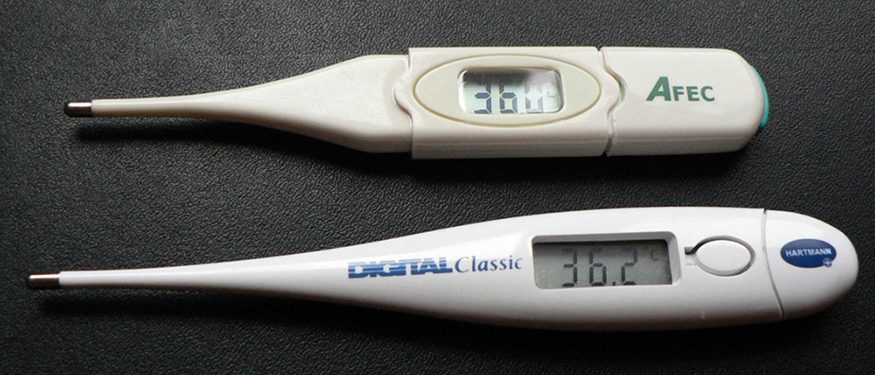
is the temperature dependence of the resistance of an object, where is the original resistance and is the resistance after a temperature change . Numerous thermometers are based on the effect of temperature on resistance. (See Figure 20.14.) One of the most common is the thermistor, a semiconductor crystal with a strong temperature dependence, the resistance of which is measured to obtain its temperature. The device is small, so that it quickly comes into thermal equilibrium with the part of a person it touches.
Test Prep for AP Courses
Which of the following affect the resistivity of a wire?
- length
- area of cross section
- material
- all of the above
The lengths and diameters of four wires are given as shown.
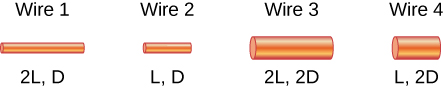
If the four wires are made from the same material, which of the following is true? Select two answers.
- Resistance of Wire 3 > Resistance of Wire 2
- Resistance of Wire 1 > Resistance of Wire 2
- Resistance of Wire 1 < Resistance of Wire 4
- Resistance of Wire 4 < Resistance of Wire 3
(b), (d)
Suppose the resistance of a wire is R Ω. What will be the resistance of another wire of the same material having the same length but double the diameter?
- R/2
- 2R
- R/4
- 4R
The resistances of two wires having the same lengths and cross section areas are 3 Ω and 11 Ω. If the resistivity of the 3 Ω wire is 2.65 × 10⁻⁸ Ω∙m, find the resistivity of the 1 Ω wire.
9.72 × 10⁻⁸ Ω∙m
The lengths and diameters of three wires are given below. If they all have the same resistance, find the ratio of their resistivities.
| Wire | Length | Diameter |
|---|---|---|
| Wire 1 | 2 m | 1 cm |
| Wire 2 | 1 m | 0.5 cm |
| Wire 3 | 1 m | 1 cm |
Suppose the resistance of a wire is 2 Ω. If the wire is stretched to three times its length, what will be its resistance? Assume that the volume does not change.
18 Ω
Section Summary
- The resistance of a cylinder of length and cross-sectional area is , where is the resistivity of the material.
- Values of in Table 20.2 show that materials fall into three groups—conductors, semiconductors, and insulators.
- Temperature affects resistivity; for relatively small temperature changes , resistivity is , where is the original resistivity and is the temperature coefficient of resistivity.
- Table 20.3 gives values for , the temperature coefficient of resistivity.
- The resistance of an object also varies with temperature: , where is the original resistance, and is the resistance after the temperature change.
Conceptual Questions
In which of the three semiconducting materials listed in Table 20.2 do impurities supply free charges? (Hint: Examine the range of resistivity for each and determine whether the pure semiconductor has the higher or lower conductivity.)
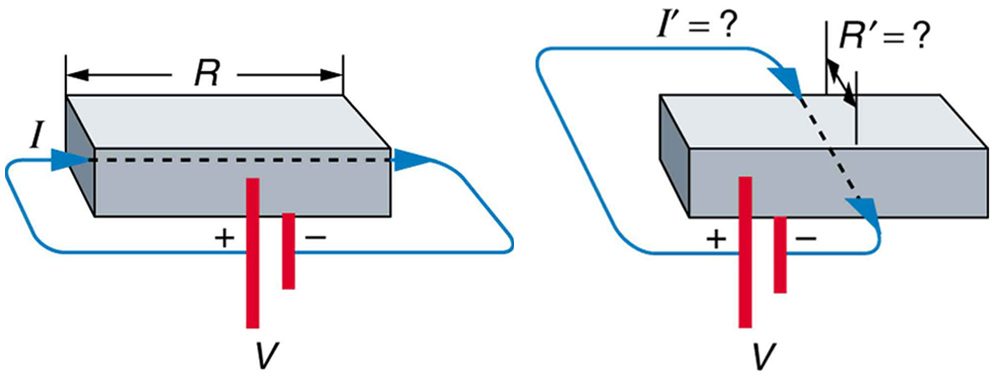
Does the resistance of an object depend on the path current takes through it? Consider, for example, a rectangular bar—is its resistance the same along its length as across its width? (See Figure 20.16.)
If aluminum and copper wires of the same length have the same resistance, which has the larger diameter? Why?
Explain why for the temperature variation of the resistance of an object is not as accurate as , which gives the temperature variation of resistivity .
Problems & Exercises
What is the resistance of a 20.0-m-long piece of 12-gauge copper wire having a 2.053-mm diameter?
Exercise 20.25
The diameter of 0-gauge copper wire is 8.252 mm. Find the resistance of a 1.00-km length of such wire used for power transmission.
If the 0.010-mm diameter tungsten filament in a light bulb is to have a resistance of at , how long should it be?
Find the ratio of the diameter of aluminum to copper wire, if they have the same resistance per unit length (as they might in household wiring).
What current flows through a 2.54-cm-diameter rod of pure silicon that is 20.0 cm long, when is applied to it? (Such a rod may be used to make nuclear-particle detectors, for example.)
(a) To what temperature must you raise a copper wire, originally at , to double its resistance, neglecting any changes in dimensions? (b) Does this happen in household wiring under ordinary circumstances?
A resistor made of Nichrome wire is used in an application where its resistance cannot change more than 1.00% from its value at . Over what temperature range can it be used?
Of what material is a resistor made if its resistance is 40.0% greater at than at ?
An electronic device designed to operate at any temperature in the range from contains pure carbon resistors. By what factor does their resistance increase over this range?
1.03
(a) Of what material is a wire made, if it is 25.0 m long with a 0.100 mm diameter and has a resistance of at ? (b) What is its resistance at ?
Assuming a constant temperature coefficient of resistivity, what is the maximum percent decrease in the resistance of a constantan wire starting at ?
0.06%
A wire is drawn through a die, stretching it to four times its original length. By what factor does its resistance increase?
A copper wire has a resistance of at , and an iron wire has a resistance of at the same temperature. At what temperature are their resistances equal?
(a) Digital medical thermometers determine temperature by measuring the resistance of a semiconductor device called a thermistor (which has ) when it is at the same temperature as the patient. What is a patient’s temperature if the thermistor’s resistance at that temperature is 82.0% of its value at (normal body temperature)? (b) The negative value for may not be maintained for very high temperatures. Discuss why and whether this is the case here. (Hint: Resistance can’t become negative.)
Integrated Concepts
(a) Redo Exercise 20.25 taking into account the thermal expansion of the tungsten filament. You may assume a thermal expansion coefficient of . (b) By what percentage does your answer differ from that in the example?
(a) (total)
(b) 3.0% decrease
Unreasonable Results
(a) To what temperature must you raise a resistor made of constantan to double its resistance, assuming a constant temperature coefficient of resistivity? (b) To cut it in half? (c) What is unreasonable about these results? (d) Which assumptions are unreasonable, or which premises are inconsistent?
Adapted from College Physics 2e by OpenStax (openstax.org), licensed under CC BY-NC-SA 4.0. Changes were made. License: CC-BY-NC-SA-4.0.