
20.2 Ohm’s Law: Resistance and Simple Circuits
Learning Objectives
By the end of this section, you will be able to:
- Explain the origin of Ohm’s law.
- Calculate voltages, currents, or resistances with Ohm’s law.
- Explain what an ohmic material is.
- Describe a simple circuit.
What drives current? We can think of various devices—such as batteries, generators, wall outlets, and so on—which are necessary to maintain a current. All such devices create a potential difference and are loosely referred to as voltage sources. When a voltage source is connected to a conductor, it applies a potential difference that creates an electric field. The electric field in turn exerts force on charges, causing current.
Ohm’s Law
The current that flows through most substances is directly proportional to the voltage applied to it. The German physicist Georg Simon Ohm (1787–1854) was the first to demonstrate experimentally that the current in a metal wire is directly proportional to the voltage applied:
This important relationship is known as Ohm’s law. It can be viewed as a cause-and-effect relationship, with voltage the cause and current the effect. This is an empirical law like that for friction—an experimentally observed phenomenon. Such a linear relationship doesn’t always occur.
Resistance and Simple Circuits
If voltage drives current, what impedes it? The electric property that impedes current (crudely similar to friction and air resistance) is called resistance . Collisions of moving charges with atoms and molecules in a substance transfer energy to the substance and limit current. Resistance is defined as inversely proportional to current, or
Thus, for example, current is cut in half if resistance doubles. Combining the relationships of current to voltage and current to resistance gives
This relationship is also called Ohm’s law. Ohm’s law in this form really defines resistance for certain materials. Ohm’s law (like Hooke’s law) is not universally valid. The many substances for which Ohm’s law holds are called ohmic. These include good conductors like copper and aluminum, and some poor conductors under certain circumstances. Ohmic materials have a resistance that is independent of voltage and current . An object that has simple resistance is called a resistor, even if its resistance is small. The unit for resistance is an ohm and is given the symbol (upper case Greek omega). Rearranging gives , and so the units of resistance are 1 ohm = 1 volt per ampere:
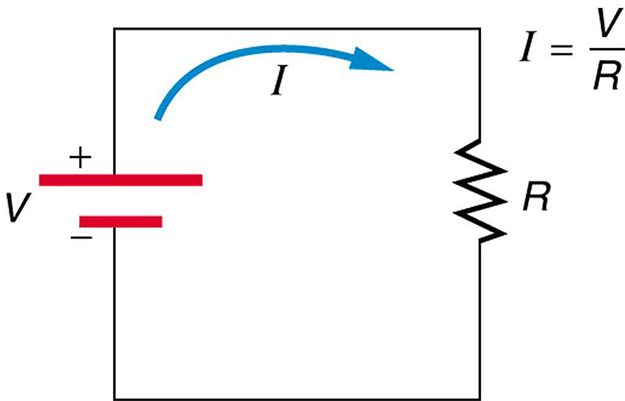
Figure 20.10 shows the schematic for a simple circuit. A simple circuit has a single voltage source and a single resistor. The wires connecting the voltage source to the resistor can be assumed to have negligible resistance, or their resistance can be included in .
Resistances range over many orders of magnitude. Some ceramic insulators, such as those used to support power lines, have resistances of or more. A dry person may have a hand-to-foot resistance of , whereas the resistance of the human heart is about . A meter-long piece of large-diameter copper wire may have a resistance of , and superconductors have no resistance at all (they are non-ohmic). Resistance is related to the shape of an object and the material of which it is composed, as will be seen in Resistance and Resistivity.
Additional insight is gained by solving for yielding
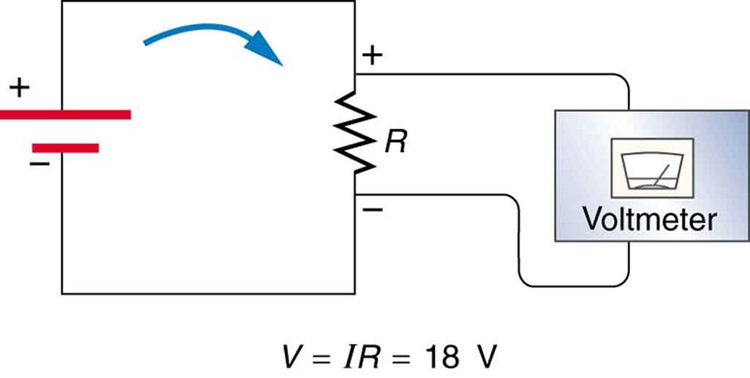
This expression for can be interpreted as the voltage drop across a resistor produced by the flow of current . The phrase drop is often used for this voltage. For instance, the headlight in Example 1 has an drop of 12.0 V. If voltage is measured at various points in a circuit, it will be seen to increase at the voltage source and decrease at the resistor. Voltage is similar to fluid pressure. The voltage source is like a pump, creating a pressure difference, causing current—the flow of charge. The resistor is like a pipe that reduces pressure and limits flow because of its resistance. Conservation of energy has important consequences here. The voltage source supplies energy (causing an electric field and a current), and the resistor converts it to another form (such as thermal energy). In a simple circuit (one with a single simple resistor), the voltage supplied by the source equals the voltage drop across the resistor, since , and the same flows through each. Thus the energy supplied by the voltage source and the energy converted by the resistor are equal. (See Figure 20.11.)
Test Prep for AP Courses
If the voltage across a fixed resistance is doubled, what happens to the current?
- It doubles.
- It halves.
- It stays the same.
- The current cannot be determined.
(a)
The table below gives the voltages and currents recorded across a resistor.
| Voltage (V) | 2.50 | 5.00 | 7.50 | 10.00 | 12.50 |
|---|---|---|---|---|---|
| Current (A) | 0.69 | 1.38 | 2.09 | 2.76 | 3.49 |
- Plot the graph and comment on the shape.
- Calculate the value of the resistor.
What is the resistance of a bulb if the current in it is 1.25 A when a 4 V voltage supply is connected to it? If the voltage supply is increased to 7 V, what will be the current in the bulb?
3.2 Ω, 2.19 A
Section Summary
- A simple circuit is one in which there is a single voltage source and a single resistance.
- One statement of Ohm’s law gives the relationship between current , voltage , and resistance in a simple circuit to be
- Resistance has units of ohms (), related to volts and amperes by .
- There is a voltage or drop across a resistor, caused by the current flowing through it, given by .
Conceptual Questions
The drop across a resistor means that there is a change in potential or voltage across the resistor. Is there any change in current as it passes through a resistor? Explain.
How is the drop in a resistor similar to the pressure drop in a fluid flowing through a pipe?
Problems & Exercises
What current flows through the bulb of a 3.00-V flashlight when its hot resistance is ?
0.833 A
Calculate the effective resistance of a pocket calculator that has a 1.35-V battery and through which 0.200 mA flows.
What is the effective resistance of a car’s starter motor when 150 A flows through it as the car battery applies 11.0 V to the motor?
How many volts are supplied to operate an indicator light on a DVD player that has a resistance of , given that 25.0 mA passes through it?
(a) Find the voltage drop in an extension cord having a resistance and through which 5.00 A is flowing. (b) A cheaper cord utilizes thinner wire and has a resistance of . What is the voltage drop in it when 5.00 A flows? (c) Why is the voltage to whatever appliance is being used reduced by this amount? What is the effect on the appliance?
(a) 0.300 V
(b) 1.50 V
(c) The voltage supplied to whatever appliance is being used is reduced because the total voltage drop from the wall to the final output of the appliance is fixed. Thus, if the voltage drop across the extension cord is large, the voltage drop across the appliance is significantly decreased, so the power output by the appliance can be significantly decreased, reducing the ability of the appliance to work properly.
A power transmission line is hung from metal towers with glass insulators having a resistance of What current flows through the insulator if the voltage is 200 kV? (Some high-voltage lines are DC.)
Adapted from College Physics 2e by OpenStax (openstax.org), licensed under CC BY-NC-SA 4.0. Changes were made. License: CC-BY-NC-SA-4.0.