Compare and discuss underdamped and overdamped oscillating systems.
Explain critically damped system.
Figure 16.23In order to counteract dampening forces, this mom needs to keep pushing the swing.In order to counteract dampening forces, this mom needs to keep pushing the swing. (credit: Erik A. Johnson, Flickr)
A guitar string stops oscillating a few seconds after being plucked. To keep a child happy on a swing, you must keep pushing. Although we can often make friction and other non-conservative forces negligibly small, completely undamped motion is rare. In fact, we may even want to damp oscillations, such as with car shock absorbers.
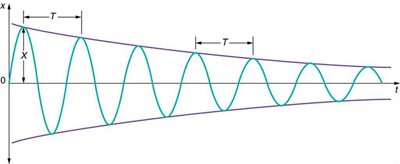
For a system that has a small amount of damping, the period and frequency are nearly the same as for simple harmonic motion, but the amplitude gradually decreases as shown in Figure 16.24. This occurs because the non-conservative damping force removes energy from the system, usually in the form of thermal energy. In general, energy removal by non-conservative forces is described as
where is work done by a non-conservative force (here the damping force). For a damped harmonic oscillator, is negative because it removes mechanical energy (KE + PE) from the system.
Figure 16.24In this graph of displacement versus time for a harmonic oscillator with a small amount of damping, the amplitude slowly decreases, but the period and frequency are nearly the same as if the system were completely undamped.
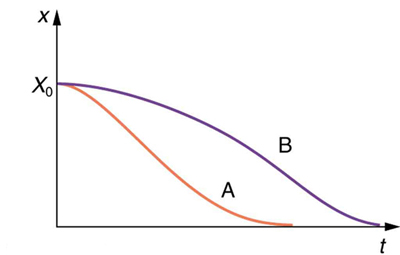
If you gradually increase the amount of damping in a system, the period and frequency begin to be affected, because damping opposes and hence slows the back and forth motion. (The net force is smaller in both directions.) If there is very large damping, the system does not even oscillate—it slowly moves toward equilibrium. Figure 16.25 shows the displacement of a harmonic oscillator for different amounts of damping. When we want to damp out oscillations, such as in the suspension of a car, we may want the system to return to equilibrium as quickly as possible Critical damping is defined as the condition in which the damping of an oscillator results in it returning as quickly as possible to its equilibrium position. The critically damped system may overshoot the equilibrium position, but if it does, it will do so only once. Critical damping is represented by Curve A in Figure 16.25. With less-than critical damping, the system will return to equilibrium faster but will overshoot and cross over one or more times. Such a system is underdamped; its displacement is represented by the curve in Figure 16.24. Curve B in Figure 16.25 represents an overdamped system. As with critical damping, it too may overshoot the equilibrium position, but will reach equilibrium over a longer period of time.
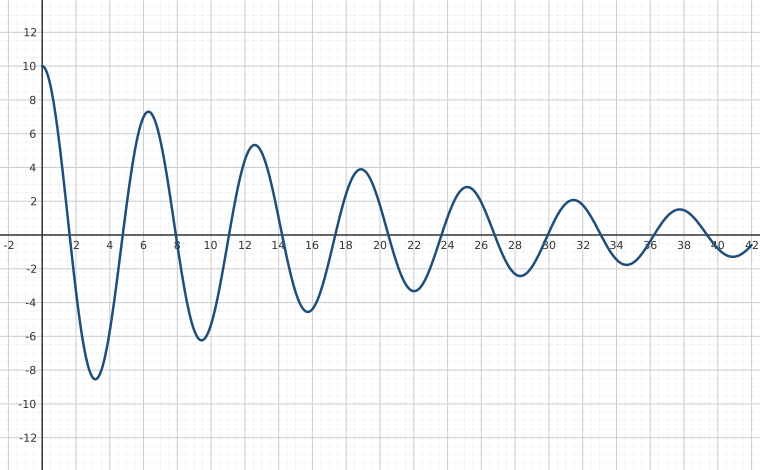
Interactive figureA damped oscillator from light damping to nearly critical, with the damping ratio on a sliderDrag the Damping ratio ζ (0 = undamped, 1 = critical damping) slider from 0 to 0.99.
XYZ Graph · viewer build 5edf91b
A 0.200-kg object on a spring stiff enough to give an undamped angular frequency ω₀ = 1.0 rad/s (k = mω₀² = 0.20 N/m), pulled 10 cm from equilibrium and RELEASED FROM REST at t = 0 — the same release distance as the worked example in this section. Release from rest is what fixes the shape: the exact underdamped solution is then x(t) = A e^(−ζω₀t)[cos(ω_d t) + (ζ/√(1−ζ²)) sin(ω_d t)] with ω_d = ω₀√(1−ζ²). The sine term is not decoration — without it the curve would leave t = 0 with a downward velocity of −ζω₀A instead of zero, which is a different experiment. Because ω₀ = 1.0 rad/s, ζω₀ is numerically equal to ζ and the plotted expression carries no explicit ω₀; t is in seconds throughout. The horizontal axis is time in seconds and the vertical axis is displacement in centimetres. The slider is the damping ratio ζ = b/(2√(km)), which is dimensionless — ζ = 0 is undamped and ζ = 1 is critical damping. It opens at ζ = 0.05, the 'small amount of damping' case where the text says the period is nearly unchanged and only the amplitude decays. Now raise ζ and watch the claim this figure exists to make: the zero crossings spread apart, because ω_d falls below ω₀. The stretch is deliberately slow at first — at ζ = 0.3 the period is only about 5% longer — and then runs away, doubling at ζ ≈ 0.87. Every curve starts at exactly 10 cm however hard you damp it, because that is where the object was let go. The slider stops at 0.99 rather than 1.00 because this is the underdamped solution and critical damping is a different formula, A(1 + ω₀t)e^(−ω₀t); by ζ = 0.99 the damped period is about 44 s, longer than the 42 s on screen, so the curve sags back to equilibrium without completing one swing — the behaviour the text describes.Figure 16.25Displacement versus time for a critically damped harmonic oscillator (A) and an overdamped harmonic oscillator (B). The critically damped oscillator returns to equilibrium at in the smallest time possible without overshooting.
Critical damping is often desired, because such a system returns to equilibrium rapidly and remains at equilibrium as well. In addition, a constant force applied to a critically damped system moves the system to a new equilibrium position in the shortest time possible without overshooting or oscillating about the new position. For example, when you stand on bathroom scales that have a needle gauge, the needle moves to its equilibrium position without oscillating. It would be quite inconvenient if the needle oscillated about the new equilibrium position for a long time before settling. Damping forces can vary greatly in character. Friction, for example, is sometimes independent of velocity (as assumed in most places in this text). But many damping forces depend on velocity—sometimes in complex ways, sometimes simply being proportional to velocity.
Why are completely undamped harmonic oscillators so rare?
Friction often comes into play whenever an object is moving. Friction causes damping in a harmonic oscillator.
Describe the difference between overdamping, underdamping, and critical damping.
An overdamped system moves slowly toward equilibrium. An underdamped system moves quickly to equilibrium, but will oscillate about the equilibrium point as it does so. A critically damped system moves as quickly as possible toward equilibrium without oscillating about the equilibrium.
Test Prep for AP Courses
The non-conservative damping force removes energy from a system in which form?
Mechanical energy
Electrical energy
Thermal energy
None of the above
(c)
The time rate of change of mechanical energy for a damped oscillator is always:
0
Negative
Positive
Undefined
A 0.5-kg object is connected to a spring that undergoes oscillatory motion. There is friction between the object and the surface it is kept on given by coefficient of friction
. If the object is released 0.2 m from equilibrium, what is the distance that the object travels? Given that the force constant of the spring is 50 N m-1 and the frictional force between the objects is 0.294 N.
Section Summary
Damped harmonic oscillators have non-conservative forces that dissipate their energy.
Critical damping returns the system to equilibrium as fast as possible without overshooting.
An underdamped system will oscillate through the equilibrium position.
An overdamped system moves more slowly toward equilibrium than one that is critically damped.
Conceptual Questions
Give an example of a damped harmonic oscillator. (They are more common than undamped or simple harmonic oscillators.)
How would a car bounce after a bump under each of these conditions?
overdamping
underdamping
critical damping
Most harmonic oscillators are damped and, if undriven, eventually come to a stop. How is this observation related to the second law of thermodynamics?
Problems & Exercises
The amplitude of a lightly damped oscillator decreases by during each cycle. What percentage of the mechanical energy of the oscillator is lost in each cycle?
Adapted from College Physics 2e by OpenStax (openstax.org), licensed under CC BY-NC-SA 4.0. Changes were made. License: CC-BY-NC-SA-4.0.
These eBooks are a prerelease and are not yet certified conformant with WCAG 2.1 AA or ADA Title II. Every page is built against an automated accessibility gate, and the published editions will meet ADA Title II requirements when they release in late September 2026. If something is unusable, please tell us.