
16.2 Period and Frequency in Oscillations
Learning Objectives
By the end of this section, you will be able to:
- Observe the vibrations of a guitar string.
- Determine the frequency of oscillations.
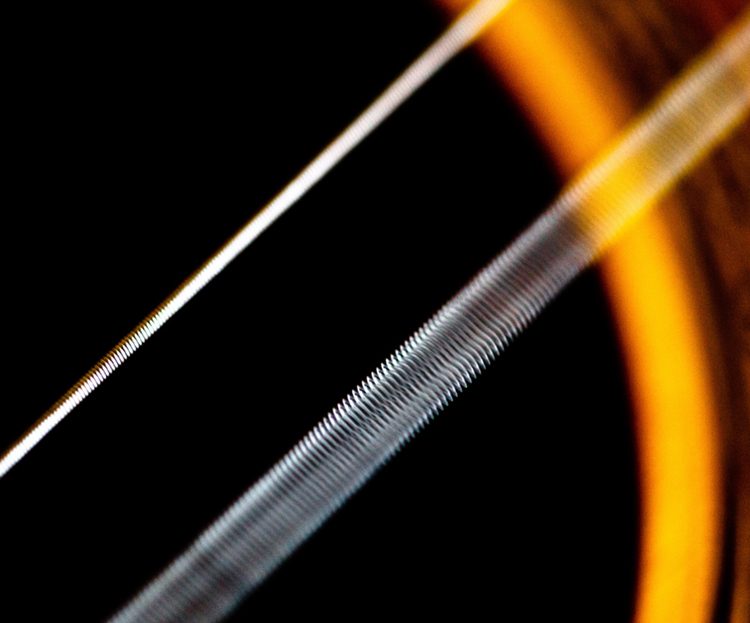
When you pluck a guitar string, the resulting sound has a steady tone and lasts a long time. Each successive vibration of the string takes the same time as the previous one. We define periodic motion to be a motion that repeats itself at regular time intervals, such as exhibited by the guitar string or by an object on a spring moving up and down. The time to complete one oscillation remains constant and is called the period . Its units are usually seconds, but may be any convenient unit of time. The word period refers to the time for some event whether repetitive or not; but we shall be primarily interested in periodic motion, which is by definition repetitive. A concept closely related to period is the frequency of an event. For example, if you get a paycheck twice a month, the frequency of payment is two per month and the period between checks is half a month. Frequency is defined to be the number of events per unit time. For periodic motion, frequency is the number of oscillations per unit time. The relationship between frequency and period is
The SI unit for frequency is the cycle per second, which is defined to be a hertz (Hz):
A cycle is one complete oscillation. Note that a vibration can be a single or multiple event, whereas oscillations are usually repetitive for a significant number of cycles.
Identify an event in your life (such as receiving a paycheck) that occurs regularly. Identify both the period and frequency of this event.
I visit my parents for dinner every other Sunday. The frequency of my visits is 26 per calendar year. The period is two weeks.
Test Prep for AP Courses
A mass attached to a spring oscillates and completes 50 full cycles in 30 s. What is the time period and frequency of this system?
The frequency is given by
Time period is:
Section Summary
- Periodic motion is a repetitious oscillation.
- The time for one oscillation is the period .
- The number of oscillations per unit time is the frequency .
- These quantities are related by
Problems & Exercises
What is the period of electrical power?
16.7 ms
If your heart rate is 150 beats per minute during strenuous exercise, what is the time per beat in units of seconds?
Find the frequency of a tuning fork that takes to complete one oscillation.
400 Hz
A stroboscope is set to flash every . What is the frequency of the flashes?
12,500 Hz
A tire has a tread pattern with a crevice every 2.00 cm. Each crevice makes a single vibration as the tire moves. What is the frequency of these vibrations if the car moves at 30.0 m/s?
1.50 kHz
Engineering Application
Each piston of an engine makes a sharp sound every other revolution of the engine. (a) How fast is a race car going if its eight-cylinder engine emits a sound of frequency 750 Hz, given that the engine makes 2000 revolutions per kilometer? (b) At how many revolutions per minute is the engine rotating?
(a) 93.8 m/s
(b)
Adapted from College Physics 2e by OpenStax (openstax.org), licensed under CC BY-NC-SA 4.0. Changes were made. License: CC-BY-NC-SA-4.0.