
16.1 Hooke’s Law: Stress and Strain Revisited
Learning Objectives
By the end of this section, you will be able to:
- Explain Newton’s third law of motion with respect to stress and deformation.
- Describe the restoration of force and displacement.
- Calculate the energy in Hooke’s Law of deformation, and the stored energy in a spring.
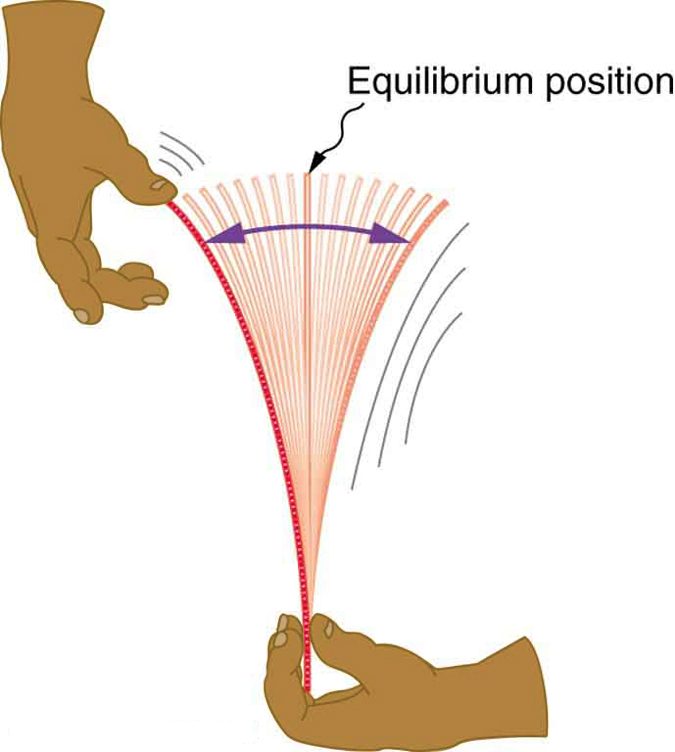
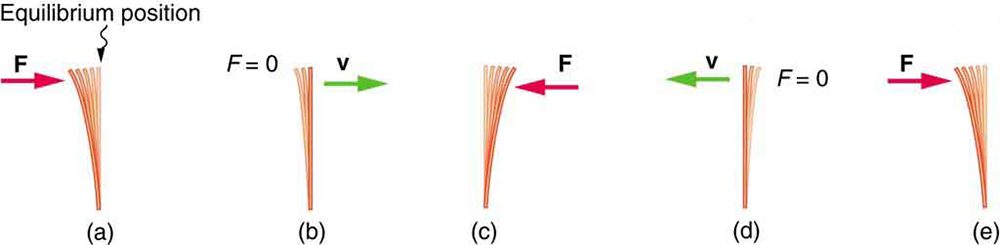
Newton’s first law implies that an object oscillating back and forth is experiencing forces. Without force, the object would move in a straight line at a constant speed rather than oscillate. Consider, for example, plucking a plastic ruler to the left as shown in Figure 16.2. The deformation of the ruler creates a force in the opposite direction, known as a restoring force. Once released, the restoring force causes the ruler to move back toward its stable equilibrium position, where the net force on it is zero. However, by the time the ruler gets there, it gains momentum and continues to move to the right, producing the opposite deformation. It is then forced to the left, back through equilibrium, and the process is repeated until dissipative forces dampen the motion. These forces remove mechanical energy from the system, gradually reducing the motion until the ruler comes to rest.
The simplest oscillations occur when the restoring force is directly proportional to displacement. When stress and strain were covered in Newton’s Third Law of Motion, the name was given to this relationship between force and displacement was Hooke’s law:
Here, is the restoring force, is the displacement from equilibrium or deformation, and is a constant related to the difficulty in deforming the system. The minus sign indicates the restoring force is in the direction opposite to the displacement.
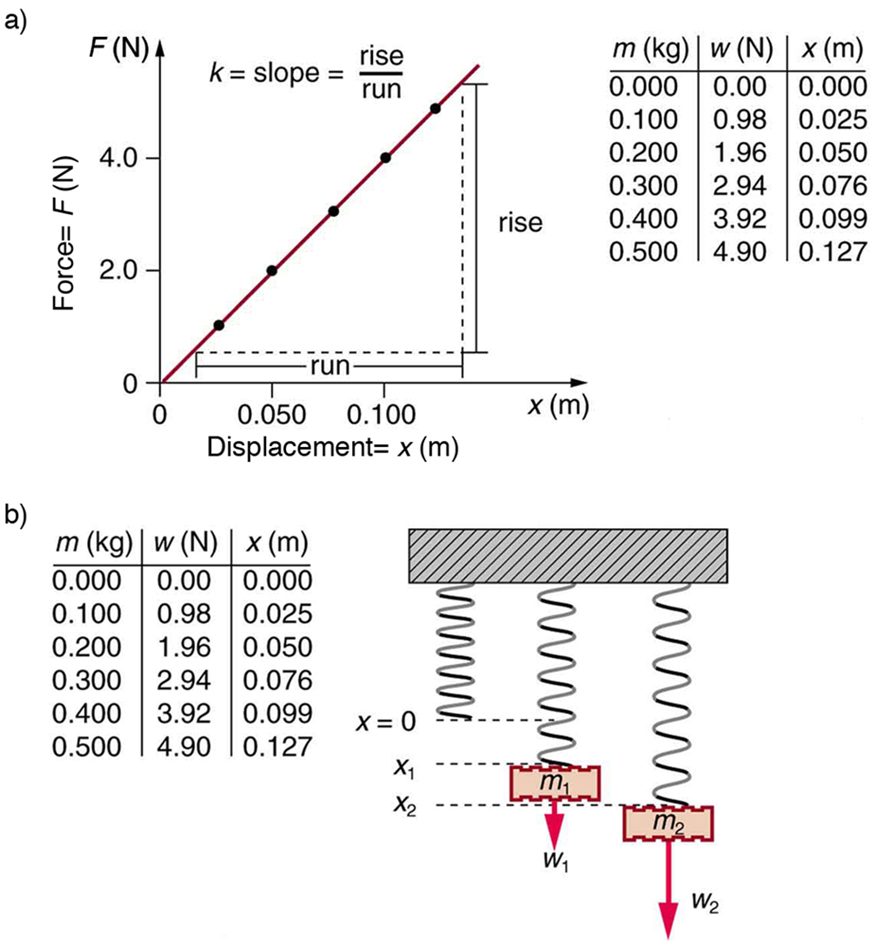
The force constant is related to the rigidity (or stiffness) of a system—the larger the force constant, the greater the restoring force, and the stiffer the system. The units of are newtons per meter (N/m). For example, is directly related to Young’s modulus when we stretch a string. Figure 16.4 shows a graph of the absolute value of the restoring force versus the displacement for a system that can be described by Hooke’s law—a simple spring in this case. The slope of the graph equals the force constant in newtons per meter. A common physics laboratory exercise is to measure restoring forces created by springs, determine if they follow Hooke’s law, and calculate their force constants if they do.
Energy in Hooke’s Law of Deformation
In order to produce a deformation, work must be done. That is, a force must be exerted through a distance, whether you pluck a guitar string or compress a car spring. If the only result is deformation, and no work goes into thermal, sound, or kinetic energy, then all the work is initially stored in the deformed object as some form of potential energy. The potential energy stored in a spring is . Here, we generalize the idea to elastic potential energy for a deformation of any system that can be described by Hooke’s law. Hence,
where is the elastic potential energy stored in any deformed system that obeys Hooke’s law and has a displacement from equilibrium and a force constant .
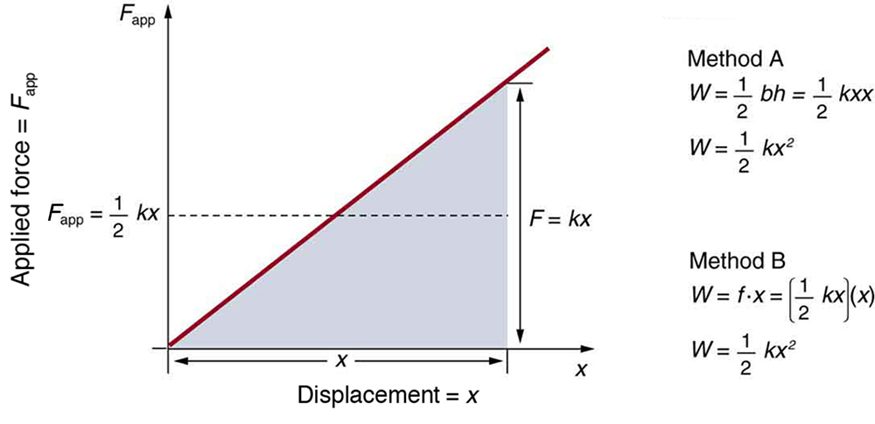
It is possible to find the work done in deforming a system in order to find the energy stored. This work is performed by an applied force . The applied force is exactly opposite to the restoring force (action-reaction), and so . Figure 16.6 shows a graph of the applied force versus deformation for a system that can be described by Hooke’s law. Work done on the system is force multiplied by distance, which equals the area under the curve or (Method A in the figure). Another way to determine the work is to note that the force increases linearly from 0 to , so that the average force is , the distance moved is , and thus (Method B in the figure).
Envision holding the end of a ruler with one hand and deforming it with the other. When you let go, you can see the oscillations of the ruler. In what way could you modify this simple experiment to increase the rigidity of the system?
You could hold the ruler at its midpoint so that the part of the ruler that oscillates is half as long as in the original experiment.
If you apply a deforming force on an object and let it come to equilibrium, what happened to the work you did on the system?
It was stored in the object as potential energy.
Test Prep for AP Courses
Which of the following represents the distance (how much ground the particle covers) moved by a particle in a simple harmonic motion in one time period? (Here, A represents the amplitude of the oscillation.)
- 0 cm
- A cm
- 2A cm
- 4A cm
(d)
A spring has a spring constant of 80 N∙m−1. What is the force required to (a) compress the spring by 5 cm and (b) expand the spring by 15 cm?
In the formula , what does the minus sign indicate?
- It indicates that the restoring force is in the direction of the displacement.
- It indicates that the restoring force is in the direction opposite the displacement.
- It indicates that mechanical energy in the system decreases when a system undergoes oscillation.
- None of the above
(b)
The splashing of a liquid resembles an oscillation. The restoring force in this scenario will be due to which of the following?
- Potential energy
- Kinetic energy
- Gravity
- Mechanical energy
Section Summary
- An oscillation is a back and forth motion of an object between two points of deformation.
- An oscillation may create a wave, which is a disturbance that propagates from where it was created.
- The simplest type of oscillations and waves are related to systems that can be described by Hooke’s law:
where is the restoring force, is the displacement from equilibrium or deformation, and is the force constant of the system.
- Elastic potential energy stored in the deformation of a system that can be described by Hooke’s law is given by
Conceptual Questions
Describe a system in which elastic potential energy is stored.
Problems & Exercises
Fish are hung on a spring scale to determine their mass (most fishermen feel no obligation to truthfully report the mass).
(a) What is the force constant of the spring in such a scale if it the spring stretches 8.00 cm for a 10.0 kg load?
(b) What is the mass of a fish that stretches the spring 5.50 cm?
(c) How far apart are the half-kilogram marks on the scale?
(a)
(b)
(c)
It is weigh-in time for the local under-85-kg rugby team. The bathroom scale used to assess eligibility can be described by Hooke’s law and is depressed 0.75 cm by its maximum load of 120 kg. (a) What is the spring’s effective spring constant? (b) A player stands on the scales and depresses it by 0.48 cm. Is he eligible to play on this under-85 kg team?
One type of BB gun uses a spring-driven plunger to blow the BB from its barrel. (a) Calculate the force constant of its plunger’s spring if you must compress it 0.150 m to drive the 0.0500-kg plunger to a top speed of 20.0 m/s. (b) What force must be exerted to compress the spring?
(a) 889 N/m
(b) 133 N
(a) The springs of a pickup truck act like a single spring with a force constant of . By how much will the truck be depressed by its maximum load of 1000 kg?
(b) If the pickup truck has four identical springs, what is the force constant of each?
When an 80.0-kg man stands on a pogo stick, the spring is compressed 0.120 m.
(a) What is the force constant of the spring? (b) Will the spring be compressed more when he hops down the road?
(a)
(b) Yes
A spring has a length of 0.200 m when a 0.300-kg mass hangs from it, and a length of 0.750 m when a 1.95-kg mass hangs from it. (a) What is the force constant of the spring? (b) What is the unloaded length of the spring?
Adapted from College Physics 2e by OpenStax (openstax.org), licensed under CC BY-NC-SA 4.0. Changes were made. License: CC-BY-NC-SA-4.0.