
8.6 Collisions of Point Masses in Two Dimensions
Learning Objectives
By the end of this section, you will be able to:
- Discuss two dimensional collisions as an extension of one dimensional analysis.
- Define point masses.
- Derive an expression for conservation of momentum along x-axis and y-axis.
- Describe elastic collisions of two objects with equal mass.
- Determine the magnitude and direction of the final velocity given initial velocity, and scattering angle.
In the previous two sections, we considered only one-dimensional collisions; during such collisions, the incoming and outgoing velocities are all along the same line. But what about collisions, such as those between billiard balls, in which objects scatter to the side? These are two-dimensional collisions, and we shall see that their study is an extension of the one-dimensional analysis already presented. The approach taken (similar to the approach in discussing two-dimensional kinematics and dynamics) is to choose a convenient coordinate system and resolve the motion into components along perpendicular axes. Resolving the motion yields a pair of one-dimensional problems to be solved simultaneously.
One complication arising in two-dimensional collisions is that the objects might rotate before or after their collision. For example, if two ice skaters hook arms as they pass by one another, they will spin in circles. We will not consider such rotation until later, and so for now we arrange things so that no rotation is possible. To avoid rotation, we consider only the scattering of point masses—that is, structureless particles that cannot rotate or spin.
We start by assuming that , so that momentum is conserved. The simplest collision is one in which one of the particles is initially at rest. (See Figure 8.13.) The best choice for a coordinate system is one with an axis parallel to the velocity of the incoming particle, as shown in Figure 8.13. Because momentum is conserved, the components of momentum along the - and -axes will also be conserved, but with the chosen coordinate system, is initially zero and is the momentum of the incoming particle. Both facts simplify the analysis. (Even with the simplifying assumptions of point masses, one particle initially at rest, and a convenient coordinate system, we still gain new insights into nature from the analysis of two-dimensional collisions.)
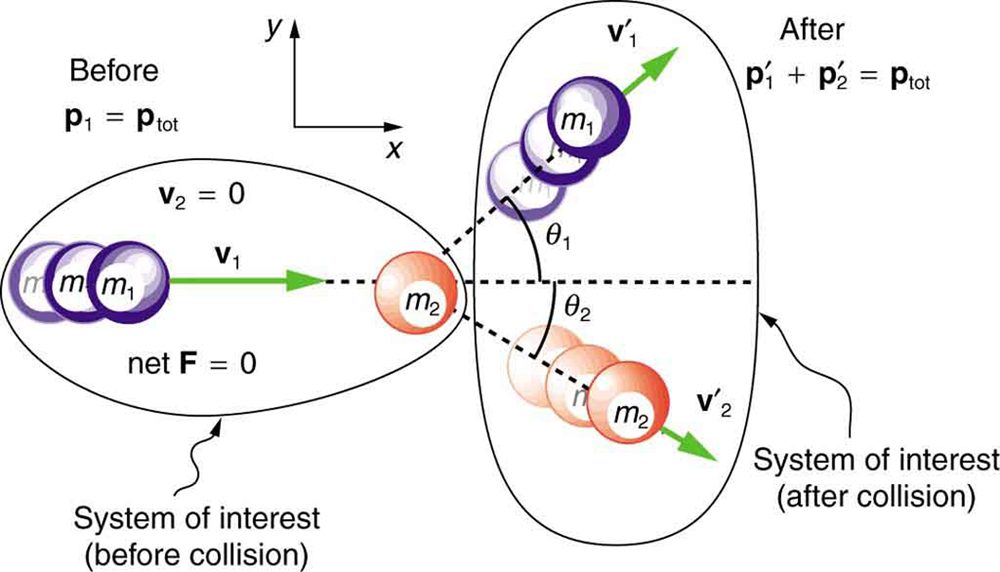
Along the -axis, the equation for conservation of momentum is
Where the subscripts denote the particles and axes and the primes denote the situation after the collision. In terms of masses and velocities, this equation is
But because particle 2 is initially at rest, this equation becomes
The components of the velocities along the -axis have the form . Because particle 1 initially moves along the -axis, we find .
Conservation of momentum along the -axis gives the following equation:
where and are as shown in Figure 8.13.
Along the -axis, the equation for conservation of momentum is
or
But is zero, because particle 1 initially moves along the -axis. Because particle 2 is initially at rest, is also zero. The equation for conservation of momentum along the -axis becomes
The components of the velocities along the -axis have the form .
Thus, conservation of momentum along the -axis gives the following equation:
The equations of conservation of momentum along the -axis and -axis are very useful in analyzing two-dimensional collisions of particles, where one is originally stationary (a common laboratory situation). But two equations can only be used to find two unknowns, and so other data may be necessary when collision experiments are used to explore nature at the subatomic level.
Elastic Collisions of Two Objects with Equal Mass
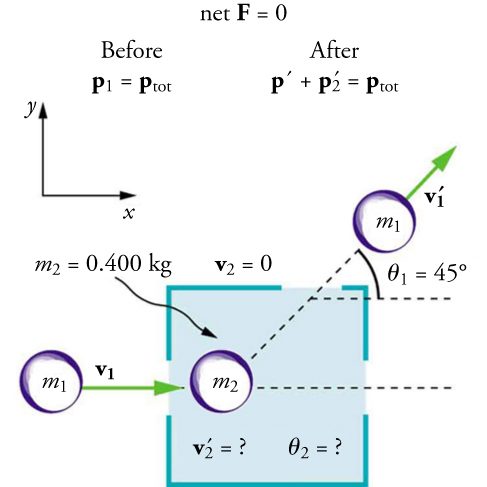
Some interesting situations arise when the two colliding objects have equal mass and the collision is elastic. This situation is nearly the case with colliding billiard balls, and precisely the case with some subatomic particle collisions. We can thus get a mental image of a collision of subatomic particles by thinking about billiards (or pool). (Refer to Figure 8.13 for masses and angles.) First, an elastic collision conserves internal kinetic energy. Again, let us assume object 2 is initially at rest. Then, the internal kinetic energy before and after the collision of two objects that have equal masses is
Because the masses are equal, . Algebraic manipulation (left to the reader) of conservation of momentum in the - and -directions can show that
(Remember that is negative here.) The two preceding equations can both be true only if
There are three ways that this term can be zero. They are
- : head-on collision; incoming ball stops
- : no collision; incoming ball continues unaffected
- : angle of separation is after the collision
All three of these ways are familiar occurrences in billiards and pool, although most of us try to avoid the second. If you play enough pool, you will notice that the angle between the balls is very close to after the collision, although it will vary from this value if a great deal of spin is placed on the ball. (Large spin carries in extra energy and a quantity called angular momentum, which must also be conserved.) The assumption that the scattering of billiard balls is elastic is reasonable based on the correctness of the three results it produces. This assumption also implies that, to a good approximation, momentum is conserved for the two-ball system in billiards and pool. The problems below explore these and other characteristics of two-dimensional collisions.
Test Prep for AP Courses
Two cars of equal mass approach an intersection. Car A is moving east at a speed of 45 m/s. Car B is moving south at a speed of 35 m/s. They collide inelastically and stick together after the collision, moving as one object. Which of the following statements is true about the center-of-mass velocity of this system?
- The center-of-mass velocity will decrease after the collision as a result of lost energy (but not drop to zero).
- The center-of-mass velocity will remain the same after the collision since momentum is conserved.
- The center-of-mass velocity will drop to zero since the two objects stick together.
- The magnitude of the center-of-mass velocity will remain the same, but the direction of the velocity will change.
(b)
Car A has a mass of 2000 kg and approaches an intersection with a velocity of 38 m/s directed to the east. Car B has a mass of 3500 kg and approaches the intersection with a velocity of 53 m/s directed 63° north of east. The two cars collide and stick together after the collision. Will the center-of-mass velocity change as a result of the collision? Explain why or why not. Calculate the center-of-mass velocity before and after the collision.
Section Summary
- The approach to two-dimensional collisions is to choose a convenient coordinate system and break the motion into components along perpendicular axes. Choose a coordinate system with the -axis parallel to the velocity of the incoming particle.
- Two-dimensional collisions of point masses where mass 2 is initially at rest conserve momentum along the initial direction of mass 1 (the -axis), stated by and along the direction perpendicular to the initial direction (the -axis) stated by .
- The internal kinetic before and after the collision of two objects that have equal masses is
- Point masses are structureless particles that cannot spin.
Conceptual Questions
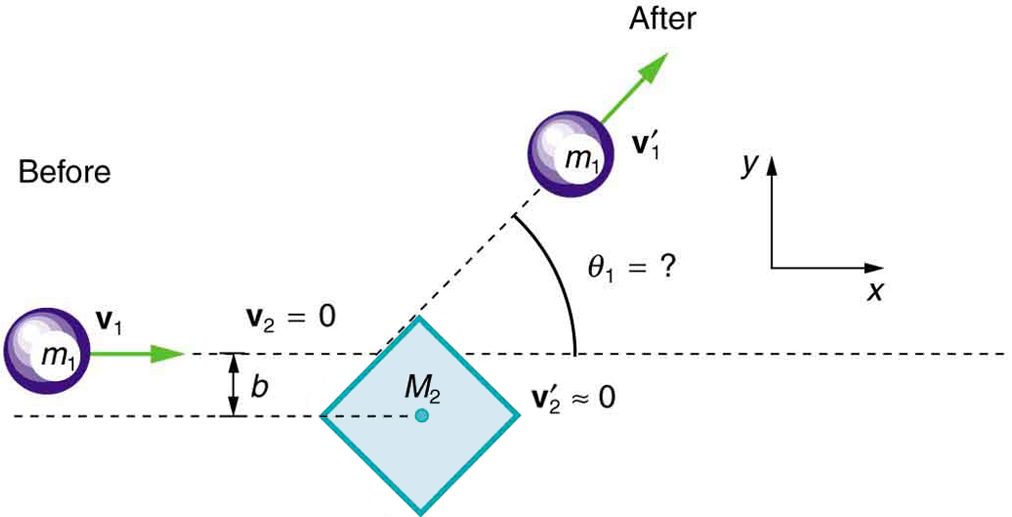
Figure 8.15 shows a cube at rest and a small object heading toward it. (a) Describe the directions (angle ) at which the small object can emerge after colliding elastically with the cube. How does depend on , the so-called impact parameter? Ignore any effects that might be due to rotation after the collision, and assume that the cube is much more massive than the small object. (b) Answer the same questions if the small object instead collides with a massive sphere.
Problems & Exercises
Two identical pucks collide on an air hockey table. One puck was originally at rest. (a) If the incoming puck has a speed of 6.00 m/s and scatters to an angle of ,what is the velocity (magnitude and direction) of the second puck? (You may use the result that for elastic collisions of objects that have identical masses.) (b) Confirm that the collision is elastic.
(a) 3.00 m/s, below -axis
(b) Find speed of first puck after collision:
Verify that ratio of initial to final KE equals one:
Confirm that the results of the example Example 1 do conserve momentum in both the - and -directions.
A 3000-kg cannon is mounted so that it can recoil only in the horizontal direction. (a) Calculate its recoil velocity when it fires a 15.0-kg shell at 480 m/s at an angle of above the horizontal. (b) What is the kinetic energy of the cannon? This energy is dissipated as heat transfer in shock absorbers that stop its recoil. (c) What happens to the vertical component of momentum that is imparted to the cannon when it is fired?
(a)
(b)
(c) The ground will exert a normal force to oppose recoil of the cannon in the vertical direction. The momentum in the vertical direction is transferred to the earth. The energy is transferred into the ground, making a dent where the cannon is. After long barrages, cannon have erratic aim because the ground is full of divots.
Professional Application
A 5.50-kg bowling ball moving at 9.00 m/s collides with a 0.850-kg bowling pin, which is scattered at an angle of to the initial direction of the bowling ball and with a speed of 15.0 m/s. (a) Calculate the final velocity (magnitude and direction) of the bowling ball. (b) Is the collision elastic? (c) Linear kinetic energy is greater after the collision. Discuss how spin on the ball might be converted to linear kinetic energy in the collision.
Professional Application
Ernest Rutherford (the first New Zealander to be awarded the Nobel Prize in Chemistry) demonstrated that nuclei were very small and dense by scattering helium-4 nuclei from gold-197 nuclei . The energy of the incoming helium nucleus was , and the masses of the helium and gold nuclei were and , respectively (note that their mass ratio is 4 to 197). (a) If a helium nucleus scatters to an angle of during an elastic collision with a gold nucleus, calculate the helium nucleus’s final speed and the final velocity (magnitude and direction) of the gold nucleus. (b) What is the final kinetic energy of the helium nucleus?
(a) at
(b)
Professional Application
Two cars collide at an icy intersection and stick together afterward. The first car has a mass of 1200 kg and is approaching at due south. The second car has a mass of 850 kg and is approaching at due west. (a) Calculate the final velocity (magnitude and direction) of the cars. (b) How much kinetic energy is lost in the collision? (This energy goes into deformation of the cars.) "Note that since both cars have an initial velocity, you cannot use Equation 8.54 and must write and solve the equations for conservation of momentum along the -axis and -axis; instead, you must look for other simplifying aspects.
Starting with equations and for conservation of momentum in the - and -directions and assuming that one object is originally stationary, prove that for an elastic collision of two objects of equal masses,
as discussed in the text.
We are given that . The given equations then become:
and
Square each equation to get
Add these two equations and simplify:
Multiply the entire equation by to recover the kinetic energy:
Integrated Concepts
A 90.0-kg ice hockey player hits a 0.150-kg puck, giving the puck a velocity of 45.0 m/s. If both are initially at rest and if the ice is frictionless, how far does the player recoil in the time it takes the puck to reach the goal 15.0 m away?
Adapted from College Physics 2e by OpenStax (openstax.org), licensed under CC BY-NC-SA 4.0. Changes were made. License: CC-BY-NC-SA-4.0.