
8.2 Impulse
Learning Objectives
By the end of this section, you will be able to:
- Define impulse.
- Describe effects of impulses in everyday life.
- Determine the average effective force using graphical representation.
- Calculate average force and impulse given mass, velocity, and time.
The effect of a force on an object depends on how long it acts, as well as how great the force is. In Example 2 in Section 8.1, a very large force acting for a short time had a great effect on the momentum of the tennis ball. A small force could cause the same change in momentum, but it would have to act for a much longer time. For example, if the ball were thrown upward, the gravitational force (which is much smaller than the tennis racquet’s force) would eventually reverse the momentum of the ball. Quantitatively, the effect we are talking about is the change in momentum .
By rearranging the equation to be
we can see how the change in momentum equals the average net external force multiplied by the time this force acts. The quantity is given the name impulse. Impulse is the same as the change in momentum.
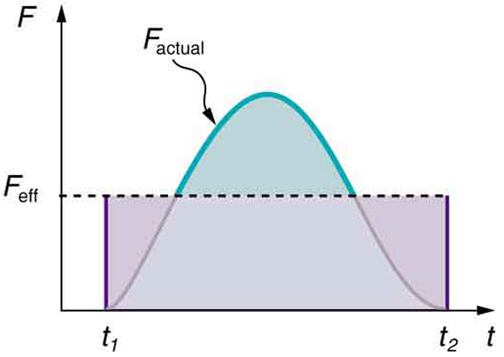
Our definition of impulse includes an assumption that the force is constant over the time interval . Forces are usually not constant. Forces vary considerably even during the brief time intervals considered. It is, however, possible to find an average effective force that produces the same result as the corresponding time-varying force. Figure 8.2 shows a graph of what an actual force looks like as a function of time for a ball bouncing off the floor. The area under the curve has units of momentum and is equal to the impulse or change in momentum between times and . That area is equal to the area inside the rectangle bounded by , , and . Thus the impulses and their effects are the same for both the actual and effective forces.
Test Prep for AP Courses
A 1.0-kg ball of putty is released from rest and falls vertically 1.5 m until it strikes a hard floor, where it comes to rest in a 0.045-s time interval. What is the magnitude and direction of the average force exerted on the ball by the floor during the collision?
- 33 N, up
- 120 N, up
- 120 N, down
- 240 N, down
(b)
A 75-g ball is dropped from rest from a height of 2.2 m. It bounces off the floor and rebounds to a maximum height of 1.7 m. If the ball is in contact with the floor for 0.024 s, what is the magnitude and direction of the average force exerted on the ball by the floor during the collision?
A 2.4-kg ceramic bowl falls to the floor. During the 0.018-s impact, the bowl experiences an average force of 750 N from the floor. The bowl is at rest after the impact. From what initial height did the bowl fall?
- 1.6 m
- 2.8 m
- 3.2 m
- 5.6 m
(a)
Whether or not an object (such as a plate, glass, or bone) breaks upon impact depends on the average force exerted on that object by the surface. When a 1.2-kg glass figure hits the floor, it will break if it experiences an average force of 330 N. When it hits a tile floor, the glass comes to a stop in 0.015 s. From what minimum height must the glass fall to experience sufficient force to break? How would your answer change if the figure were falling to a padded or carpeted surface? Explain.
A 2.5-kg block slides across a frictionless table toward a horizontal spring.As the block bounces off the spring, a probe measures the velocity of the block (initially negative, moving away from the probe) over time as follows:
| Velocity (m/s) | Time (s) |
|---|---|
| −12.0 | 0 |
| −10.0 | 0.10 |
| −6.0 | 0.20 |
| 0 | 0.30 |
| 6.0 | 0.40 |
| 10.0 | 0.50 |
| 12.0 | 0.60 |
What is the average force exerted on the block by the spring over the entire 0.60-s time interval of the collision?
- 50 N
- 60 N
- 100 N
- 120 N
(c) (based on calculation of )
During an automobile crash test, the average force exerted by a solid wall on a 2500-kg car that hits the wall is measured to be 740,000 N over a 0.22-s time interval. What was the initial speed of the car prior to the collision, assuming the car is at rest at the end of the time interval?
A test car is driving toward a solid crash-test barrier with a speed of 45 mi/h. Two seconds prior to impact, the car begins to brake, but it is still moving when it hits the wall. After the collision with the wall, the car crumples somewhat and comes to a complete stop. In order to estimate the average force exerted by the wall on the car, what information would you need to collect?
- The (negative) acceleration of the car before it hits the wall and the distance the car travels while braking.
- The (negative) acceleration of the car before it hits the wall and the velocity of the car just before impact.
- The velocity of the car just before impact and the duration of the collision with the wall.
- The duration of the collision with the wall and the distance the car travels while braking.
(c)
Design an experiment to verify the relationship between the average force exerted on an object and the change in momentum of that object. As part of your explanation, list the equipment you would use and describe your experimental setup. What would you measure and how? How exactly would you verify the relationship? Explain.
A 22-g puck hits the wall of an air hockey table perpendicular to the wall with an initial speed of 14 m/s.The puck is in contact with the wall for 0.0055 s, and it rebounds from the wall with a speed of 14 m/s in the opposite direction.What is the magnitude of the average force exerted by the wall on the puck?
- 0.308 N
- 0.616 N
- 56 N
- 112 N
(d)
A 22-g puck hits the wall of an air hockey table perpendicular to the wall with an initial speed of 7 m/s. The puck is in contact with the wall for 0.011 s, and the wall exerts an average force of 28 N on the puck during that time. Calculate the magnitude and direction of the change in momentum of the puck.
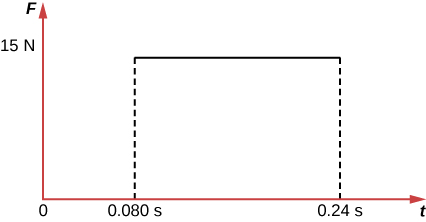
The graph in Figure 8.3 represents the force exerted on a particle during a collision. What is the magnitude of the change in momentum of the particle as a result of the collision?
- 1.2 kg ⋅ m/s
- 2.4 kg ⋅ m/s
- 3.6 kg ⋅ m/s
- 4.8 kg ⋅ m/s
(b)
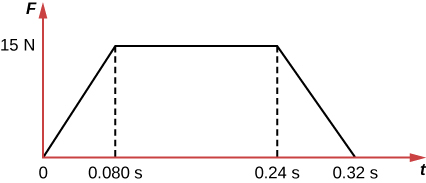
The graph in Figure 8.4 represents the force exerted on a particle during a collision. What is the magnitude of the change in momentum of the particle as a result of the collision?
Section Summary
- Impulse, or change in momentum, equals the average net external force multiplied by the time this force acts:
- Forces are usually not constant over a period of time.
Conceptual Questions
Professional Application
Explain in terms of impulse how padding reduces forces in a collision. State this in terms of a real example, such as the advantages of a carpeted vs. tile floor for a day care center.
While jumping on a trampoline, sometimes you land on your back and other times on your feet. In which case can you reach a greater height and why?
Professional Application
Tennis racquets have “sweet spots.” If the ball hits a sweet spot then the player's arm is not jarred as much as it would be otherwise. Explain why this is the case.
Problems & Exercises
A bullet is accelerated down the barrel of a gun by hot gases produced in the combustion of gun powder. What is the average force exerted on a 0.0300-kg bullet to accelerate it to a speed of 600.0 m/s in a time of 2.00 ms (milliseconds)?
Professional Application
A car moving at 10.0 m/s crashes into a tree and stops in 0.26 s. Calculate the force the seat belt exerts on a passenger in the car to bring him to a halt. The mass of the passenger is 70.0 kg.
A person slaps her leg with her hand, bringing her hand to rest in 2.50 milliseconds from an initial speed of 4.00 m/s. (a) What is the average force exerted on the leg, taking the effective mass of the hand and forearm to be 1.50 kg? (b) Would the force be any different if the woman clapped her hands together at the same speed and brought them to rest in the same time? Explain why or why not.
a) toward the leg
b) The force on each hand would have the same magnitude as that found in part (a) (but in opposite directions by Newton’s third law) because the change in momentum and the time interval are the same.
Professional Application
A professional boxer hits his opponent with a 1000-N horizontal blow that lasts for 0.150 s. (a) Calculate the impulse imparted by this blow. (b) What is the opponent’s final velocity, if his mass is 105 kg and he is motionless in midair when struck near his center of mass? (c) Calculate the recoil velocity of the opponent’s 10.0-kg head if hit in this manner, assuming the head does not initially transfer significant momentum to the boxer’s body. (d) Discuss the implications of your answers for parts (b) and (c).
Professional Application
Suppose a child drives a bumper car head on into the side rail, which exerts a force of 4000 N on the car for 0.200 s. (a) What impulse is imparted by this force? (b) Find the final velocity of the bumper car if its initial velocity was 2.80 m/s and the car plus driver have a mass of 200 kg. You may neglect friction between the car and floor.
a) away from the wall
b) away from the wall
Professional Application
One hazard of space travel is debris left by previous missions. There are several thousand objects orbiting Earth that are large enough to be detected by radar, but there are far greater numbers of very small objects, such as flakes of paint. Calculate the force exerted by a 0.100-mg chip of paint that strikes a spacecraft window at a relative speed of , given the collision lasts .
Professional Application
A 75.0-kg person is riding in a car moving at 20.0 m/s when the car runs into a bridge abutment. (a) Calculate the average force on the person if he is stopped by a padded dashboard that compresses an average of 1.00 cm. (b) Calculate the average force on the person if he is stopped by an air bag that compresses an average of 15.0 cm.
(a) away from the dashboard
(b) away from the dashboard
Professional Application
Military rifles have a mechanism for reducing the recoil forces of the gun on the person firing it. An internal part recoils over a relatively large distance and is stopped by damping mechanisms in the gun. The larger distance reduces the average force needed to stop the internal part. (a) Calculate the recoil velocity of a 1.00-kg plunger that directly interacts with a 0.0200-kg bullet fired at 600 m/s from the gun. (b) If this part is stopped over a distance of 20.0 cm, what average force is exerted upon it by the gun? (c) Compare this to the force exerted on the gun if the bullet is accelerated to its velocity in 10.0 ms (milliseconds).
A cruise ship with a mass of strikes a pier at a speed of 0.750 m/s. It comes to rest 6.00 m later, damaging the ship, the pier, and the tugboat captain’s finances. Calculate the average force exerted on the pier using the concept of impulse. (Hint: First calculate the time it took to bring the ship to rest.)
in the boat’s original direction of motion
Calculate the final speed of a 110-kg rugby player who is initially running at 8.00 m/s but collides head-on with a padded goalpost and experiences a backward force of for .
Water from a fire hose is directed horizontally against a wall at a rate of 50.0 kg/s and a speed of 42.0 m/s. Calculate the magnitude of the force exerted on the wall, assuming the water’s horizontal momentum is reduced to zero.
away from the wall
A 0.450-kg hammer is moving horizontally at 7.00 m/s when it strikes a nail and comes to rest after driving the nail 1.00 cm into a board. (a) Calculate the duration of the impact. (b) What was the average force exerted on the nail?
Starting with the definitions of momentum and kinetic energy, derive an equation for the kinetic energy of a particle expressed as a function of its momentum.
A ball with an initial velocity of 10 m/s moves at an angle above the -direction. The ball hits a vertical wall and bounces off so that it is moving above the -direction with the same speed. In terms of m, the mass of the ball, what is the impulse delivered by the wall?
When serving a tennis ball, a player hits the ball when its velocity is zero (at the highest point of a vertical toss). The racquet exerts a force of 540 N on the ball for 5.00 ms, giving it a final velocity of 45.0 m/s. Using these data, find the mass of the ball.
60.0 g
A punter drops a ball from rest vertically 1 meter down onto his foot. The ball leaves the foot with a speed of 18 m/s at an angle above the horizontal. In terms of m, the mass of the ball, what is the impulse delivered by the foot (magnitude and direction)?
Adapted from College Physics 2e by OpenStax (openstax.org), licensed under CC BY-NC-SA 4.0. Changes were made. License: CC-BY-NC-SA-4.0.