
8.5 Inelastic Collisions in One Dimension
Learning Objectives
By the end of this section, you will be able to:
- Define inelastic collision.
- Explain perfectly inelastic collision.
- Apply an understanding of collisions to sports.
- Determine recoil velocity and loss in kinetic energy given mass and initial velocity.
We have seen that in an elastic collision, internal kinetic energy is conserved. An inelastic collision is one in which the internal kinetic energy changes (it is not conserved). This lack of conservation means that the forces between colliding objects may remove or add internal kinetic energy. Work done by internal forces may change the forms of energy within a system. For inelastic collisions, such as when colliding objects stick together, this internal work may transform some internal kinetic energy into heat transfer. Or it may convert stored energy into internal kinetic energy, such as when exploding bolts separate a satellite from its launch vehicle.
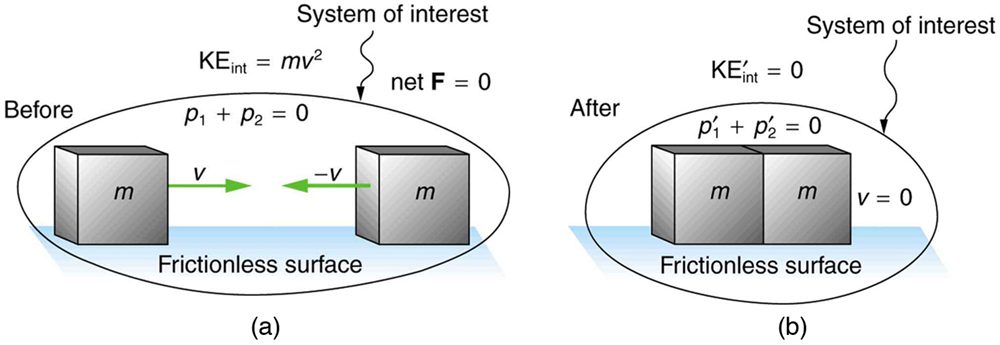
Figure 8.10 shows an example of an inelastic collision. Two objects that have equal masses head toward one another at equal speeds and then stick together. Their total internal kinetic energy is initially . The two objects come to rest after sticking together, conserving momentum. But the internal kinetic energy is zero after the collision. A collision in which the objects stick together is sometimes called a perfectly inelastic collision because it reduces internal kinetic energy more than does any other type of inelastic collision. In fact, such a collision reduces internal kinetic energy to the minimum it can have while still conserving momentum.
Test Prep for AP Courses
Mass A (2.0 kg) has an initial velocity of 4 m/s in the +x-direction. Mass B (2.0 kg) has an initial velocity of 5 m/s in the –x-direction. If the two masses have an elastic collision, what will be the final velocities of the masses after the collision?
- Both will move 0.5 m/s in the –x-direction.
- Mass A will stop; mass B will move 9 m/s in the +x-direction.
- Mass B will stop; mass A will move 9 m/s in the –x-direction.
- Mass A will move 5 m/s in the –x-direction; mass B will move 4 m/s in the +x-direction.
(d)
Mass A has an initial velocity of 22 m/s in the +x-direction. Mass B is three times more massive than mass A and has an initial velocity of 22 m/s in the –x-direction. If the two masses have an elastic collision, what will be the final velocities of the masses after the collision?
Mass A (2.0 kg) is moving with an initial velocity of 15 m/s in the +x-direction, and it collides with mass B (5.0 kg), initially at rest. After the collision, the two objects stick together and move as one. What is the change in kinetic energy of the system as a result of the collision?
- no change
- decrease by 225 J
- decrease by 161 J
- decrease by 64 J
(c). Because of conservation of momentum, the final velocity of the combined mass must be 4.286 m/s. The initial kinetic energy is . The final kinetic energy is , so the difference is −161 J.
Mass A (2.0 kg) is moving with an initial velocity of 15 m/s in the +x-direction, and it collides with mass B (4.0 kg), initially moving 7.0 m/s in the +x-direction. After the collision, the two objects stick together and move as one. What is the change in kinetic energy of the system as a result of the collision?
Mass A slides across a rough table with an initial velocity of 12 m/s in the +x-direction. By the time mass A collides with mass B (a stationary object with equal mass), mass A has slowed to 10 m/s. After the collision, the two objects stick together and move as one. Immediately after the collision, the velocity of the system is measured to be 5 m/s in the +x-direction, and the system eventually slides to a stop. Which of the following statements is true about this motion?
- Momentum is conserved during the collision, but it is not conserved during the motion before and after the collision.
- Momentum is not conserved at any time during this analysis.
- Momentum is conserved at all times during this analysis.
- Momentum is not conserved during the collision, but it is conserved during the motion before and after the collision.
(a)
Mass A is initially moving with a velocity of 12 m/s in the +x-direction. Mass B is twice as massive as mass A and is initially at rest. After the two objects collide, the two masses move together as one with a velocity of 4 m/s in the +x-direction. Is momentum conserved in this collision?
Mass A is initially moving with a velocity of 24 m/s in the +x-direction. Mass B is twice as massive as mass A and is initially at rest. The two objects experience a totally inelastic collision. What is the final speed of both objects after the collision?
- A is not moving; B is moving 24 m/s in the +x-direction.
- Neither A nor B is moving.
- A is moving 24 m/s in the –x-direction. B is not moving.
- Both A and B are moving together 8 m/s in the +x-direction.
(d)
Mass A is initially moving with some unknown velocity in the +x-direction. Mass B is twice as massive as mass A and initially at rest. The two objects collide, and after the collision, they move together with a speed of 6 m/s in the +x-direction. (a) Is this collision elastic or inelastic? Explain. (b) Determine the initial velocity of mass A.
Mass A is initially moving with a velocity of 2 m/s in the +x-direction. Mass B is initially moving with a velocity of 6 m/s in the –x-direction. The two objects have equal masses. After they collide, mass A moves with a speed of 4 m/s in the –x-direction. What is the final velocity of mass B after the collision?
- 6 m/s in the +x-direction
- 4 m/s in the +x-direction
- zero
- 4 m/s in the –x-direction
(c)
Mass A is initially moving with a velocity of 15 m/s in the +x-direction. Mass B is twice as massive and is initially moving with a velocity of 10 m/s in the –x-direction. The two objects collide, and after the collision, mass A moves with a speed of 15 m/s in the –x-direction. (a) What is the final velocity of mass B after the collision? (b) Calculate the change in kinetic energy as a result of the collision, assuming mass A is 5.0 kg.
Section Summary
- An inelastic collision is one in which the internal kinetic energy changes (it is not conserved).
- A collision in which the objects stick together is sometimes called perfectly inelastic because it reduces internal kinetic energy more than does any other type of inelastic collision.
- Sports science and technologies also use physics concepts such as momentum and rotational motion and vibrations.
Conceptual Questions
What is an inelastic collision? What is a perfectly inelastic collision?
Mixed-pair ice skaters performing in a show are standing motionless at arms length just before starting a routine. They reach out, clasp hands, and pull themselves together by only using their arms. Assuming there is no friction between the blades of their skates and the ice, what is their velocity after their bodies meet?
A small pickup truck that has a camper shell slowly coasts toward a red light with negligible friction. Two dogs in the back of the truck are moving and making various inelastic collisions with each other and the walls. What is the effect of the dogs on the motion of the center of mass of the system (truck plus entire load)? What is their effect on the motion of the truck?
Problems & Exercises
A 0.240-kg billiard ball that is moving at 3.00 m/s strikes the bumper of a pool table and bounces straight back at 2.40 m/s (80% of its original speed). The collision lasts 0.0150 s. (a) Calculate the average force exerted on the ball by the bumper. (b) How much kinetic energy in joules is lost during the collision? (c) What percent of the original energy is left?
(a) 86.4 N perpendicularly away from the bumper
(b) 0.389 J
(c) 64.0%
During an ice show, a 60.0-kg skater leaps into the air and is caught by an initially stationary 75.0-kg skater. (a) What is their final velocity assuming negligible friction and that the 60.0-kg skater’s original horizontal velocity is 4.00 m/s? (b) How much kinetic energy is lost?
Professional Application
Using mass and speed data from Example 1 in Section 8.1 and assuming that the football player catches the ball with his feet off the ground with both of them moving horizontally, calculate: (a) the final velocity if the ball and player are going in the same direction and (b) the loss of kinetic energy in this case. (c) Repeat parts (a) and (b) for the situation in which the ball and the player are going in opposite directions. Might the loss of kinetic energy be related to how much it hurts to catch the pass?
(a) 8.06 m/s
(b) -56.0 J
(c)(i) 7.88 m/s; (ii) -223 J
A battleship that is and is originally at rest fires a 1100-kg artillery shell horizontally with a velocity of 575 m/s. (a) If the shell is fired straight aft (toward the rear of the ship), there will be negligible friction opposing the ship’s recoil. Calculate its recoil velocity. (b) Calculate the increase in internal kinetic energy (that is, for the ship and the shell). This energy is less than the energy released by the gun powder—significant heat transfer occurs.
Professional Application
Two piloted satellites approaching one another, at a relative speed of 0.250 m/s, intending to dock. The first has a mass of , and the second a mass of . (a) Calculate the final velocity (after docking) by using the frame of reference in which the first satellite was originally at rest. (b) What is the loss of kinetic energy in this inelastic collision? (c) Repeat both parts by using the frame of reference in which the second satellite was originally at rest. Explain why the change in velocity is different in the two frames, whereas the change in kinetic energy is the same in both.
(a) 0.163 m/s in the direction of motion of the more massive satellite
(b) 81.6 J
(c) in the direction of motion of the less massive satellite, 81.5 J. Because there are no external forces, the velocity of the center of mass of the two-satellite system is unchanged by the collision. The two velocities calculated above are the velocity of the center of mass in each of the two different individual reference frames. The loss in KE is the same in both reference frames because the KE lost to internal forces (heat, friction, etc.) is the same regardless of the coordinate system chosen.
Professional Application
A 30,000-kg freight car is coasting at 0.850 m/s with negligible friction under a hopper that dumps 110,000 kg of scrap metal into it. (a) What is the final velocity of the loaded freight car? (b) How much kinetic energy is lost?
Professional Application
Space probes may be separated from their launchers by exploding bolts. (They bolt away from one another.) Suppose a 4800-kg satellite uses this method to separate from the 1500-kg remains of its launcher, and that 5000 J of kinetic energy is supplied to the two parts. What are their subsequent velocities using the frame of reference in which they were at rest before separation?
0.704 m/s
–2.25 m/s
A 0.0250-kg bullet is accelerated from rest to a speed of 550 m/s in a 3.00-kg rifle. The pain of the rifle’s kick is much worse if you hold the gun loosely a few centimeters from your shoulder rather than holding it tightly against your shoulder. (a) Calculate the recoil velocity of the rifle if it is held loosely away from the shoulder. (b) How much kinetic energy does the rifle gain? (c) What is the recoil velocity if the rifle is held tightly against the shoulder, making the effective mass 28.0 kg? (d) How much kinetic energy is transferred to the rifle-shoulder combination? The pain is related to the amount of kinetic energy, which is significantly less in this latter situation. (e) Calculate the momentum of a 110-kg football player running at 8.00 m/s. Compare the player’s momentum with the momentum of a hard-thrown 0.410-kg football that has a speed of 25.0 m/s. Discuss its relationship to this problem.
(a) 4.58 m/s away from the bullet
(b) 31.5 J
(c) –0.491 m/s
(d) 3.38 J
Professional Application
One of the waste products of a nuclear reactor is plutonium-239 . This nucleus is radioactive and decays by splitting into a helium-4 nucleus and a uranium-235 nucleus , the latter of which is also radioactive and will itself decay some time later. The energy emitted in the plutonium decay is and is entirely converted to kinetic energy of the helium and uranium nuclei. The mass of the helium nucleus is , while that of the uranium is (note that the ratio of the masses is 4 to 235). (a) Calculate the velocities of the two nuclei, assuming the plutonium nucleus is originally at rest. (b) How much kinetic energy does each nucleus carry away? Note that the data given here are accurate to three digits only.
Professional Application
The Moon’s craters are remnants of meteorite collisions. Suppose a fairly large asteroid that has a mass of (about a kilometer across) strikes the Moon at a speed of 15.0 km/s. (a) At what speed does the Moon recoil after the perfectly inelastic collision (the mass of the Moon is ) ? (b) How much kinetic energy is lost in the collision? Such an event may have been observed by medieval English monks who reported observing a red glow and subsequent haze about the Moon. (c) In October 2009, NASA crashed a rocket into the Moon, and analyzed the plume produced by the impact. (Significant amounts of water were detected.) Answer part (a) and (b) for this real-life experiment. The mass of the rocket was 2000 kg and its speed upon impact was 9000 km/h. How does the plume produced alter these results?
(a)
(b) (almost all KE lost)
(c) Recoil speed is , energy lost is . The plume will not affect the momentum result because the plume is still part of the Moon system. The plume may affect the kinetic energy result because a significant part of the initial kinetic energy may be transferred to the kinetic energy of the plume particles.
Professional Application
Two football players collide head-on in midair while trying to catch a thrown football. The first player is 95.0 kg and has an initial velocity of 6.00 m/s, while the second player is 115 kg and has an initial velocity of –3.50 m/s. What is their velocity just after impact if they cling together?
What is the speed of a garbage truck that is and is initially moving at 25.0 m/s just after it hits and adheres to a trash can that is 80.0 kg and is initially at rest?
24.8 m/s
During a circus act, an elderly performer thrills the crowd by catching a cannon ball shot at him. The cannon ball has a mass of 10.0 kg and the horizontal component of its velocity is 8.00 m/s when the 65.0-kg performer catches it. If the performer is on nearly frictionless roller skates, what is his recoil velocity?
(a) During an ice skating performance, an initially motionless 80.0-kg clown throws a fake barbell away. The clown’s ice skates allow her to recoil frictionlessly. If the clown recoils with a velocity of 0.500 m/s and the barbell is thrown with a velocity of 10.0 m/s, what is the mass of the barbell? (b) How much kinetic energy is gained by this maneuver? (c) Where does the kinetic energy come from?
(a) 4.00 kg
(b) 210 J
(c) The clown does work to throw the barbell, so the kinetic energy comes from the muscles of the clown. The muscles convert the chemical potential energy of ATP into kinetic energy.
Adapted from College Physics 2e by OpenStax (openstax.org), licensed under CC BY-NC-SA 4.0. Changes were made. License: CC-BY-NC-SA-4.0.