
7.6 Conservation of Energy
Learning Objectives
By the end of this section, you will be able to:
- Explain the law of the conservation of energy.
- Describe some of the many forms of energy.
- Define efficiency of an energy conversion process as the fraction left as useful energy or work, rather than being transformed, for example, into thermal energy.
Law of Conservation of Energy
Energy, as we have noted, is conserved, making it one of the most important physical quantities in nature. The law of conservation of energy can be stated as follows:
Total energy is constant in any process. It may change in form or be transferred from one system to another, but the total remains the same.
We have explored some forms of energy and some ways it can be transferred from one system to another. This exploration led to the definition of two major types of energy—mechanical energy and energy transferred via work done by nonconservative forces . But energy takes many other forms, manifesting itself in many different ways, and we need to be able to deal with all of these before we can write an equation for the above general statement of the conservation of energy.
Other Forms of Energy than Mechanical Energy
At this point, we deal with all other forms of energy by lumping them into a single group called other energy (). Then we can state the conservation of energy in equation form as
All types of energy and work can be included in this very general statement of conservation of energy. Kinetic energy is , work done by a conservative force is represented by , work done by nonconservative forces is , and all other energies are included as . This equation applies to all previous examples; in those situations was constant, and so it subtracted out and was not directly considered.
When does play a role? One example occurs when a person eats. Food is oxidized with the release of carbon dioxide, water, and energy. Some of this chemical energy is converted to kinetic energy when the person moves, to potential energy when the person changes altitude, and to thermal energy (another form of ).
Some of the Many Forms of Energy
What are some other forms of energy? You can probably name a number of forms of energy not yet discussed. Many of these will be covered in later chapters, but let us detail a few here. Electrical energy is a common form that is converted to many other forms and does work in a wide range of practical situations. Fuels, such as gasoline and food, carry chemical energy that can be transferred to a system through oxidation. Chemical fuel can also produce electrical energy, such as in batteries. Batteries can in turn produce light, which is a very pure form of energy. Most energy sources on Earth are in fact stored energy from the energy we receive from the Sun. We sometimes refer to this as radiant energy, or electromagnetic radiation, which includes visible light, infrared, and ultraviolet radiation. Nuclear energy comes from processes that convert measurable amounts of mass into energy. Nuclear energy is transformed into the energy of sunlight, into electrical energy in power plants, and into the energy of the heat transfer and blast in weapons. Atoms and molecules inside all objects are in random motion. This internal mechanical energy from the random motions is called thermal energy, because it is related to the temperature of the object. These and all other forms of energy can be converted into one another and can do work.
Table 7.2 gives the amount of energy stored, used, or released from various objects and in various phenomena. The range of energies and the variety of types and situations is impressive.
Transformation of Energy
The transformation of energy from one form into others is happening all the time. The chemical energy in food is converted into thermal energy through metabolism; light energy is converted into chemical energy through photosynthesis. In a larger example, the chemical energy contained in coal is converted into thermal energy as it burns to turn water into steam in a boiler. This thermal energy in the steam in turn is converted to mechanical energy as it spins a turbine, which is connected to a generator to produce electrical energy. (In all of these examples, not all of the initial energy is converted into the forms mentioned. This important point is discussed later in this section.)
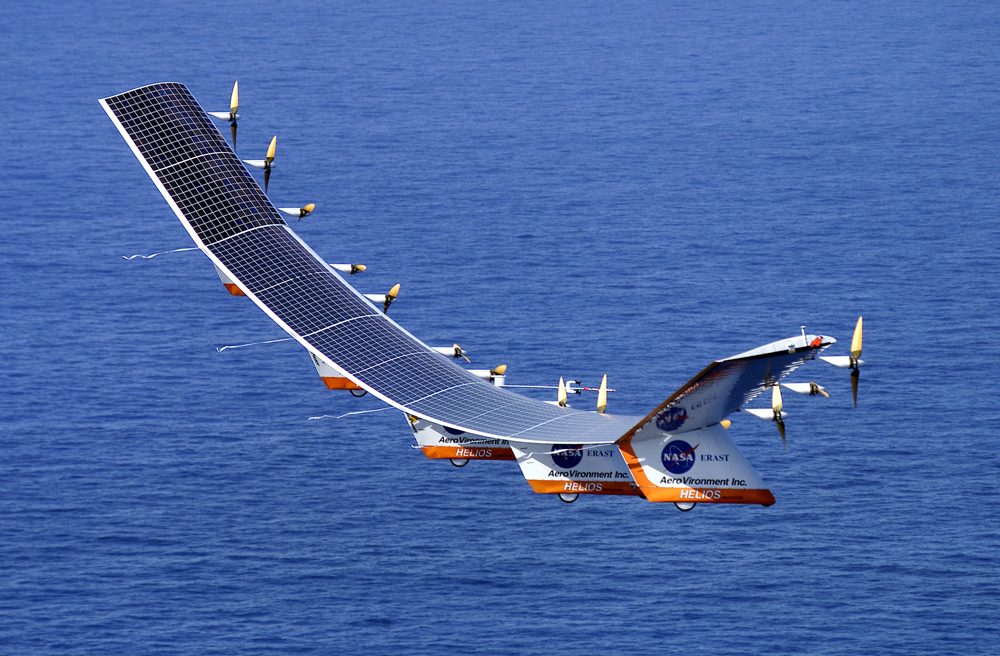
Another example of energy conversion occurs in a solar cell. Sunlight impinging on a solar cell (see Figure 7.27) produces electricity, which in turn can be used to run an electric motor. Energy is converted from the primary source of solar energy into electrical energy and then into mechanical energy.
| Object/phenomenon | Energy in joules |
|---|---|
| Big Bang | |
| Energy released in a supernova | |
| Fusion of all the hydrogen in Earth’s oceans | |
| Annual world energy use | |
| Large fusion bomb (9 megaton) | |
| 1 kg hydrogen (fusion to helium) | |
| 1 kg uranium (nuclear fission) | |
| Hiroshima-size fission bomb (10 kiloton) | |
| 90,000-metric ton aircraft carrier at 30 knots | |
| 1 barrel crude oil | |
| 1 ton TNT | |
| 1 gallon of gasoline | |
| Daily home electricity use (developed countries) | |
| Daily adult food intake (recommended) | |
| 1000-kg car at 90 km/h | |
| 1 g fat (9.3 kcal) | |
| ATP hydrolysis reaction | |
| 1 g carbohydrate (4.1 kcal) | |
| 1 g protein (4.1 kcal) | |
| Tennis ball at 100 km/h | |
| Mosquito | |
| Single electron in a TV tube beam | |
| Energy to break one DNA strand |
Efficiency
Even though energy is conserved in an energy conversion process, the output of useful energy or work will be less than the energy input. The efficiency of an energy conversion process is defined as
Table 7.3 lists some efficiencies of mechanical devices and human activities. In a coal-fired power plant, for example, about 40% of the chemical energy in the coal becomes useful electrical energy. The other 60% transforms into other (perhaps less useful) energy forms, such as thermal energy, which is then released to the environment through combustion gases and cooling towers.
| Activity/device | Efficiency (%)1 |
|---|---|
| Cycling and climbing | 20 |
| Swimming, surface | 2 |
| Swimming, submerged | 4 |
| Shoveling | 3 |
| Weightlifting | 9 |
| Steam engine | 17 |
| Gasoline engine | 30 |
| Diesel engine | 35 |
| Nuclear power plant | 35 |
| Coal power plant | 42 |
| Electric motor | 98 |
| Compact fluorescent light | 20 |
| Gas heater (residential) | 90 |
| Solar cell | 10 |
Test Prep for AP Courses
You do 30 J of work to load a toy dart gun. However, the dart is 10 cm long and feels a frictional force of 10 N while going through the dart gun’s barrel. What is the kinetic energy of the fired dart?
- 30 J
- 29 J
- 28 J
- 27 J
(c)
When an object is lifted by a crane, it begins and ends its motion at rest. The same is true of an object pushed across a rough surface. Explain why this happens. What are the differences between these systems?
A child has two red wagons, with the rear one tied to the front by a stretchy rope (a spring). If the child pulls on the front wagon, the ____ increases.
- kinetic energy of the wagons
- potential energy stored in the spring
- both A and B
- not enough information
(c)
A child has two red wagons, with the rear one tied to the front by a stretchy rope (a spring). If the child pulls on the front wagon, the energy stored in the system increases. How do the relative amounts of potential and kinetic energy in this system change over time?
Which of the following are closed systems?
- Earth
- a car
- a frictionless pendulum
- a mass on a spring in a vacuum
(c), (d)
Describe a real-world example of a closed system.
A 5.0-kg rock falls off of a 10 m cliff. If air resistance exerts an average force of 10 N, what is the kinetic energy when the rock hits the ground?
- 400 J
- 12.6 m/s
- 100 J
- 500 J
(a)
Hydroelectricity is generated by storing water behind a dam, and then letting some of it run through generators in the dam to turn them. If the system is the water, what is the environment that is doing work on it? If a dam has water 100 m deep behind it, how much energy was generated if 10,000 kg of water exited the dam at 2.0 m/s?
Before railroads were invented, goods often traveled along canals, with mules pulling barges from the bank. If a mule is exerting a 1200 N force for 10 km, and the rope connecting the mule to the barge is at a 20 degree angle from the direction of travel, how much work did the mule do on the barge?
- 12 MJ
- 11 MJ
- 4.1 MJ
- 6 MJ
(b)
Describe an instance today in which you did work, by the scientific definition. Then calculate how much work you did in that instance, showing your work.
Section Summary
- The law of conservation of energy states that the total energy is constant in any process. Energy may change in form or be transferred from one system to another, but the total remains the same.
- When all forms of energy are considered, conservation of energy is written in equation form as , where is all other forms of energy besides mechanical energy.
- Commonly encountered forms of energy include electric energy, chemical energy, radiant energy, nuclear energy, and thermal energy.
- Energy is often utilized to do work, but it is not possible to convert all the energy of a system to work.
- The efficiency of a machine or human is defined to be , where is useful work output and is the energy consumed.
Conceptual Questions
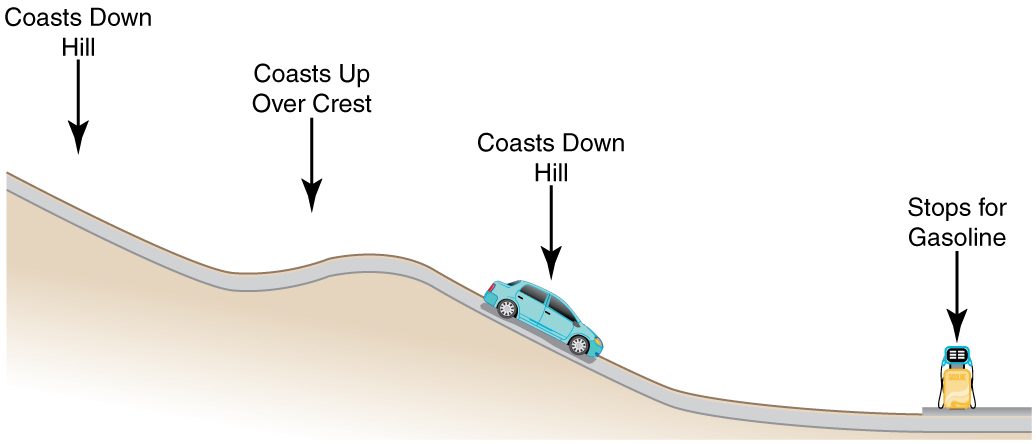
Consider the following scenario. A car for which friction is not negligible accelerates from rest down a hill, running out of gasoline after a short distance. The driver lets the car coast farther down the hill, then up and over a small crest. He then coasts down that hill into a gas station, where he brakes to a stop and fills the tank with gasoline. Identify the forms of energy the car has, and how they are changed and transferred in this series of events. (See Figure 7.28.)
Describe the energy transfers and transformations for a javelin, starting from the point at which an athlete picks up the javelin and ending when the javelin is stuck into the ground after being thrown.
Do devices with efficiencies of less than one violate the law of conservation of energy? Explain.
List four different forms or types of energy. Give one example of a conversion from each of these forms to another form.
List the energy conversions that occur when riding a bicycle.
Problems & Exercises
Using values from Table 7.2, how many DNA molecules could be broken by the energy carried by a single electron in the beam of an old-fashioned TV tube? (These electrons were not dangerous in themselves, but they did create dangerous x rays. Later model tube TVs had shielding that absorbed x rays before they escaped and exposed viewers.)
Using energy considerations and assuming negligible air resistance, show that a rock thrown from a bridge 20.0 m above water with an initial speed of 15.0 m/s strikes the water with a speed of 24.8 m/s independent of the direction thrown.
Equating and , we obtain
If the energy in fusion bombs were used to supply the energy needs of the world, how many of the 9-megaton variety would be needed for a year’s supply of energy (using data from Table 7.2)? This is not as far-fetched as it may sound—there are thousands of nuclear bombs, and their energy can be trapped in underground explosions and converted to electricity, as natural geothermal energy is.
(a) Use of hydrogen fusion to supply energy is a dream that may be realized in the next century. Fusion would be a relatively clean and almost limitless supply of energy, as can be seen from Table 7.2. To illustrate this, calculate how many years the present energy needs of the world could be supplied by one millionth of the oceans’ hydrogen fusion energy. (b) How does this time compare with historically significant events, such as the duration of stable economic systems?
(a)
(b) This is much, much longer than human time scales.
Adapted from College Physics 2e by OpenStax (openstax.org), licensed under CC BY-NC-SA 4.0. Changes were made. License: CC-BY-NC-SA-4.0.