
7.1 Work: The Scientific Definition
Learning Objectives
By the end of this section, you will be able to:
- Explain how an object must be displaced for a force on it to do work.
- Explain how relative directions of force and displacement determine whether the work done is positive, negative, or zero.
What It Means to Do Work
The scientific definition of work differs in some ways from its everyday meaning. Certain things we think of as hard work, such as writing an exam or carrying a heavy load on level ground, are not work as defined by a scientist. The scientific definition of work reveals its relationship to energy—whenever work is done, energy is transferred.
For work, in the scientific sense, to be done, a force must be exerted and there must be displacement in the direction of the force.
Formally, the work done on a system by a constant force is defined to be the product of the component of the force in the direction of motion times the distance through which the force acts. For one-way motion in one dimension, this is expressed in equation form as
where is work, is the displacement of the system, and is the angle between the force vector and the displacement vector , as in Figure 7.2. We can also write this as
To find the work done on a system that undergoes motion that is not one-way or that is in two or three dimensions, we divide the motion into one-way one-dimensional segments and add up the work done over each segment.
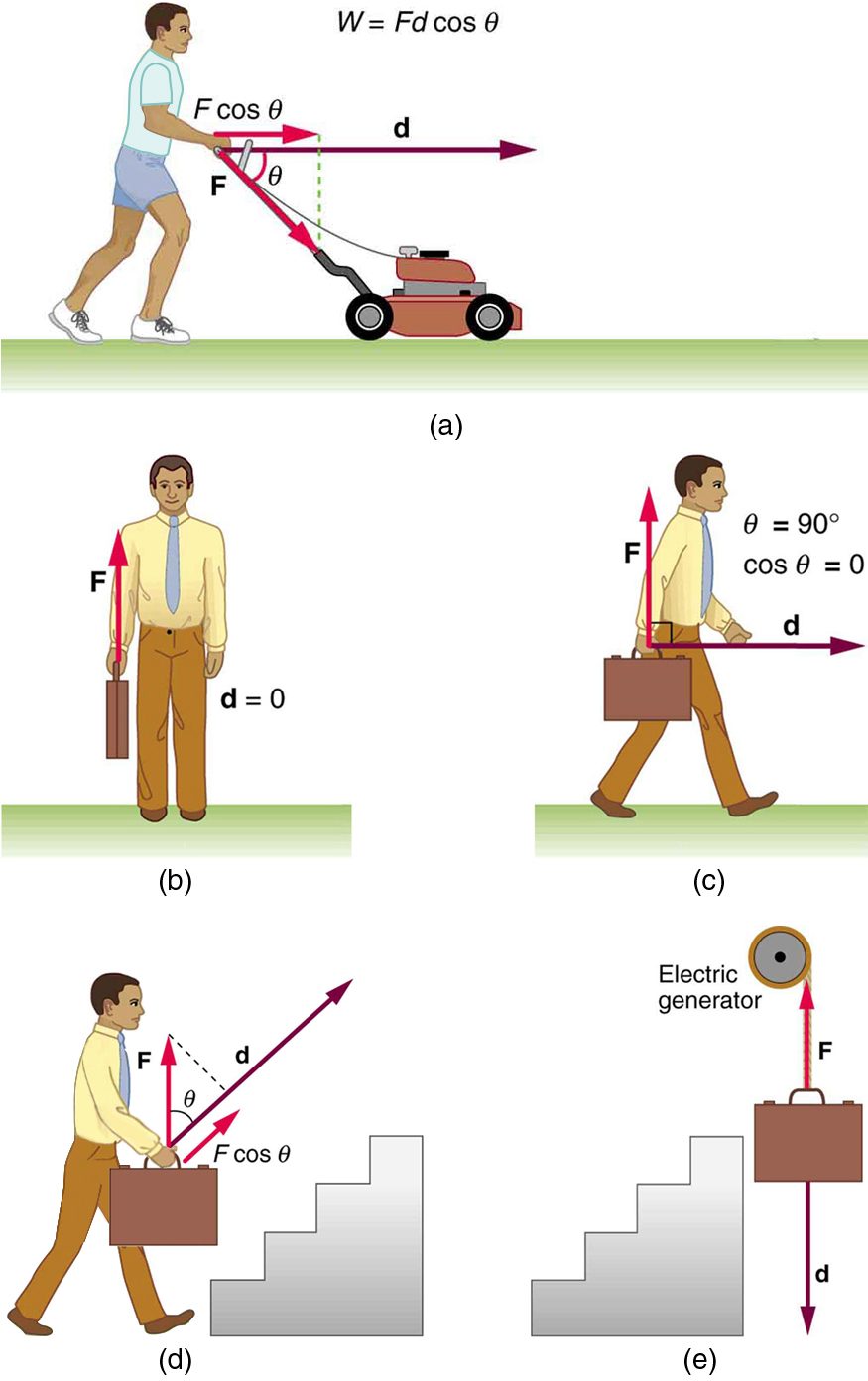
To examine what the definition of work means, let us consider the other situations shown in Figure 7.2. The person holding the briefcase in Figure 7.2(b) does no work, for example. Here , so . Why is it you get tired just holding a load? The answer is that your muscles are doing work against one another, but they are doing no work on the system of interest (the “briefcase-Earth system”—see Gravitational Potential Energy for more details). There must be displacement for work to be done, and there must be a component of the force in the direction of the motion. For example, the person carrying the briefcase on level ground in Figure 7.2(c) does no work on it, because the force is perpendicular to the motion. That is, , and so .
In contrast, when a force exerted on the system has a component in the direction of motion, such as in Figure 7.2(d), work is done—energy is transferred to the briefcase. Finally, in Figure 7.2(e), energy is transferred from the briefcase to a generator. There are two good ways to interpret this energy transfer. One interpretation is that the briefcase’s weight does work on the generator, giving it energy. The other interpretation is that the generator does negative work on the briefcase, thus removing energy from it. The drawing shows the latter, with the force from the generator upward on the briefcase, and the displacement downward. This makes , and ; therefore, is negative.
Calculating Work
Work and energy have the same units. From the definition of work, we see that those units are force times distance. Thus, in SI units, work and energy are measured in newton-meters. A newton-meter is given the special name joule (J), and . One joule is not a large amount of energy; it would lift a small 100-gram apple a distance of about 1 meter.
Test Prep for AP Courses
Given Table 7.1 about how much force does the rocket engine exert on the 3.0-kg payload?
| Distance traveled with rocket engine firing (m) | Payload final velocity (m/s) |
|---|---|
| 500 | 310 |
| 490 | 300 |
| 1020 | 450 |
| 505 | 312 |
- 150 N
- 300 N
- 450 N
- 600 N
(b)
You have a cart track, a cart, several masses, and a position-sensing pulley. Design an experiment to examine how the force exerted on the cart does work as it moves through a distance.
Look at Figure 7.17(c). You compress a spring by x, and then release it. Next you compress the spring by 2x. How much more work did you do the second time than the first?
- Half as much
- The same
- Twice as much
- Four times as much
(d)
You have a cart track, two carts, several masses, a position-sensing pulley, and a piece of carpet (a rough surface) that will fit over the track. Design an experiment to examine how the force exerted on the cart does work as the cart moves through a distance.
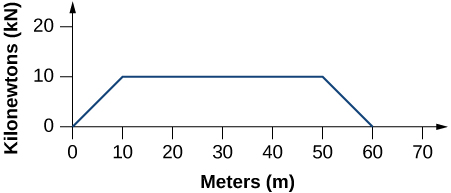
A crane is lifting construction materials from the ground to an elevation of 60 m. Over the first 10 m, the motor linearly increases the force it exerts from 0 to 10 kN. It exerts that constant force for the next 40 m, and then winds down to 0 N again over the last 10 m, as shown in the figure. What is the total work done on the construction materials?
- 500 kJ
- 600 kJ
- 300 kJ
- 18 MJ
(a)
Section Summary
- Work is the transfer of energy by a force acting on an object as it is displaced.
- The work that a force does on an object is the product of the magnitude of the force, times the magnitude of the displacement, times the cosine of the angle between them. In symbols,
- The SI unit for work and energy is the joule (J), where .
- The work done by a force is zero if the displacement is either zero or perpendicular to the force.
- The work done is positive if the force and displacement have the same direction, and negative if they have opposite direction.
Conceptual Questions
Give an example of something we think of as work in everyday circumstances that is not work in the scientific sense. Is energy transferred or changed in form in your example? If so, explain how this is accomplished without doing work.
Give an example of a situation in which there is a force and a displacement, but the force does no work. Explain why it does no work.
Describe a situation in which a force is exerted for a long time but does no work. Explain.
Problems & Exercises
How much work does a supermarket checkout attendant do on a can of soup he pushes 0.600 m horizontally with a force of 5.00 N? Express your answer in joules and kilocalories.
A 75.0-kg person climbs stairs, gaining 2.50 meters in height. Find the work done to accomplish this task. (Neglect friction in your calculations.)
(a) Calculate the work done on a 1500-kg elevator car by its cable to lift it 40.0 m at constant speed, assuming friction averages 100 N. (b) What is the work done on the elevator car by the gravitational force in this process? (c) What is the total work done on the elevator car?
(a)
(b)
(c) The net force is zero.
Suppose a car travels 108 km at a speed of 30.0 m/s, and uses 2.0 gal of gasoline. Only 30% of the gasoline goes into useful work by the force that keeps the car moving at constant speed despite friction. (See Table 7.2 for the energy content of gasoline.) (a) What is the magnitude of the force exerted to keep the car moving at constant speed? (b) If the required force is directly proportional to speed, how many gallons will be used to drive 108 km at a speed of 28.0 m/s?
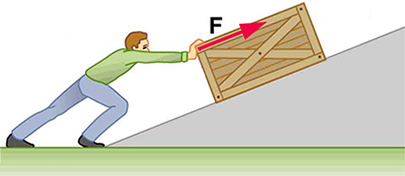
Calculate the work done by an 85.0-kg man who pushes a crate 4.00 m up along a ramp that makes an angle of with the horizontal. (See Figure 7.4.) He exerts a force of 500 N on the crate parallel to the ramp and moves at a constant speed. Be certain to include the work he does on the crate and on his body to get up the ramp.
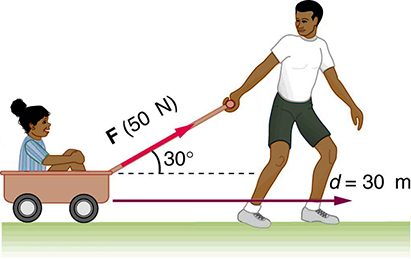
How much work is done by the boy pulling his sister 30.0 m in a wagon as shown in Figure 7.5? Assume no friction acts on the wagon.
A shopper pushes a grocery cart 20.0 m at constant speed on level ground, against a 35.0 N frictional force. He pushes in a direction below the horizontal. (a) What is the work done on the cart by friction? (b) What is the work done on the cart by the gravitational force? (c) What is the work done on the cart by the shopper? (d) Find the force the shopper exerts, using energy considerations. (e) What is the total work done on the cart?
(a)
(b) 0
(c) 700 J
(d) 38.6 N
(e) 0
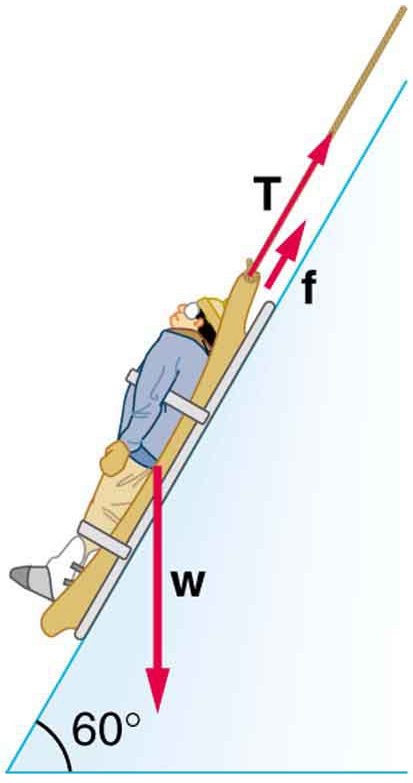
Suppose the ski patrol lowers a rescue sled and victim, having a total mass of 90.0 kg, down a slope at constant speed, as shown in Figure 7.6. The coefficient of friction between the sled and the snow is 0.100. (a) How much work is done by friction as the sled moves 30.0 m along the hill? (b) How much work is done by the rope on the sled in this distance? (c) What is the work done by the gravitational force on the sled? (d) What is the total work done?
Adapted from College Physics 2e by OpenStax (openstax.org), licensed under CC BY-NC-SA 4.0. Changes were made. License: CC-BY-NC-SA-4.0.