
7.2 Kinetic Energy and the Work-Energy Theorem
Learning Objectives
By the end of this section, you will be able to:
- Explain work as a transfer of energy and net work as the work done by the net force.
- Explain and apply the work-energy theorem.
Work Transfers Energy
What happens to the work done on a system? Energy is transferred into the system, but in what form? Does it remain in the system or move on? The answers depend on the situation. For example, if the lawn mower in Figure 7.2(a) is pushed just hard enough to keep it going at a constant speed, then energy put into the mower by the person is removed continuously by friction, and eventually leaves the system in the form of heat transfer. In contrast, work done on the briefcase by the person carrying it up stairs in Figure 7.2(d) is stored in the briefcase-Earth system and can be recovered at any time, as shown in Figure 7.2(e). In fact, the building of the pyramids in ancient Egypt is an example of storing energy in a system by doing work on the system. Some of the energy imparted to the stone blocks in lifting them during construction of the pyramids remains in the stone-Earth system and has the potential to do work.
In this section we begin the study of various types of work and forms of energy. We will find that some types of work leave the energy of a system constant, for example, whereas others change the system in some way, such as making it move. We will also develop definitions of important forms of energy, such as the energy of motion.
Net Work and the Work-Energy Theorem
We know from the study of Newton’s laws in Dynamics: Force and Newton's Laws of Motion that net force causes acceleration. We will see in this section that work done by the net force gives a system energy of motion, and in the process we will also find an expression for the energy of motion.
Let us start by considering the total, or net, work done on a system. Net work is defined to be the sum of work on an object. The net work can be written in terms of the net force on an object. . In equation form, this is where is the angle between the force vector and the displacement vector.
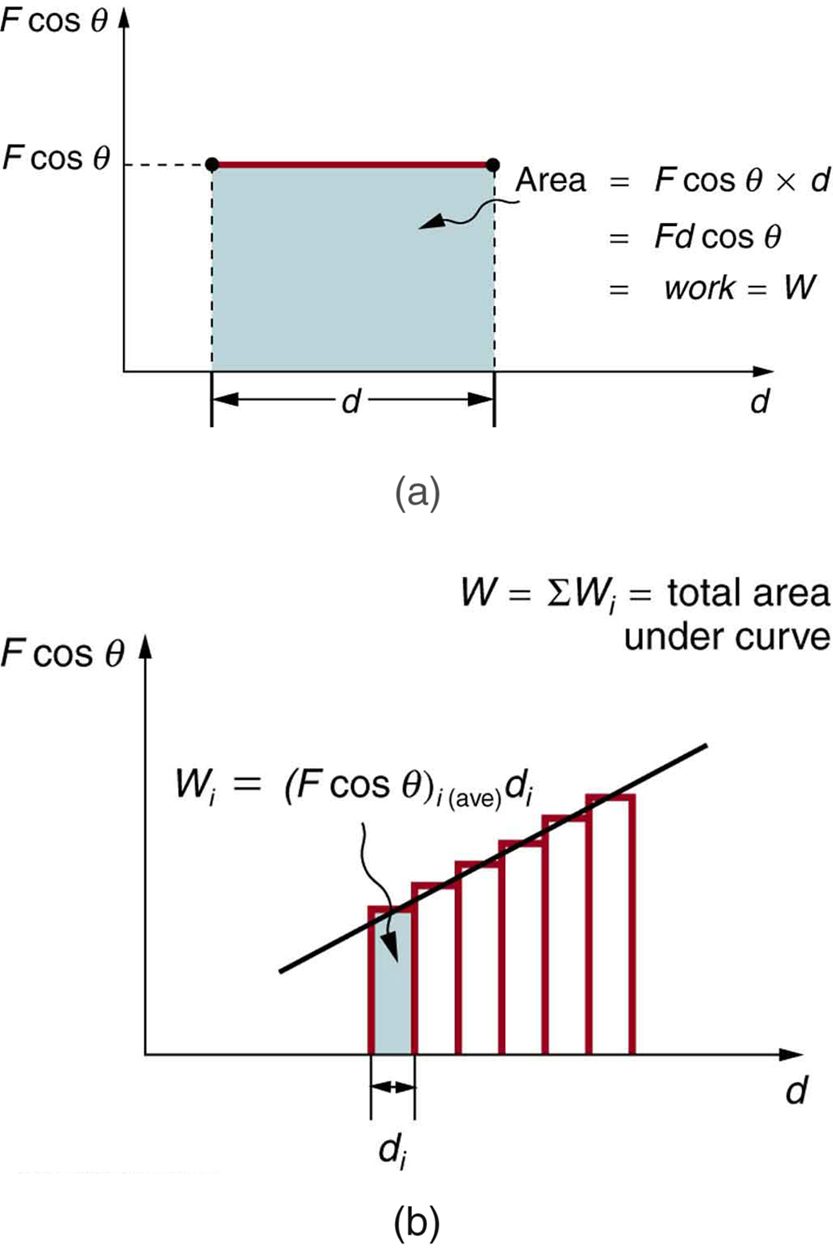
Figure 7.7(a) shows a graph of force versus displacement for the component of the force in the direction of the displacement—that is, an vs. graph. In this case, is constant. You can see that the area under the graph is , or the work done. Figure 7.7(b) shows a more general process where the force varies. The area under the curve is divided into strips, each having an average force . The work done is for each strip, and the total work done is the sum of the . Thus the total work done is the total area under the curve, a useful property to which we shall refer later.
Net work will be simpler to examine if we consider a one-dimensional situation where a force is used to accelerate an object in a direction parallel to its initial velocity. Such a situation occurs for the package on the roller belt conveyor system shown in Figure 7.8.
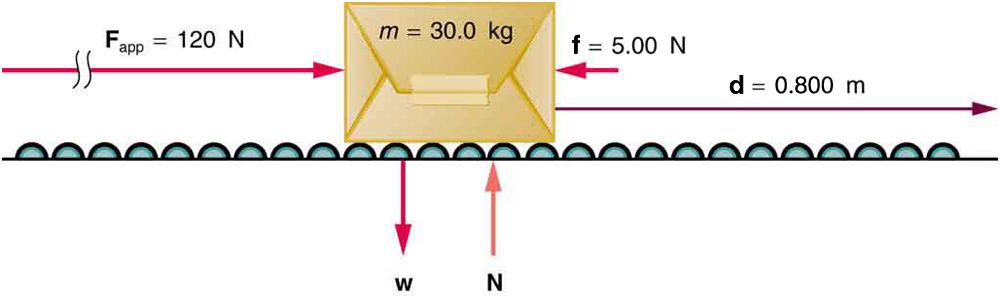
The force of gravity and the normal force acting on the package are perpendicular to the displacement and do no work. Moreover, they are also equal in magnitude and opposite in direction so they cancel in calculating the net force. The net force arises solely from the horizontal applied force and the horizontal friction force . Thus, as expected, the net force is parallel to the displacement, so that and , and the net work is given by
The effect of the net force is to accelerate the package from to . The kinetic energy of the package increases, indicating that the net work done on the system is positive. (See Example 1.) By using Newton’s second law, and doing some algebra, we can reach an interesting conclusion. Substituting from Newton’s second law gives
To get a relationship between net work and the speed given to a system by the net force acting on it, we take and use the equation studied in Motion Equations for Constant Acceleration in One Dimension for the change in speed over a distance if the acceleration has the constant value ; namely, (note that appears in the expression for the net work). Solving for acceleration gives . When is substituted into the preceding expression for , we obtain
The cancels, and we rearrange this to obtain
This expression is called the work-energy theorem, and it actually applies in general (even for forces that vary in direction and magnitude), although we have derived it for the special case of a constant force parallel to the displacement. The theorem implies that the net work on a system equals the change in the quantity . This quantity is our first example of a form of energy.
The quantity in the work-energy theorem is defined to be the translational kinetic energy (KE) of a mass moving at a speed . (Translational kinetic energy is distinct from rotational kinetic energy, which is considered later.) In equation form, the translational kinetic energy,
is the energy associated with translational motion. Kinetic energy is a form of energy associated with the motion of a particle, single body, or system of objects moving together.
We are aware that it takes energy to get an object, like a car or the package in Figure 7.8, up to speed, but it may be a bit surprising that kinetic energy is proportional to speed squared. This proportionality means, for example, that a car traveling at 100 km/h has four times the kinetic energy it has at 50 km/h, helping to explain why high-speed collisions are so devastating. We will now consider a series of examples to illustrate various aspects of work and energy.
Some of the examples in this section can be solved without considering energy, but at the expense of missing out on gaining insights about what work and energy are doing in this situation. On the whole, solutions involving energy are generally shorter and easier than those using kinematics and dynamics alone.
Test Prep for AP Courses
A toy car is going around a loop-the-loop. Gravity ____ the kinetic energy on the upward side of the loop, ____ the kinetic energy at the top, and ____ the kinetic energy on the downward side of the loop.
- increases, decreases, has no effect on
- decreases, has no effect on, increases
- increases, has no effect on, decreases
- decreases, increases, has no effect on
A roller coaster is set up with a track in the form of a perfect cosine. Describe and graph what happens to the kinetic energy of a cart as it goes through the first full period of the track.
The kinetic energy should change in the form of –cos, with an initial value of 0 or slightly above, and ending at the same level.
If wind is blowing horizontally toward a car with an angle of 30 degrees from the direction of travel, the kinetic energy will ____. If the wind is blowing at a car at 135 degrees from the direction of travel, the kinetic energy will ____.
- increase, increase
- increase, decrease
- decrease, increase
- decrease, decrease
In what direction relative to the direction of travel can a force act on a car (traveling on level ground), and not change the kinetic energy? Can you give examples of such forces?
Any force acting perpendicular will have no effect on kinetic energy. Obvious examples are gravity and the normal force, but others include wind directly from the side and rain or other precipitation falling straight down.
A 2000-kg airplane is coming in for a landing, with a velocity 5 degrees below the horizontal and a drag force of 40 kN acting directly rearward. Ignoring thrust and lift on the plane, kinetic energy will ____ due to the net force of ____.
- increase, 20 kN
- decrease, 40 kN
- increase, 45 kN
- decrease, 45 kN
You are participating in the Iditarod, and your sled dogs are pulling you across a frozen lake with a force of 1200 N while a 300 N wind is blowing at you at 135 degrees from your direction of travel. What is the net force, and will your kinetic energy increase or decrease?
Note that the wind is pushing from behind and one side, so your KE will increase. The net force has components of 1400 N in the direction of travel and 212 N perpendicular to the direction of travel. So the net force is 1420 N at 8.5 degrees from the direction of travel.
A model drag car is being accelerated along its track from rest by a motor with a force of 75 N, but there is a drag force of 30 N due to the track. What is the kinetic energy after 2 m of travel?
- 90 J
- 150 J
- 210 J
- 60 J
You are launching a 0.315-kg potato out of a potato cannon. The cannon is 1.5 m long and is aimed 30.0 degrees above the horizontal. It exerts an average 45 N force on the potato. Ignoring friction, what is the kinetic energy of the potato as it leaves the muzzle of the potato cannon?
Gravity has a component perpendicular to the cannon (and to displacement, so it is irrelevant) and has a component parallel to the cannon. The latter is equal to 9.8 N. Thus the net force in the direction of the displacement is 45 N − 9.8 N, and the kinetic energy is 53 J.
When the force acting on an object is parallel to the direction of the motion of the center of mass, the mechanical energy ____. When the force acting on an object is antiparallel to the direction of the center of mass, the mechanical energy ____.
- increases, increases
- increases, decreases
- decreases, increases
- decreases, decreases
Describe a system in which the main forces acting are parallel or antiparallel to the center of mass, and justify your answer.
The potato cannon (and many other projectile launchers) above is an option, with a force launching the projectile, friction, potentially gravity depending on the direction it is pointed, etc. A drag (or other) car accelerating is another possibility.
A child is pulling two red wagons, with the second one tied to the first by a (non-stretching) rope. Each wagon has a mass of 10 kg. If the child exerts a force of 30 N for 5.0 m, how much has the kinetic energy of the two-wagon system changed?
- 300 J
- 150 J
- 75 J
- 60 J
A child has two red wagons, with the rear one tied to the front by a (non-stretching) rope. If the child pushes on the rear wagon, what happens to the kinetic energy of each of the wagons, and the two-wagon system?
The kinetic energy of the rear wagon increases. The front wagon does not, until the rear wagon collides with it. The total system may be treated by its center of mass, halfway between the wagons, and its energy increases by the same amount as the sum of the two individual wagons.
Draw a graph of the force parallel to displacement exerted on a stunt motorcycle going through a loop-the-loop versus the distance traveled around the loop. Explain the net change in energy.
Section Summary
- The net work is the work done by the net force acting on an object.
- Work done on an object transfers energy to the object.
- The translational kinetic energy of an object of mass moving at speed is .
- The work-energy theorem states that the net work on a system changes its kinetic energy, .
Conceptual Questions
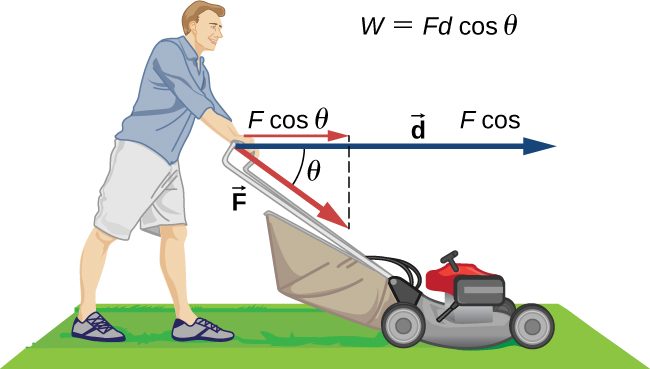
The person in Figure 7.9 does work on the lawn mower. Under what conditions would the mower gain energy? Under what conditions would it lose energy?
Work done on a system puts energy into it. Work done by a system removes energy from it. Give an example for each statement.
When solving for speed in Example 3, we kept only the positive root. Why?
Problems & Exercises
Compare the kinetic energy of a 20,000-kg truck moving at 110 km/h with that of an 80.0-kg astronaut in orbit moving at 27,500 km/h.
(a) How fast must a 3000-kg elephant move to have the same kinetic energy as a 65.0-kg sprinter running at 10.0 m/s? (b) Discuss how the larger energies needed for the movement of larger animals would relate to metabolic rates.
Confirm the value given for the kinetic energy of an aircraft carrier in Table 7.2. You will need to look up the definition of a nautical mile (1 knot = 1 nautical mile/h).
(a) Calculate the force needed to bring a 950-kg car to rest from a speed of 90.0 km/h in a distance of 120 m (a fairly typical distance for a non-panic stop). (b) Suppose instead the car hits a concrete abutment at full speed and is brought to a stop in 2.00 m. Calculate the force exerted on the car and compare it with the force found in part (a).
A car’s bumper is designed to withstand a 4.0-km/h (1.12-m/s) collision with an immovable object without damage to the body of the car. The bumper cushions the shock by absorbing the force over a distance. Calculate the magnitude of the average force on a bumper that collapses 0.200 m while bringing a 900-kg car to rest from an initial speed of 1.12 m/s.
Boxing gloves are padded to lessen the force of a blow. (a) Calculate the force exerted by a boxing glove on an opponent’s face, if the glove and face compress 7.50 cm during a blow in which the 7.00-kg arm and glove are brought to rest from an initial speed of 10.0 m/s. (b) Calculate the force exerted by an identical blow in the days when no gloves were used and the knuckles and face would compress only 2.00 cm. (c) Discuss the magnitude of the force with glove on. Does it seem high enough to cause damage even though it is lower than the force with no glove?
Using energy considerations, calculate the average force a 60.0-kg sprinter exerts backward on the track to accelerate from 2.00 to 8.00 m/s in a distance of 25.0 m, if he encounters a headwind that exerts an average force of 30.0 N against him.
102 N
Adapted from College Physics 2e by OpenStax (openstax.org), licensed under CC BY-NC-SA 4.0. Changes were made. License: CC-BY-NC-SA-4.0.