
7.5 Nonconservative Forces
Learning Objectives
By the end of this section, you will be able to:
- Define nonconservative forces and explain how they affect mechanical energy.
- Show how the principle of conservation of energy can be applied by treating the conservative forces in terms of their potential energies and any nonconservative forces in terms of the work they do.
Nonconservative Forces and Friction
Forces are either conservative or nonconservative. Conservative forces were discussed in Conservative Forces and Potential Energy. A nonconservative force is one for which work depends on the path taken. Friction is a good example of a nonconservative force. As illustrated in Figure 7.20, work done against friction depends on the length of the path between the starting and ending points. Because of this dependence on path, there is no potential energy associated with nonconservative forces. An important characteristic is that the work done by a nonconservative force adds or removes mechanical energy from a system. Friction, for example, creates thermal energy that dissipates, removing energy from the system. Furthermore, even if the thermal energy is retained or captured, it cannot be fully converted back to work, so it is lost or not recoverable in that sense as well.

How Nonconservative Forces Affect Mechanical Energy
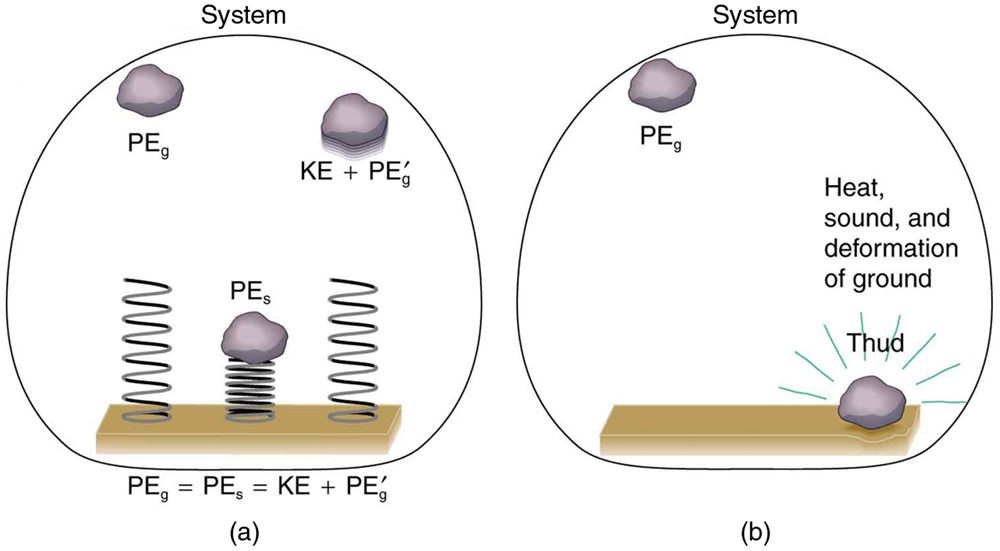
Mechanical energy may not be conserved when nonconservative forces act. For example, when a car is brought to a stop by friction on level ground, it loses kinetic energy, which is dissipated as thermal energy, reducing its mechanical energy. Figure 7.21 compares the effects of conservative and nonconservative forces. We often choose to understand simpler systems such as that described in Figure 7.21(a) first before studying more complicated systems as in Figure 7.21(b).
How the Work-Energy Theorem Applies
Now let us consider what form the work-energy theorem takes when both conservative and nonconservative forces act. We will see that the work done by nonconservative forces equals the change in the mechanical energy of a system. As noted in Kinetic Energy and the Work-Energy Theorem, the work-energy theorem states that the net work on a system equals the change in its kinetic energy, or . The net work is the sum of the work by nonconservative forces plus the work by conservative forces. That is,
so that
where is the total work done by all nonconservative forces and is the total work done by all conservative forces.
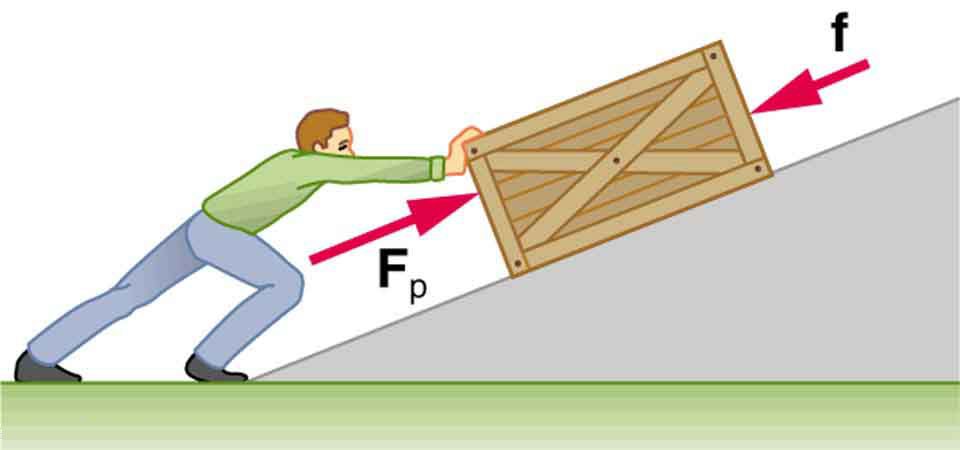
Consider Figure 7.22, in which a person pushes a crate up a ramp and is opposed by friction. As in the previous section, we note that work done by a conservative force comes from a loss of gravitational potential energy, so that . Substituting this equation into the previous one and solving for gives
This equation means that the total mechanical energy changes by exactly the amount of work done by nonconservative forces. In Figure 7.22, this is the work done by the person minus the work done by friction. So even if energy is not conserved for the system of interest (such as the crate), we know that an equal amount of work was done to cause the change in total mechanical energy.
We rearrange to obtain
This means that the amount of work done by nonconservative forces adds to the mechanical energy of a system. If is positive, then mechanical energy is increased, such as when the person pushes the crate up the ramp in Figure 7.22. If is negative, then mechanical energy is decreased, such as when the rock hits the ground in Figure 7.21(b). If is zero, then mechanical energy is conserved, and nonconservative forces are balanced. For example, when you push a lawn mower at constant speed on level ground, your work done is removed by the work of friction, and the mower has a constant energy.
Applying Energy Conservation with Nonconservative Forces
When no change in potential energy occurs, applying amounts to applying the work-energy theorem by setting the change in kinetic energy to be equal to the net work done on the system, which in the most general case includes both conservative and nonconservative forces. But when seeking instead to find a change in total mechanical energy in situations that involve changes in both potential and kinetic energy, the previous equation says that you can start by finding the change in mechanical energy that would have resulted from just the conservative forces, including the potential energy changes, and add to it the work done, with the proper sign, by any nonconservative forces involved.
Test Prep for AP Courses
You are in a room in a basement with a smooth concrete floor (friction force equals 40 N) and a nice rug (friction force equals 55 N) that is 3 m by 4 m. However, you have to push a very heavy box from one corner of the rug to the opposite corner of the rug. Will you do more work against friction going around the floor or across the rug, and how much extra?
- Across the rug is 275 J extra
- Around the floor is 5 J extra
- Across the rug is 5 J extra
- Around the floor is 280 J extra
(b)
In the Appalachians, along the interstate, there are ramps of loose gravel for semis that have had their brakes fail to drive into to stop. Design an experiment to measure how effective this would be.
Section Summary
- A nonconservative force is one for which work depends on the path.
- Friction is an example of a nonconservative force that changes mechanical energy into thermal energy.
- Work done by a nonconservative force changes the mechanical energy of a system. In equation form, or, equivalently, .
- When both conservative and nonconservative forces act, energy conservation can be applied and used to calculate motion in terms of the known potential energies of the conservative forces and the work done by nonconservative forces, instead of finding the net work from the net force, or having to directly apply Newton’s laws.
Problems & Exercises
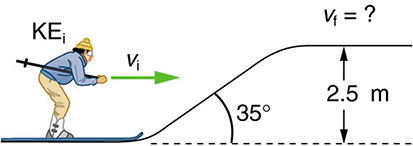
A 60.0-kg skier with an initial speed of 12.0 m/s coasts up a 2.50-m-high rise as shown in Figure 7.26. Find her final speed at the top, given that the coefficient of friction between her skis and the snow is 0.0800. (Hint: Find the distance traveled up the incline assuming a straight-line path as shown in the figure.)
9.46 m/s
(a) How high a hill can a car coast up (engine disengaged) if work done by friction is negligible and its initial speed is 110 km/h? (b) If, in actuality, a 750-kg car with an initial speed of 110 km/h is observed to coast up a hill to a height 22.0 m above its starting point, how much thermal energy was generated by friction? (c) What is the average force of friction if the hill has a slope above the horizontal?
Adapted from College Physics 2e by OpenStax (openstax.org), licensed under CC BY-NC-SA 4.0. Changes were made. License: CC-BY-NC-SA-4.0.