
3.3 Vector Addition and Subtraction: Analytical Methods
Learning Objectives
By the end of this section, you will be able to:
- Understand the rules of vector addition and subtraction using analytical methods.
- Apply analytical methods to determine vertical and horizontal component vectors.
- Apply analytical methods to determine the magnitude and direction of a resultant vector.
Analytical methods of vector addition and subtraction employ geometry and simple trigonometry rather than the ruler and protractor of graphical methods. Part of the graphical technique is retained, because vectors are still represented by arrows for easy visualization. However, analytical methods are more concise, accurate, and precise than graphical methods, which are limited by the accuracy with which a drawing can be made. Analytical methods are limited only by the accuracy and precision with which physical quantities are known.
Resolving a Vector into Perpendicular Components
Analytical techniques and right triangles go hand-in-hand in physics because (among other things) motions along perpendicular directions are independent. We very often need to separate a vector into perpendicular components. For example, given a vector like in Figure 3.30, we may wish to find which two perpendicular vectors, and , add to produce it.
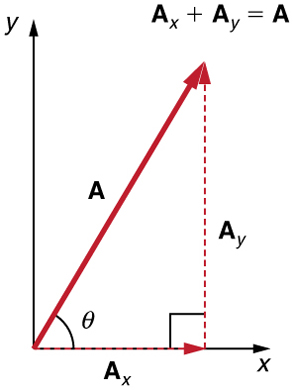
and are defined to be the components of along the x- and y-axes. The three vectors , , and form a right triangle:
Note that this relationship between vector components and the resultant vector holds only for vector quantities (which include both magnitude and direction). The relationship does not apply for the magnitudes alone. For example, if east, north, and north-east, then it is true that the vectors . However, it is not true that the sum of the magnitudes of the vectors is also equal. That is,
Thus,
If the vector is known, then its magnitude (its length) and its angle (its direction) are known. To find and , its x- and y-components, we use the following relationships for a right triangle.
and
![]A dotted vector A sub x whose magnitude is equal to A cosine theta is drawn from the origin along the x axis. From the head of the vector A sub x another vector A sub y whose magnitude is equal to A sine theta is drawn in the upward direction. Their resultant vector A is drawn from the tail of the vector A sub x to the head of the vector A-y at an angle theta from the x axis. Therefore vector A is the sum of the vectors A sub x and A sub y.](photos/Figure_03_03_02a.jpg)
Suppose, for example, that is the vector representing the total displacement of the person walking in a city considered in Kinematics in Two Dimensions: An Introduction and Vector Addition and Subtraction: Graphical Methods.
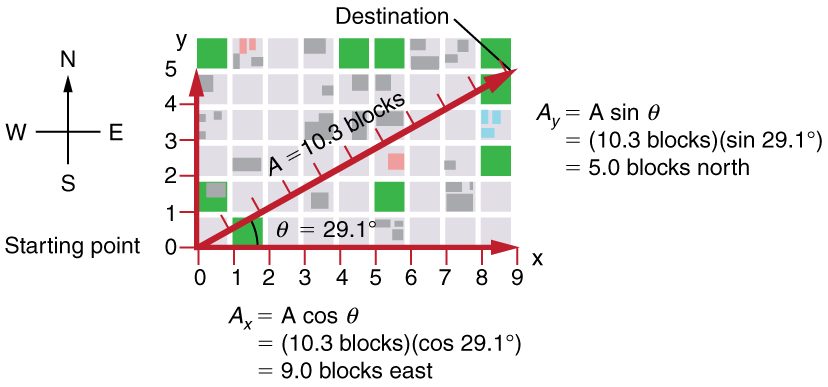
Then blocks and , so that
Calculating a Resultant Vector
If the perpendicular components and of a vector are known, then can also be found analytically. To find the magnitude and direction of a vector from its perpendicular components and , relative to the x-axis, we use the following relationships:
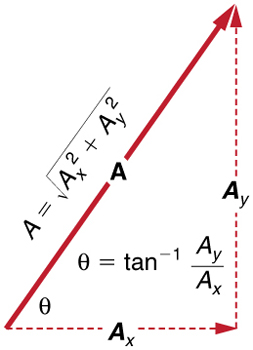
Note that the equation is just the Pythagorean theorem relating the legs of a right triangle to the length of the hypotenuse. For example, if and are 9 and 5 blocks, respectively, then blocks, again consistent with the example of the person walking in a city. Finally, the direction is , as before.
Adding Vectors Using Analytical Methods
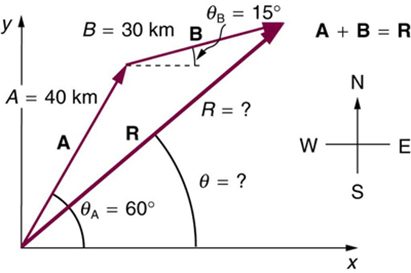
To see how to add vectors using perpendicular components, consider Figure 3.34, in which the vectors and are added to produce the resultant .
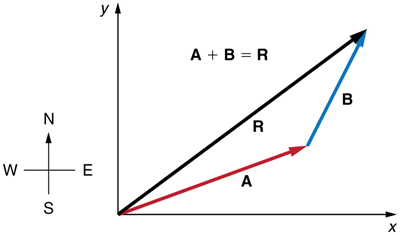
If and represent two legs of a walk (two displacements), then is the total displacement. The person taking the walk ends up at the tip of There are many ways to arrive at the same point. In particular, the person could have walked first in the x-direction and then in the y-direction. Those paths are the x- and y-components of the resultant, and . If we know and , we can find and using the equations and . When you use the analytical method of vector addition, you can determine the components or the magnitude and direction of a vector.
Step 1. Identify the x- and y-axes that will be used in the problem. Then, find the components of each vector to be added along the chosen perpendicular axes. Use the equations and to find the components. In Figure 3.35, these components are , , , and . The angles that vectors and make with the x-axis are and , respectively.
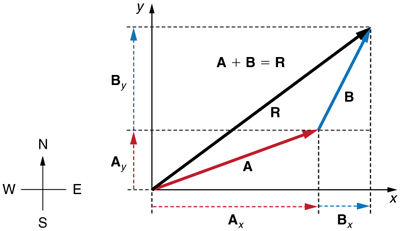
Step 2. Find the components of the resultant along each axis by adding the components of the individual vectors along that axis. That is, as shown in Figure 3.36,
and
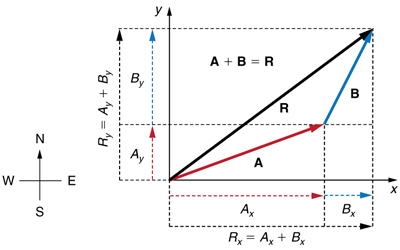
Components along the same axis, say the x-axis, are vectors along the same line and, thus, can be added to one another like ordinary numbers. The same is true for components along the y-axis. (For example, a 9-block eastward walk could be taken in two legs, the first 3 blocks east and the second 6 blocks east, for a total of 9, because they are along the same direction.) So resolving vectors into components along common axes makes it easier to add them. Now that the components of are known, its magnitude and direction can be found.
Step 3. To get the magnitude of the resultant, use the Pythagorean theorem:
Step 4. To get the direction of the resultant relative to the x-axis:
The following example illustrates this technique for adding vectors using perpendicular components.
Analyzing vectors using perpendicular components is very useful in many areas of physics, because perpendicular quantities are often independent of one another. The next module, Projectile Motion, is one of many in which using perpendicular components helps make the picture clear and simplifies the physics.
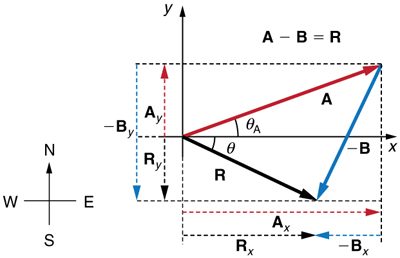
Summary
- The analytical method of vector addition and subtraction involves using the Pythagorean theorem and trigonometric identities to determine the magnitude and direction of a resultant vector.
- The steps to add vectors and using the analytical method are as follows:
Step 1: Determine the coordinate system for the vectors. Then, determine the horizontal and vertical components of each vector using the equations
and
Step 2: Add the horizontal and vertical components of each vector to determine the components and of the resultant vector, :
and
Step 3: Use the Pythagorean theorem to determine the magnitude, , of the resultant vector :
Step 4: Use a trigonometric identity to determine the direction, , of :
Conceptual Questions
Suppose you add two vectors and . What relative direction between them produces the resultant with the greatest magnitude? What is the maximum magnitude? What relative direction between them produces the resultant with the smallest magnitude? What is the minimum magnitude?
Give an example of a nonzero vector that has a component of zero.
Explain why a vector cannot have a component greater than its own magnitude.
If the vectors and are perpendicular, what is the component of along the direction of ? What is the component of along the direction of ?
Problems & Exercises
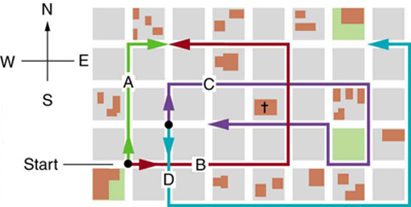
Find the following for path C in Figure 3.40: (a) the total distance traveled and (b) the magnitude and direction of the displacement from start to finish. In this part of the problem, explicitly show how you follow the steps of the analytical method of vector addition.
(a) 1.56 km
(b) 120 m east
Find the following for path D in Figure 3.40: (a) the total distance traveled and (b) the magnitude and direction of the displacement from start to finish. In this part of the problem, explicitly show how you follow the steps of the analytical method of vector addition.
Find the north and east components of the displacement from San Francisco to Sacramento shown in Figure 3.41.
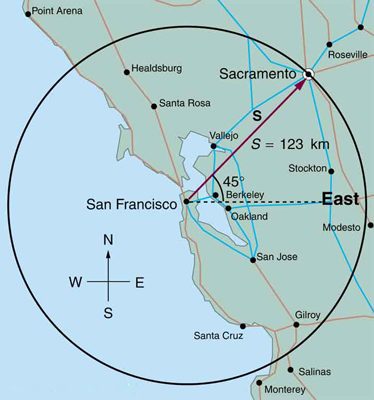
North-component 87.0 km, east-component 87.0 km
Exercise 3.16
Solve the following problem using analytical techniques: Suppose you walk 18.0 m straight west and then 25.0 m straight north. How far are you from your starting point, and what is the compass direction of a line connecting your starting point to your final position? (If you represent the two legs of the walk as vector displacements and , as in Figure 3.42, then this problem asks you to find their sum .)
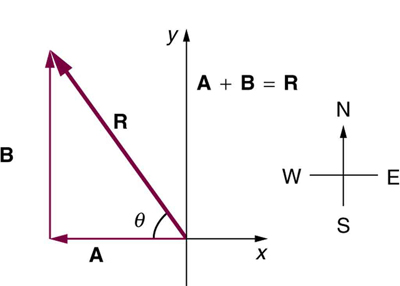
Note that you can also solve this graphically. Discuss why the analytical technique for solving this problem is potentially more accurate than the graphical technique.
Repeat Exercise 3.16 using analytical techniques, but reverse the order of the two legs of the walk and show that you get the same final result. (This problem shows that adding them in reverse order gives the same result—that is, .) Discuss how taking another path to reach the same point might help to overcome an obstacle blocking your other path.
30.8 m, 35.8 west of north
You drive in a straight line in a direction east of north. (a) Find the distances you would have to drive straight east and then straight north to arrive at the same point. (This determination is equivalent to find the components of the displacement along the east and north directions.) (b) Show that you still arrive at the same point if the east and north legs are reversed in order.
Do Exercise 3.16 again using analytical techniques and change the second leg of the walk to straight south. (This is equivalent to subtracting from —that is, finding ) (b) Repeat again, but now you first walk north and then east. (This is equivalent to subtract from —that is, to find . Is that consistent with your result?)
(a) , south of west
(b) , north of east
A new landowner has a triangular piece of flat land she wishes to fence. Starting at the west corner, she measures the first side to be 80.0 m long and the next to be 105 m. These sides are represented as displacement vectors from in Figure 3.43. She then correctly calculates the length and orientation of the third side . What is her result?
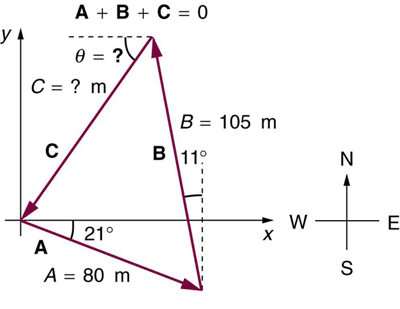
You fly in a straight line in still air in the direction south of west. (a) Find the distances you would have to fly straight south and then straight west to arrive at the same point. (This determination is equivalent to finding the components of the displacement along the south and west directions.) (b) Find the distances you would have to fly first in a direction south of west and then in a direction west of north. These are the components of the displacement along a different set of axes—one rotated .
18.4 km south, then 26.2 km west(b) 31.5 km at south of west, then 5.56 km at west of north
A farmer wants to fence off a four-sided plot of flat land. They measure the first three sides, shown as and in Figure 3.44, and then correctly calculate the length and orientation of the fourth side . What is their result?
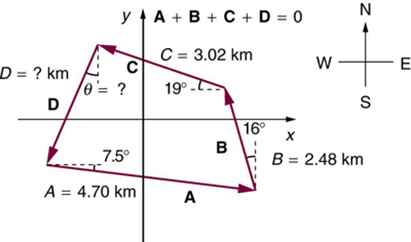
In an attempt to escape his island, Gilligan builds a raft and sets to sea. The wind shifts a great deal during the day, and he is blown along the following straight lines: north of west; then south of east; then south of west; then straight east; then east of north; then south of west; and finally north of east. What is his final position relative to the island?
, south of east
Suppose a pilot flies in a direction north of east and then flies in a direction north of east as shown in Figure 3.45. Find her total distance from the starting point and the direction of the straight-line path to the final position. Discuss qualitatively how this flight would be altered by a wind from the north and how the effect of the wind would depend on both wind speed and the speed of the plane relative to the air mass.
Adapted from College Physics 2e by OpenStax (openstax.org), licensed under CC BY-NC-SA 4.0. Changes were made. License: CC-BY-NC-SA-4.0.