
3.1 Kinematics in Two Dimensions: An Introduction
Learning Objectives
By the end of this section, you will be able to:
- Observe that motion in two dimensions consists of horizontal and vertical components.
- Understand the independence of horizontal and vertical vectors in two-dimensional motion.
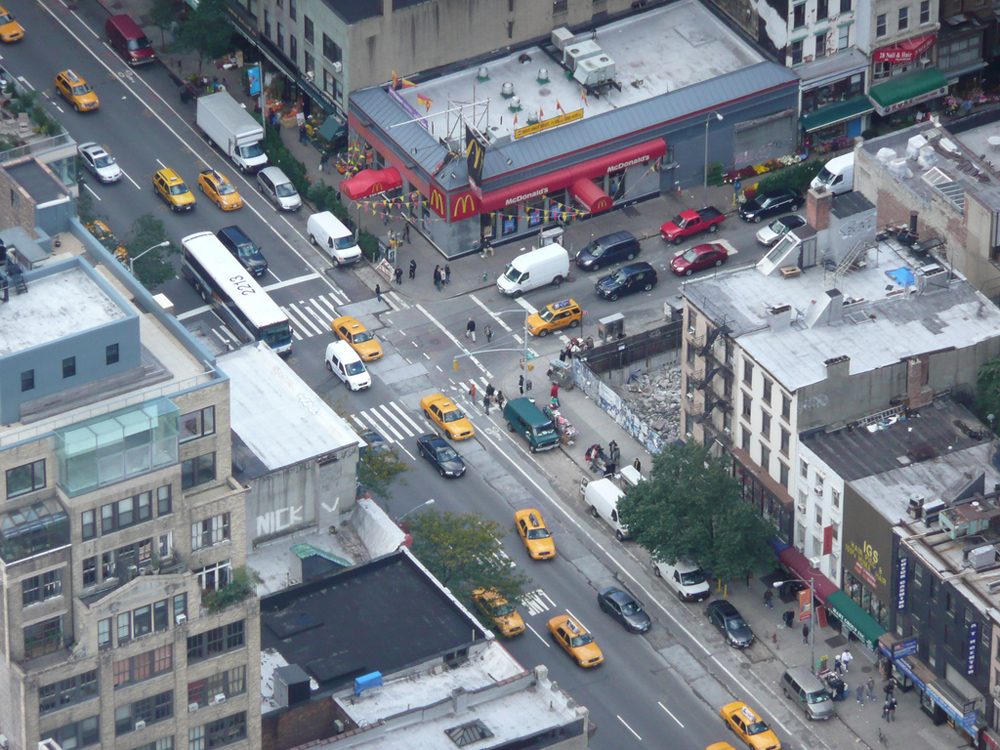
Two-Dimensional Motion: Walking in a City
Suppose you want to walk from one point to another in a city with uniform square blocks, as pictured in Figure 3.3.
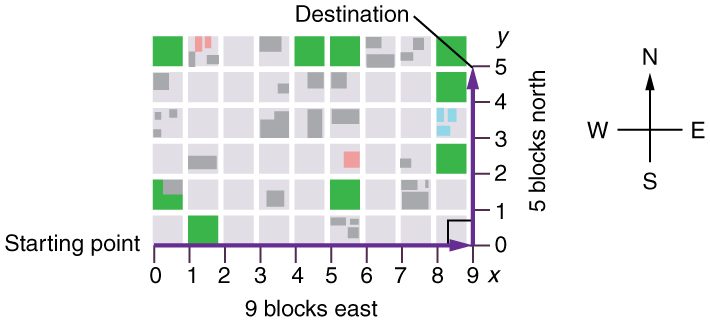
The straight-line path that a helicopter might fly is blocked to you as a pedestrian, and so you are forced to take a two-dimensional path, such as the one shown. You walk 14 blocks in all, 9 east followed by 5 north. What is the straight-line distance?
An old adage states that the shortest distance between two points is a straight line. The two legs of the trip and the straight-line path form a right triangle, and so the Pythagorean theorem, , can be used to find the straight-line distance.
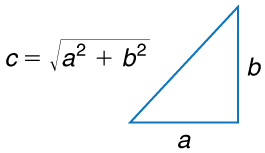
The hypotenuse of the triangle is the straight-line path, and so in this case its length in units of city blocks is , considerably shorter than the 14 blocks you walked. (Note that we are using three significant figures in the answer. Although it appears that “9” and “5” have only one significant digit, they are discrete numbers. In this case “9 blocks” is the same as “9.0 or 9.00 blocks.” We have decided to use three significant figures in the answer in order to show the result more precisely.)
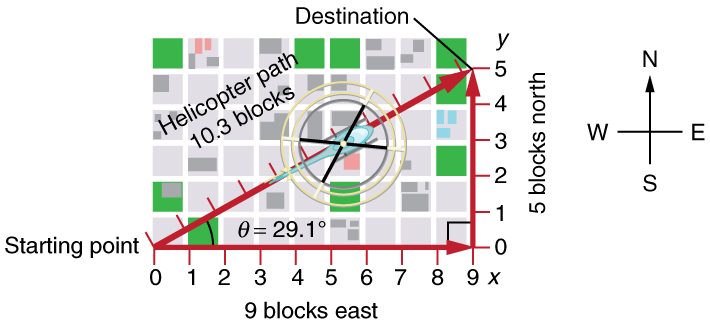
The fact that the straight-line distance (10.3 blocks) in Figure 3.5 is less than the total distance walked (14 blocks) is one example of a general characteristic of vectors. (Recall that vectors are quantities that have both magnitude and direction.)
As with one-dimensional kinematics, we use arrows to represent vectors. The length of the arrow is proportional to the vector’s magnitude. The arrow’s length is indicated by hash marks in Figure 3.3 and Figure 3.5. The arrow points in the same direction as the vector. For two-dimensional motion, the path of an object can be represented with three vectors: one vector shows the straight-line path between the initial and final points of the motion, one vector shows the horizontal component of the motion, and one vector shows the vertical component of the motion. The horizontal and vertical components of the motion add together to give the straight-line path. For example, observe the three vectors in Figure 3.5. The first represents a 9-block displacement east. The second represents a 5-block displacement north. These vectors are added to give the third vector, with a 10.3-block total displacement. The third vector is the straight-line path between the two points. Note that in this example, the vectors that we are adding are perpendicular to each other and thus form a right triangle. This means that we can use the Pythagorean theorem to calculate the magnitude of the total displacement. (Note that we cannot use the Pythagorean theorem to add vectors that are not perpendicular. We will develop techniques for adding vectors having any direction, not just those perpendicular to one another, in Vector Addition and Subtraction: Graphical Methods and Vector Addition and Subtraction: Analytical Methods.)
The Independence of Perpendicular Motions
The person taking the path shown in Figure 3.5 walks east and then north (two perpendicular directions). How far they walk east is only affected by their motion eastward. Similarly, how far they walk north is only affected by their motion northward.
This is true in a simple scenario like that of walking in one direction first, followed by another. It is also true of more complicated motion involving movement in two directions at once. For example, let’s compare the motions of two baseballs. One baseball is dropped from rest. At the same instant, another is thrown horizontally from the same height and follows a curved path. A stroboscope has captured the positions of the balls at fixed time intervals as they fall.
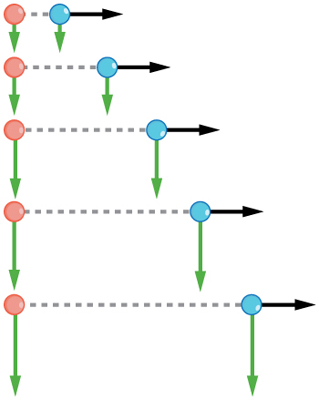
It is remarkable that for each flash of the strobe, the vertical positions of the two balls are the same. This similarity implies that the vertical motion is independent of whether or not the ball is moving horizontally. (Assuming no air resistance, the vertical motion of a falling object is influenced by gravity only, and not by any horizontal forces.) Careful examination of the ball thrown horizontally shows that it travels the same horizontal distance between flashes. This is due to the fact that there are no additional forces on the ball in the horizontal direction after it is thrown. This result means that the horizontal velocity is constant, and affected neither by vertical motion nor by gravity (which is vertical). Note that this case is true only for ideal conditions. In the real world, air resistance will affect the speed of the balls in both directions.
The two-dimensional curved path of the horizontally thrown ball is composed of two independent one-dimensional motions (horizontal and vertical). The key to analyzing such motion, called projectile motion, is to resolve (break) it into motions along perpendicular directions. Resolving two-dimensional motion into perpendicular components is possible because the components are independent. We shall see how to resolve vectors in Vector Addition and Subtraction: Graphical Methods and Vector Addition and Subtraction: Analytical Methods. We will find such techniques to be useful in many areas of physics.
Test Prep for AP Courses
A ball is thrown at an angle of 45 degrees above the horizontal. Which of the following best describes the acceleration of the ball from the instant after it leaves the thrower's hand until the time it hits the ground?
- Always in the same direction as the motion, initially positive and gradually dropping to zero by the time it hits the ground
- Initially positive in the upward direction, then zero at maximum height, then negative from there until it hits the ground
- Always in the opposite direction as the motion, initially positive and gradually dropping to zero by the time it hits the ground
- Always in the downward direction with the same constant value
(d)
In an experiment, a student launches a ball with an initial horizontal velocity at an elevation 2 meters above ground. The ball follows a parabolic trajectory until it hits the ground. Which of the following accurately describes the graph of the ball's vertical acceleration versus time (taking the downward direction to be negative)?
- A negative value that does not change with time
- A gradually increasing negative value (straight line)
- An increasing rate of negative values over time (parabolic curve)
- Zero at all times since the initial motion is horizontal
A student wishes to design an experiment to show that the acceleration of an object is independent of the object's velocity. To do this, ball A is launched horizontally with some initial speed at an elevation 1.5 meters above the ground, ball B is dropped from rest 1.5 meters above the ground, and ball C is launched vertically with some initial speed at an elevation 1.5 meters above the ground. What information would the student need to collect about each ball in order to test the hypothesis?
We would need to know the horizontal and vertical positions of each ball at several times. From that data, we could deduce the velocities over several time intervals and also the accelerations (both horizontal and vertical) for each ball over several time intervals.
Summary
- The shortest path between any two points is a straight line. In two dimensions, this path can be represented by a vector with horizontal and vertical components.
- The horizontal and vertical components of a vector are independent of one another. Motion in the horizontal direction does not affect motion in the vertical direction, and vice versa.
Adapted from College Physics 2e by OpenStax (openstax.org), licensed under CC BY-NC-SA 4.0. Changes were made. License: CC-BY-NC-SA-4.0.