
3.2 Vector Addition and Subtraction: Graphical Methods
Learning Objectives
By the end of this section, you will be able to:
- Understand the rules of vector addition, subtraction, and multiplication by scalars.
- Apply graphical methods of vector addition and subtraction to determine the displacement of moving objects.
Vectors in Two Dimensions
A vector is a quantity that has magnitude and direction. Displacement, velocity, acceleration, and force, for example, are all vectors. In one-dimensional, or straight-line, motion, the direction of a vector can be given simply by a plus or minus sign. In two dimensions (2-d), however, we specify the direction of a vector relative to some reference frame (i.e., coordinate system), using an arrow having length proportional to the vector’s magnitude and pointing in the direction of the vector.
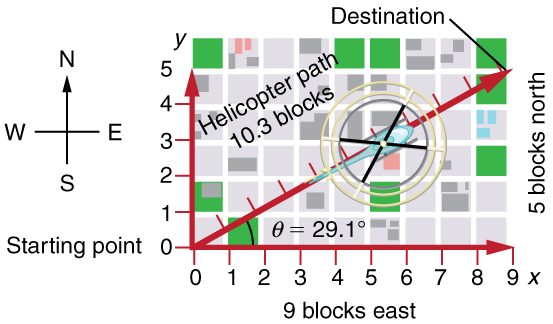
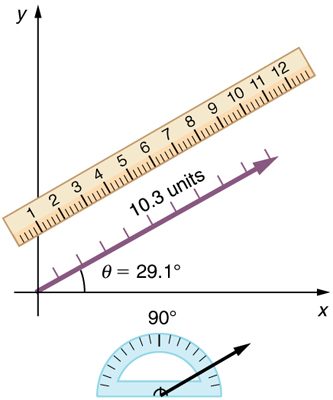
Figure 3.8 shows such a graphical representation of a vector, using as an example the total displacement for the person walking in a city considered in Kinematics in Two Dimensions: An Introduction. We shall use the notation that a boldface symbol, such as , stands for a vector. Its magnitude is represented by the symbol in italics, , and its direction by .
Vector Addition: Head-to-Tail Method
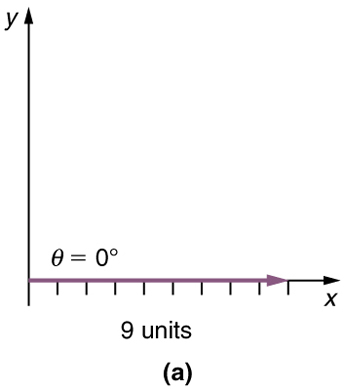
The head-to-tail method is a graphical way to add vectors, described in Figure 3.10 below and in the steps following. The tail of the vector is the starting point of the vector, and the head (or tip) of a vector is the final, pointed end of the arrow.
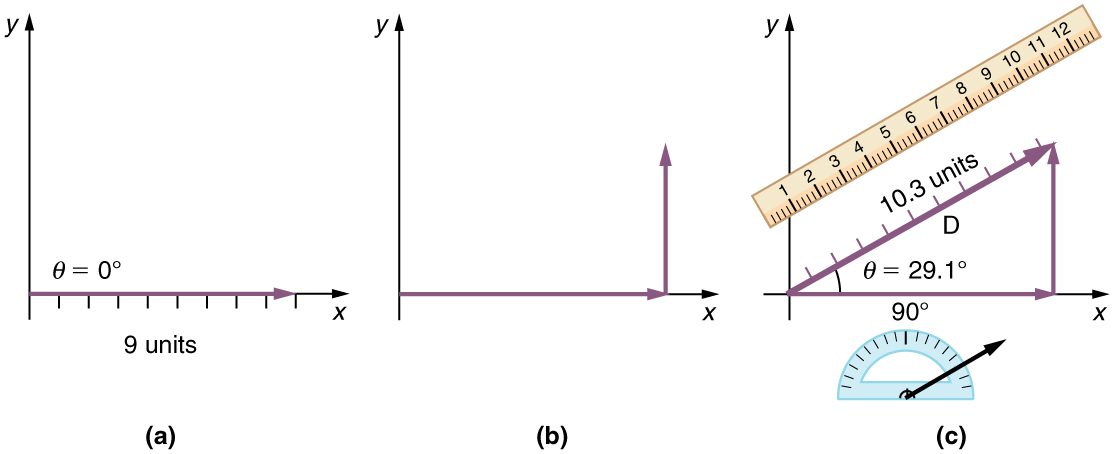
Step 1. Draw an arrow to represent the first vector (9 blocks to the east) using a ruler and protractor.
Step 2. Now draw an arrow to represent the second vector (5 blocks to the north). Place the tail of the second vector at the head of the first vector.
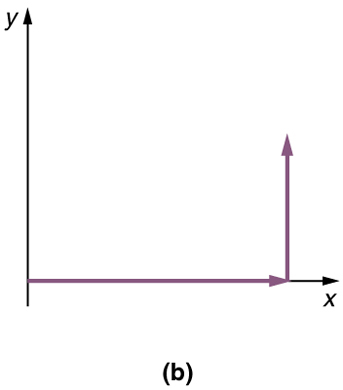
Step 3. If there are more than two vectors, continue this process for each vector to be added. Note that in our example, we have only two vectors, so we have finished placing arrows tip to tail.
Step 4. Draw an arrow from the tail of the first vector to the head of the last vector. This is the resultant, or the sum, of the other vectors.
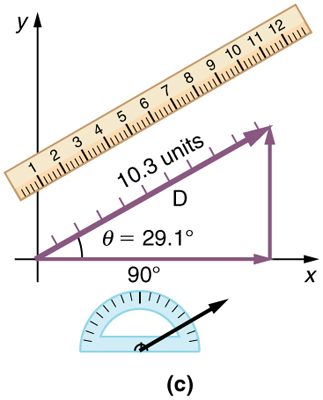
Step 5. To get the magnitude of the resultant, measure its length with a ruler. (Note that in most calculations, we will use the Pythagorean theorem to determine this length.)
Step 6. To get the direction of the resultant, measure the angle it makes with the reference frame using a protractor. (Note that in most calculations, we will use trigonometric relationships to determine this angle.)
The graphical addition of vectors is limited in accuracy only by the precision with which the drawings can be made and the precision of the measuring tools. It is valid for any number of vectors.
Vector Subtraction
Vector subtraction is a straightforward extension of vector addition. To define subtraction (say we want to subtract from , written , we must first define what we mean by subtraction. The negative of a vector is defined to be ; that is, graphically the negative of any vector has the same magnitude but the opposite direction, as shown in Figure 3.19. In other words, has the same length as , but points in the opposite direction. Essentially, we just flip the vector so it points in the opposite direction.
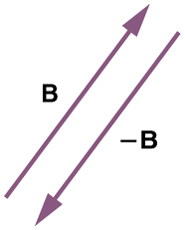
The subtraction of vector from vector is then simply defined to be the addition of to . Note that vector subtraction is the addition of a negative vector. The order of subtraction does not affect the results.
This is analogous to the subtraction of scalars (where, for example, ). Again, the result is independent of the order in which the subtraction is made. When vectors are subtracted graphically, the techniques outlined above are used, as the following example illustrates.
Multiplication of Vectors and Scalars
If we decided to walk three times as far on the first leg of the trip considered in the preceding example, then we would walk , or 82.5 m, in a direction north of east. This is an example of multiplying a vector by a positive scalar. Notice that the magnitude changes, but the direction stays the same.
If the scalar is negative, then multiplying a vector by it changes the vector’s magnitude and gives the new vector the opposite direction. For example, if you multiply by –2, the magnitude doubles but the direction changes. We can summarize these rules in the following way: When vector is multiplied by a scalar ,
- the magnitude of the vector becomes the absolute value of ,
- if is positive, the direction of the vector does not change,
- if is negative, the direction is reversed.
In our case, and . Vectors are multiplied by scalars in many situations. Note that division is the inverse of multiplication. For example, dividing by 2 is the same as multiplying by the value (1/2). The rules for multiplication of vectors by scalars are the same for division; simply treat the divisor as a scalar between 0 and 1.
Resolving a Vector into Components
In the examples above, we have been adding vectors to determine the resultant vector. In many cases, however, we will need to do the opposite. We will need to take a single vector and find what other vectors added together produce it. In most cases, this involves determining the perpendicular components of a single vector, for example the x- and y-components, or the north-south and east-west components.
For example, we may know that the total displacement of a person walking in a city is 10.3 blocks in a direction north of east and want to find out how many blocks east and north had to be walked. This method is called finding the components (or parts) of the displacement in the east and north directions, and it is the inverse of the process followed to find the total displacement. It is one example of finding the components of a vector. There are many applications in physics where this is a useful thing to do. We will see this soon in Projectile Motion, and much more when we cover forces in Dynamics: Newton’s Laws of Motion. Most of these involve finding components along perpendicular axes (such as north and east), so that right triangles are involved. The analytical techniques presented in Vector Addition and Subtraction: Analytical Methods are ideal for finding vector components.
Test Prep for AP Courses
A ball is launched vertically upward. The vertical position of the ball is recorded at various points in time in the table shown.
| Height (m) | Time (sec) |
|---|---|
| 0.490 | 0.1 |
| 0.882 | 0.2 |
| 1.176 | 0.3 |
| 1.372 | 0.4 |
| 1.470 | 0.5 |
| 1.470 | 0.6 |
| 1.372 | 0.7 |
Which of the following correctly describes the graph of the ball's vertical velocity versus time?
- Always positive, steadily decreasing
- Always positive, constant
- Initially positive, steadily decreasing, becoming negative at the end
- Initially zero, steadily getting more and more negative
| Height (m) | Time (sec) |
|---|---|
| 0.490 | 0.1 |
| 0.882 | 0.2 |
| 1.176 | 0.3 |
| 1.372 | 0.4 |
| 1.470 | 0.5 |
| 1.470 | 0.6 |
| 1.372 | 0.7 |
A ball is launched at an angle of 60 degrees above the horizontal, and the vertical position of the ball is recorded at various points in time in the table shown, assuming the ball was at a height of 0 at time t = 0.
- Draw a graph of the ball's vertical velocity versus time.
- Describe the graph of the ball's horizontal velocity.
- Draw a graph of the ball's vertical acceleration versus time.
The graph of the ball's vertical velocity over time should begin at 4.90 m/s during the time interval 0 - 0.1 sec (there should be a data point at t = 0.05 sec, v = 4.90 m/s). It should then have a slope of -9.8 m/s2, crossing through v = 0 at t = 0.55 sec and ending at v = -0.98 m/s at t = 0.65 sec.
The graph of the ball's horizontal velocity would be a constant positive value, a flat horizontal line at some positive velocity from t = 0 until t = 0.7 sec.
Summary
- The graphical method of adding vectors and involves drawing vectors on a graph and adding them using the head-to-tail method. The resultant vector is defined such that . The magnitude and direction of are then determined with a ruler and protractor, respectively.
- The graphical method of subtracting vector from involves adding the opposite of vector , which is defined as . In this case, . Then, the head-to-tail method of addition is followed in the usual way to obtain the resultant vector .
- Addition of vectors is commutative such that .
- The head-to-tail method of adding vectors involves drawing the first vector on a graph and then placing the tail of each subsequent vector at the head of the previous vector. The resultant vector is then drawn from the tail of the first vector to the head of the final vector.
- If a vector is multiplied by a scalar quantity , the magnitude of the product is given by . If is positive, the direction of the product points in the same direction as ; if is negative, the direction of the product points in the opposite direction as .
Conceptual Questions
Which of the following is a vector: a person’s height, the altitude on Mt. Everest, the age of the Earth, the boiling point of water, the cost of this book, the Earth’s population, the acceleration of gravity?
Give a specific example of a vector, stating its magnitude, units, and direction.
What do vectors and scalars have in common? How do they differ?
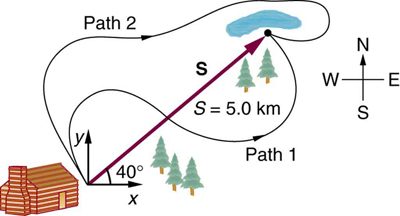
Two campers in a national park hike from their cabin to the same spot on a lake, each taking a different path, as illustrated below. The total distance traveled along Path 1 is 7.5 km, and that along Path 2 is 8.2 km. What is the final displacement of each camper?
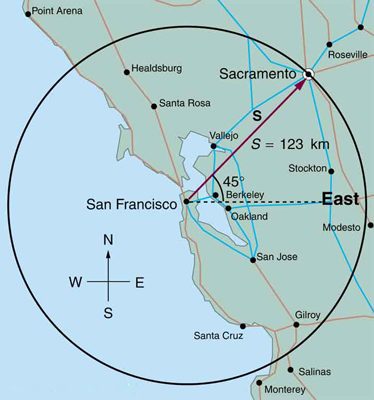
If an airplane pilot is told to fly 123 km in a straight line to get from San Francisco to Sacramento, explain why he could end up anywhere on the circle shown in Figure 3.25. What other information would he need to get to Sacramento?
Suppose you take two steps and (that is, two nonzero displacements). Under what circumstances can you end up at your starting point? More generally, under what circumstances can two nonzero vectors add to give zero? Is the maximum distance you can end up from the starting point the sum of the lengths of the two steps?
Explain why it is not possible to add a scalar to a vector.
If you take two steps of different sizes, can you end up at your starting point? More generally, can two vectors with different magnitudes ever add to zero? Can three or more?
Problems & Exercises
Use graphical methods to solve these problems. You may assume data taken from graphs is accurate to three digits.
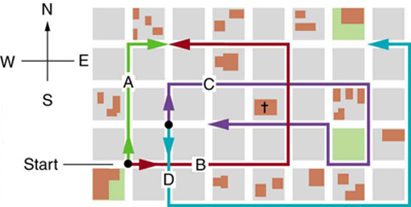
Find the following for path A in Figure 3.26: (a) the total distance traveled, and (b) the magnitude and direction of the displacement from start to finish.
(a)
(b) , east of north
Find the following for path B in Figure 3.26: (a) the total distance traveled, and (b) the magnitude and direction of the displacement from start to finish.
Find the north and east components of the displacement for the hikers shown in Figure 3.24.
north component 3.21 km, east component 3.83 km
Suppose you walk 18.0 m straight west and then 25.0 m straight north. How far are you from your starting point, and what is the compass direction of a line connecting your starting point to your final position? (If you represent the two legs of the walk as vector displacements and , as in Figure 3.27, then this problem asks you to find their sum .)
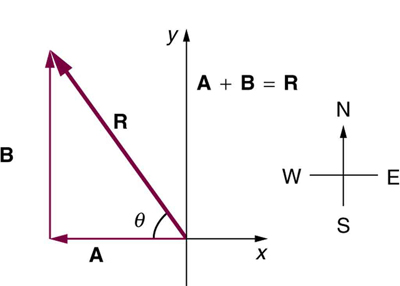
Suppose you first walk 12.0 m in a direction west of north and then 20.0 m in a direction south of west. How far are you from your starting point, and what is the compass direction of a line connecting your starting point to your final position? (If you represent the two legs of the walk as vector displacements and , as in Figure 3.28, then this problem finds their sum .)
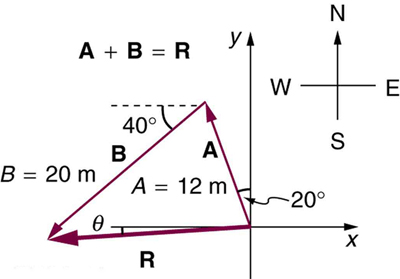
, south of west
Repeat the problem above, but reverse the order of the two legs of the walk; show that you get the same final result. That is, you first walk leg , which is 20.0 m in a direction exactly south of west, and then leg , which is 12.0 m in a direction exactly west of north. (This problem shows that .)
(a) Repeat the problem two problems prior, but for the second leg you walk 20.0 m in a direction north of east, (which is equivalent to subtracting from —that is, finding ). (b) Repeat the problem two problems prior, but now you first walk 20.0 m in a direction east of south (which is equivalent to subtracting from —that is, to finding ). Show that this is the case.
(a) , north of east
(b) , south of west
Show that the order of addition of three vectors does not affect their sum. Show this property by choosing any three vectors , , and , all having different lengths and directions. Find the sum then find their sum when added in a different order and show the result is the same. (There are five other orders in which , , and can be added; choose only one.)
Show that the sum of the vectors discussed in Example 2 gives the result shown in Figure 3.23.
, with respect to the x-axis.
Find the magnitudes of velocities and in Figure 3.29
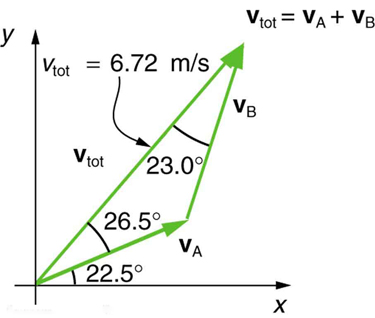
Find the components of along the x- and y-axes in Figure 3.29.
x-component 4.41 m/s
y-component 5.07 m/s
Find the components of along a set of perpendicular axes rotated counterclockwise relative to those in Figure 3.29.
Adapted from College Physics 2e by OpenStax (openstax.org), licensed under CC BY-NC-SA 4.0. Changes were made. License: CC-BY-NC-SA-4.0.