
5.7 Doppler Effect for Light
As discussed in the chapter on sound, if a source of sound and a listener are moving farther apart, the listener encounters fewer cycles of a wave in each second, and therefore lower frequency, than if their separation remains constant. For the same reason, the listener detects a higher frequency if the source and listener are getting closer. The resulting Doppler shift in detected frequency occurs for any form of wave. For sound waves, however, the equations for the Doppler shift differ markedly depending on whether it is the source, the observer, or the air, which is moving. Light requires no medium, and the Doppler shift for light traveling in vacuum depends only on the relative speed of the observer and source.
The Relativistic Doppler Effect
Suppose an observer in S sees light from a source in moving away at velocity v (Figure 5.22). The wavelength of the light could be measured within —for example, by using a mirror to set up standing waves and measuring the distance between nodes. These distances are proper lengths with as their rest frame, and change by a factor when measured in the observer’s frame S, where the ruler measuring the wavelength in is seen as moving.
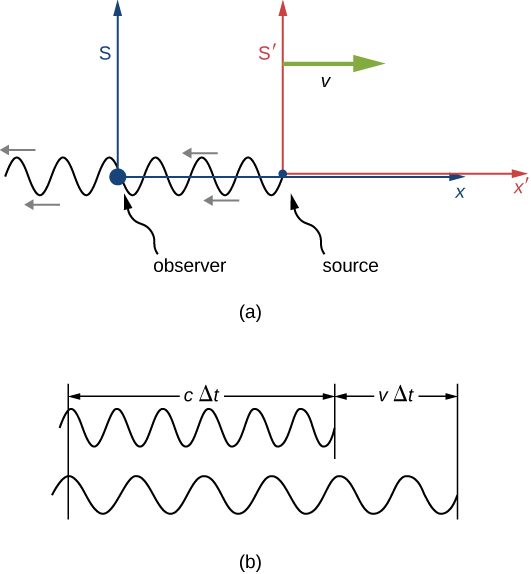
If the source were stationary in S, the observer would see a length of the wave pattern in time But because of the motion of relative to S, considered solely within S, the observer sees the wave pattern, and therefore the wavelength, stretched out by a factor of
as illustrated in (b) of Figure 5.22. The overall increase from both effects gives
where is the wavelength of the light seen by the source in and is the wavelength that the observer detects within S.
Red Shifts and Blue Shifts
The observed wavelength of electromagnetic radiation is longer (called a “red shift”) than that emitted by the source when the source moves away from the observer. Similarly, the wavelength is shorter (called a “blue shift”) when the source moves toward the observer. The amount of change is determined by
where is the wavelength in the frame of reference of the source, and v is the relative velocity of the two frames S and The velocity v is positive for motion away from an observer and negative for motion toward an observer. In terms of source frequency and observed frequency, this equation can be written as
Notice that the signs are different from those of the wavelength equation.
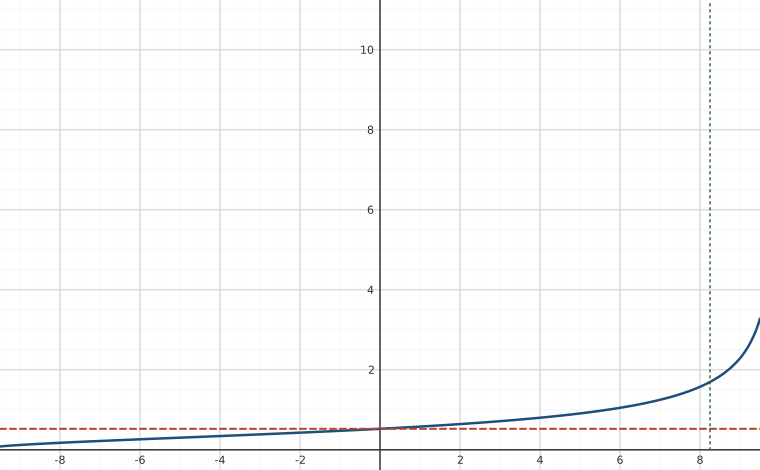
The relativistic Doppler effect has applications ranging from Doppler radar storm monitoring to providing information on the motion and distance of stars. We describe some of these applications in the exercises.
Summary
- An observer of electromagnetic radiation sees relativistic Doppler effects if the source of the radiation is moving relative to the observer. The wavelength of the radiation is longer (called a red shift) than that emitted by the source when the source moves away from the observer and shorter (called a blue shift) when the source moves toward the observer. The shifted wavelength is described by the equation: where is the observed wavelength, is the source wavelength, and v is the relative velocity of the source to the observer.
Conceptual Questions
Explain the meaning of the terms “red shift” and “blue shift” as they relate to the relativistic Doppler effect.
What happens to the relativistic Doppler effect when relative velocity is zero? Is this the expected result?
There is no measured change in wavelength or frequency in this case. The relativistic Doppler effect depends only on the relative velocity of the source and the observer, not any speed relative to a medium for the light waves.
Is the relativistic Doppler effect consistent with the classical Doppler effect in the respect that is larger for motion away?
All galaxies farther away than about exhibit a red shift in their emitted light that is proportional to distance, with those farther and farther away having progressively greater red shifts. What does this imply, assuming that the only source of red shift is relative motion?
It shows that the stars are getting more distant from Earth, that the universe is expanding, and doing so at an accelerating rate, with greater velocity for more distant stars.]
Problems
A highway patrol officer uses a device that measures the speed of vehicles by bouncing radar off them and measuring the Doppler shift. The outgoing radar has a frequency of 100 GHz and the returning echo has a frequency 15.0 kHz higher. What is the velocity of the vehicle? Note that there are two Doppler shifts in echoes. Be certain not to round off until the end of the problem, because the effect is small.
Adapted from University Physics Volume 3 by OpenStax (openstax.org), licensed under CC BY-NC-SA 4.0. Changes were made. License: CC-BY-NC-SA-4.0.