
5.3 Time Dilation
The analysis of simultaneity shows that Einstein’s postulates imply an important effect: Time intervals have different values when measured in different inertial frames. Suppose, for example, an astronaut measures the time it takes for a pulse of light to travel a distance perpendicular to the direction of his ship’s motion (relative to an earthbound observer), bounce off a mirror, and return (Figure 5.4). How does the elapsed time that the astronaut measures in the spacecraft compare with the elapsed time that an earthbound observer measures by observing what is happening in the spacecraft?
Examining this question leads to a profound result. The elapsed time for a process depends on which observer is measuring it. In this case, the time measured by the astronaut (within the spaceship where the astronaut is at rest) is smaller than the time measured by the earthbound observer (to whom the astronaut is moving). The time elapsed for the same process is different for the observers, because the distance the light pulse travels in the astronaut’s frame is smaller than in the earthbound frame, as seen in Figure 5.4. Light travels at the same speed in each frame, so it takes more time to travel the greater distance in the earthbound frame.
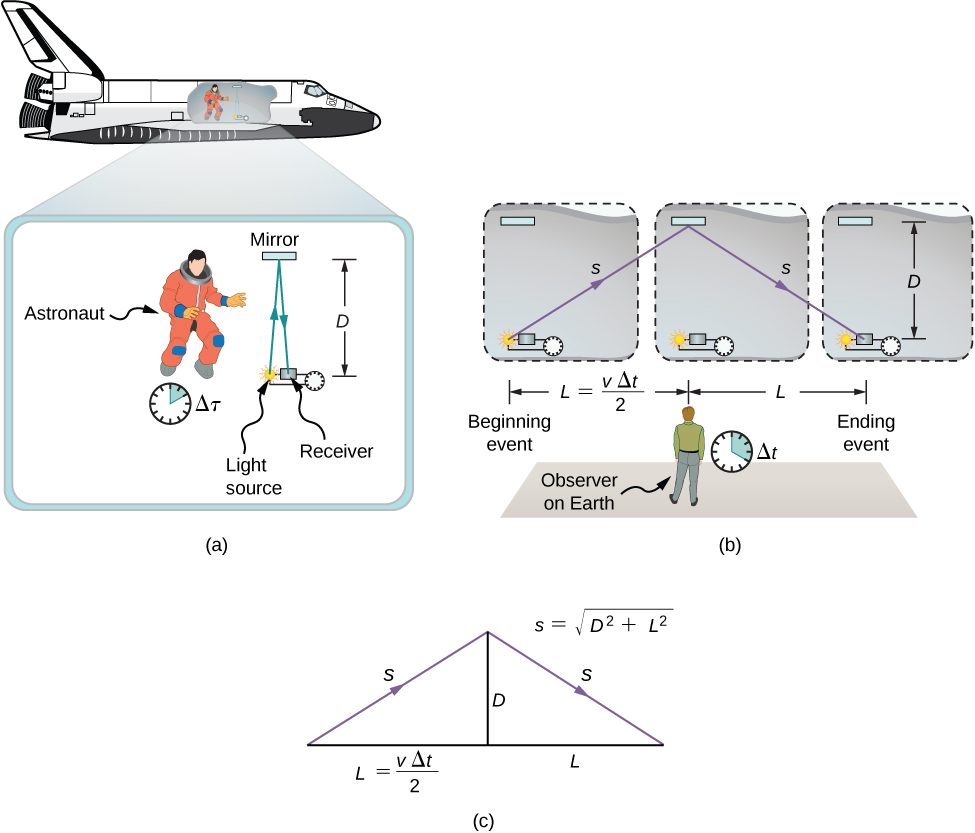
To quantitatively compare the time measurements in the two inertial frames, we can relate the distances in Figure 5.4 to each other, then express each distance in terms of the time of travel (respectively either or ) of the pulse in the corresponding reference frame. The resulting equation can then be solved for in terms of
The lengths D and L in Figure 5.4 are the sides of a right triangle with hypotenuse s. From the Pythagorean theorem,
The lengths 2s and 2L are, respectively, the distances that the pulse of light and the spacecraft travel in time in the earthbound observer’s frame. The length 2D is the distance that the light pulse travels in time in the astronaut’s frame. This gives us three equations:
Note that we used Einstein’s second postulate by taking the speed of light to be c in both inertial frames. We substitute these results into the previous expression from the Pythagorean theorem:
Then we rearrange to obtain
Finally, solving for in terms of gives us
This is equivalent to
where is the relativistic factor (often called the Lorentz factor) given by
and v and c are the speeds of the moving observer and light, respectively.
Note the asymmetry between the two measurements. Only one of them is a measurement of the time interval between two events—the emission and arrival of the light pulse—at the same position. It is a measurement of the time interval in the rest frame of a single clock. The measurement in the earthbound frame involves comparing the time interval between two events that occur at different locations. The time interval between events that occur at a single location has a separate name to distinguish it from the time measured by the earthbound observer, and we use the separate symbol to refer to it throughout this chapter.
The equation relating and is truly remarkable. First, as stated earlier, elapsed time is not the same for different observers moving relative to one another, even though both are in inertial frames. A proper time interval for an observer who, like the astronaut, is moving with the apparatus, is smaller than the time interval for other observers. It is the smallest possible measured time between two events. The earthbound observer sees time intervals within the moving system as dilated (i.e., lengthened) relative to how the observer moving relative to Earth sees them within the moving system. Alternatively, according to the earthbound observer, less time passes between events within the moving frame. Note that the shortest elapsed time between events is in the inertial frame in which the observer sees the events (e.g., the emission and arrival of the light signal) occur at the same point.
This time effect is real and is not caused by inaccurate clocks or improper measurements. Time-interval measurements of the same event differ for observers in relative motion. The dilation of time is an intrinsic property of time itself. All clocks moving relative to an observer, including biological clocks, such as a person’s heartbeat, or aging, are observed to run more slowly compared with a clock that is stationary relative to the observer.
Note that if the relative velocity is much less than the speed of light then is extremely small, and the elapsed times and are nearly equal. At low velocities, physics based on modern relativity approaches classical physics—everyday experiences involve very small relativistic effects. However, for speeds near the speed of light, is close to one, so is very small and becomes significantly larger than
Half-Life of a Muon
There is considerable experimental evidence that the equation is correct. One example is found in cosmic ray particles that continuously rain down on Earth from deep space. Some collisions of these particles with nuclei in the upper atmosphere result in short-lived particles called muons. The half-life (amount of time for half of a material to decay) of a muon is 1.52 μs when it is at rest relative to the observer who measures the half-life. This is the proper time interval This short time allows very few muons to reach Earth’s surface and be detected if Newtonian assumptions about time and space were correct. However, muons produced by cosmic ray particles have a range of velocities, with some moving near the speed of light. It has been found that the muon’s half-life as measured by an earthbound observer () varies with velocity exactly as predicted by the equation The faster the muon moves, the longer it lives. We on Earth see the muon last much longer than its half-life predicts within its own rest frame. As viewed from our frame, the muon decays more slowly than it does when at rest relative to us. A far larger fraction of muons reach the ground as a result.
Before we present the first example of solving a problem in relativity, we state a strategy you can use as a guideline for these calculations.
Note that you should not round off during the calculation. As noted in the text, you must often perform your calculations to many digits to see the desired effect. You may round off at the very end of the problem solution, but do not use a rounded number in a subsequent calculation. Also, check the answer to see if it is reasonable: Does it make sense? This may be more difficult for relativity, which has few everyday examples to provide experience with what is reasonable. But you can look for velocities greater than c or relativistic effects that are in the wrong direction (such as a time contraction where a dilation was expected).
The Twin Paradox
An intriguing consequence of time dilation is that a space traveler moving at a high velocity relative to Earth would age less than the astronaut’s earthbound twin. This is often known as the twin paradox. Imagine the astronaut moving at such a velocity that as in Figure 5.7. A trip that takes 2.00 years in her frame would take 60.0 years in the earthbound twin’s frame. Suppose the astronaut travels 1.00 year to another star system, briefly explores the area, and then travels 1.00 year back. An astronaut who was 40 years old at the start of the trip would be 42 when the spaceship returns. Everything on Earth, however, would have aged 60.0 years. The earthbound twin, if still alive, would be 100 years old.
The situation would seem different to the astronaut in Figure 5.7. Because motion is relative, the spaceship would seem to be stationary and Earth would appear to move. (This is the sensation you have when flying in a jet.) Looking out the window of the spaceship, the astronaut would see time slow down on Earth by a factor of Seen from the spaceship, the earthbound sibling will have aged only 2/30, or 0.07, of a year, whereas the astronaut would have aged 2.00 years.
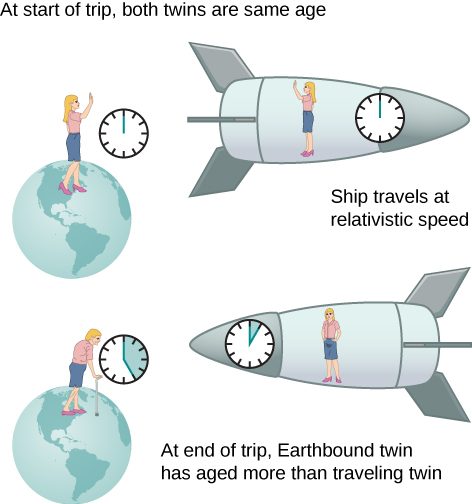
The paradox here is that the two twins cannot both be correct. As with all paradoxes, conflicting conclusions come from a false premise. In fact, the astronaut’s motion is significantly different from that of the earthbound twin. The astronaut accelerates to a high velocity and then accelerates opposite to the motion to view the star system. To return to Earth, she again accelerates and decelerates. The spacecraft is not in a single inertial frame to which the time dilation formula can be directly applied. That is, the astronaut twin changes inertial references. The earthbound twin does not experience these accelerations and remains in the same inertial frame. Thus, the situation is not symmetric, and it is incorrect to claim that the astronaut observes the same effects as her twin. The lack of symmetry between the twins will be still more evident when we analyze the journey later in this chapter in terms of the path the astronaut follows through four-dimensional space-time.
In 1971, American physicists Joseph Hafele and Richard Keating verified time dilation at low relative velocities by flying extremely accurate atomic clocks around the world on commercial aircraft. They measured elapsed time to an accuracy of a few nanoseconds and compared it with the time measured by clocks left behind. Hafele and Keating’s results were within experimental uncertainties of the predictions of relativity. Both special and general relativity had to be taken into account, because gravity and accelerations were involved as well as relative motion.
Summary
- Two events are defined to be simultaneous if an observer measures them as occurring at the same time. They are not necessarily simultaneous to all observers—simultaneity is not absolute.
- Time dilation is the lengthening of the time interval between two events when seen in a moving inertial frame rather than the rest frame of the events (in which the events occur at the same location).
- Observers moving at a relative velocity v do not measure the same elapsed time between two events. Proper time is the time measured in the reference frame where the start and end of the time interval occur at the same location. The time interval measured by an observer who sees the frame of events moving at speed v is related to the proper time interval of the events by the equation: where
- The premise of the twin paradox is faulty because the traveling twin is accelerating. The journey is not symmetrical for the two twins.
- Time dilation is usually negligible at low relative velocities, but it does occur, and it has been verified by experiment.
- The proper time is the shortest measure of any time interval. Any observer who is moving relative to the system being observed measures a time interval longer than the proper time.
Conceptual Questions
(a) Does motion affect the rate of a clock as measured by an observer moving with it? (b) Does motion affect how an observer moving relative to a clock measures its rate?
To whom does the elapsed time for a process seem to be longer, an observer moving relative to the process or an observer moving with the process? Which observer measures the interval of proper time?
The observer moving with the process sees its interval of proper time, which is the shortest seen by any observer.
(a) How could you travel far into the future of Earth without aging significantly? (b) Could this method also allow you to travel into the past?
Problems
(a) What is if (b) If
a. 1.0328; b. 1.15
(a) What is if (b) If
Particles called -mesons are produced by accelerator beams. If these particles travel at and live when at rest relative to an observer, how long do they live as viewed in the laboratory?
Suppose a particle called a kaon is created by cosmic radiation striking the atmosphere. It moves by you at and it lives when at rest relative to an observer. How long does it live as you observe it?
A neutral -meson is a particle that can be created by accelerator beams. If one such particle lives as measured in the laboratory, and when at rest relative to an observer, what is its velocity relative to the laboratory?
0.800c
A neutron lives 900 s when at rest relative to an observer. How fast is the neutron moving relative to an observer who measures its life span to be 2065 s?
If relativistic effects are to be less than 1%, then must be less than 1.01. At what relative velocity is
0.140c
If relativistic effects are to be less than 3%, then must be less than 1.03. At what relative velocity is
Adapted from University Physics Volume 3 by OpenStax (openstax.org), licensed under CC BY-NC-SA 4.0. Changes were made. License: CC-BY-NC-SA-4.0.