
5.6 Relativistic Velocity Transformation
Remaining in place in a kayak in a fast-moving river takes effort. The river current pulls the kayak along. Trying to paddle against the flow can move the kayak upstream relative to the water, but that only accounts for part of its velocity relative to the shore. The kayak’s motion is an example of how velocities in Newtonian mechanics combine by vector addition. The kayak’s velocity is the vector sum of its velocity relative to the water and the water’s velocity relative to the riverbank. However, the relativistic addition of velocities is quite different.
Velocity Transformations
Imagine a car traveling at night along a straight road, as in Figure 5.19. The driver sees the light leaving the headlights at speed c within the car’s frame of reference. If the Galilean transformation applied to light, then the light from the car’s headlights would approach the pedestrian at a speed contrary to Einstein’s postulates.
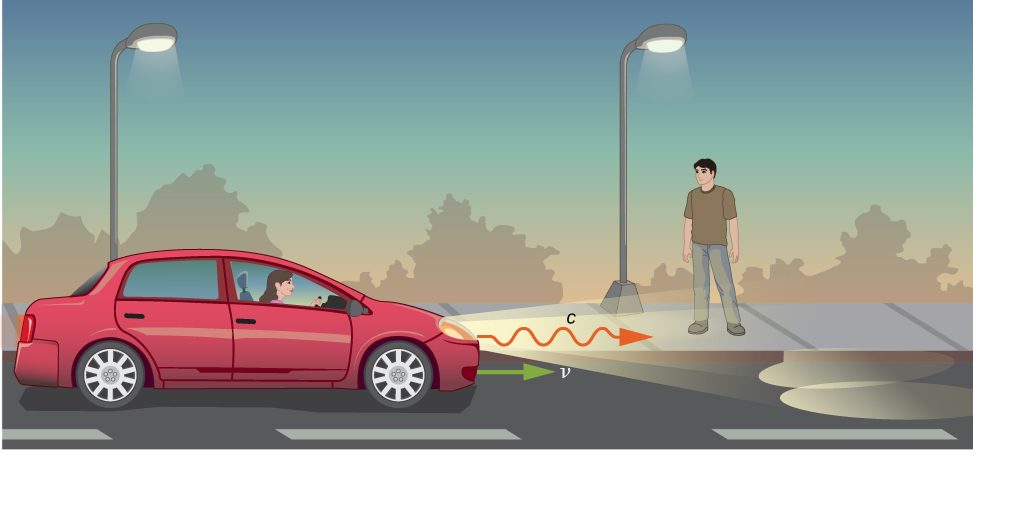
Both the distance traveled and the time of travel are different in the two frames of reference, and they must differ in a way that makes the speed of light the same in all inertial frames. The correct rules for transforming velocities from one frame to another can be obtained from the Lorentz transformation equations.
Relativistic Transformation of Velocity
Suppose an object P is moving at constant velocity as measured in the frame. The frame is moving along its at velocity v. In an increment of time , the particle is displaced by along the Applying the Lorentz transformation equations gives the corresponding increments of time and displacement in the unprimed axes:
The velocity components of the particle seen in the unprimed coordinate system are then
We thus obtain the equations for the velocity components of the object as seen in frame S:
Compare this with how the Galilean transformation of classical mechanics says the velocities transform, by adding simply as vectors:
When the relative velocity of the frames is much smaller than the speed of light, that is, when the special relativity velocity addition law reduces to the Galilean velocity law. When the speed v of relative to S is comparable to the speed of light, the relativistic velocity addition law gives a much smaller result than the classical (Galilean) velocity addition does.
Velocities cannot add to greater than the speed of light, provided that v is less than c and does not exceed c. The following example illustrates that relativistic velocity addition is not as symmetric as classical velocity addition.
Summary
- With classical velocity addition, velocities add like regular numbers in one-dimensional motion: where v is the velocity between two observers, u is the velocity of an object relative to one observer, and is the velocity relative to the other observer.
- Velocities cannot add to be greater than the speed of light.
- Relativistic velocity addition describes the velocities of an object moving at a relativistic velocity.
Problems
If two spaceships are heading directly toward each other at 0.800c, at what speed must a canister be shot from the first ship to approach the other at 0.999c as seen by the second ship?
Two planets are on a collision course, heading directly toward each other at 0.250c. A spaceship sent from one planet approaches the second at 0.750c as seen by the second planet. What is the velocity of the ship relative to the first planet?
0.615c
When a missile is shot from one spaceship toward another, it leaves the first at 0.950c and approaches the other at 0.750c. What is the relative velocity of the two ships?
What is the relative velocity of two spaceships if one fires a missile at the other at 0.750c and the other observes it to approach at 0.950c?
0.696c
Prove that for any relative velocity v between two observers, a beam of light sent from one to the other will approach at speed c (provided that v is less than c, of course).
Show that for any relative velocity v between two observers, a beam of light projected by one directly away from the other will move away at the speed of light (provided that v is less than c, of course).
(Proof)
Adapted from University Physics Volume 3 by OpenStax (openstax.org), licensed under CC BY-NC-SA 4.0. Changes were made. License: CC-BY-NC-SA-4.0.