
11.4 Magnetic Force on a Current-Carrying Conductor
Moving charges experience a force in a magnetic field. If these moving charges are in a wire—that is, if the wire is carrying a current—the wire should also experience a force. However, before we discuss the force exerted on a current by a magnetic field, we first examine the magnetic field generated by an electric current. We are studying two separate effects here that interact closely: A current-carrying wire generates a magnetic field and the magnetic field exerts a force on the current-carrying wire.
Magnetic Fields Produced by Electrical Currents
When discussing historical discoveries in magnetism, we mentioned Oersted’s finding that a wire carrying an electrical current caused a nearby compass to deflect. A connection was established that electrical currents produce magnetic fields. (This connection between electricity and magnetism is discussed in more detail in Sources of Magnetic Fields.)
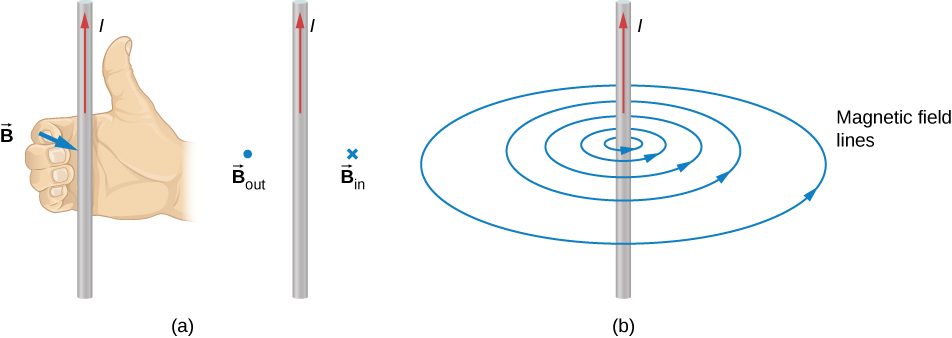
The compass needle near the wire experiences a force that aligns the needle tangent to a circle around the wire. Therefore, a current-carrying wire produces circular loops of magnetic field. To determine the direction of the magnetic field generated from a wire, we use a second right-hand rule. In RHR-2, your thumb points in the direction of the current while your fingers wrap around the wire, pointing in the direction of the magnetic field produced (Figure 11.11). If the magnetic field were coming at you or out of the page, we represent this with a dot. If the magnetic field were going into the page, we represent this with an These symbols come from considering a vector arrow: An arrow pointed toward you, from your perspective, would look like a dot or the tip of an arrow. An arrow pointed away from you, from your perspective, would look like a cross or an A composite sketch of the magnetic circles is shown in Figure 11.11, where the field strength is shown to decrease as you get farther from the wire by loops that are farther separated.
Calculating the Magnetic Force
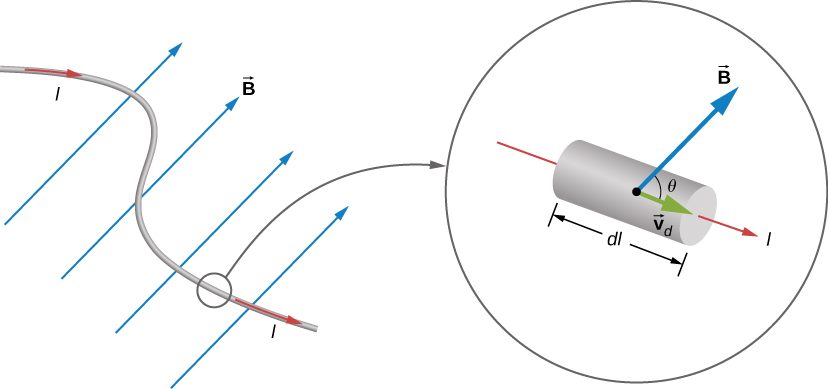
Electric current is an ordered movement of charge. A current-carrying wire in a magnetic field must therefore experience a force due to the field. To investigate this force, let’s consider the infinitesimal section of wire as shown in Figure 11.12. The length and cross-sectional area of the section are dl and A, respectively, so its volume is The wire is formed from material that contains n charge carriers per unit volume, so the number of charge carriers in the section is If the charge carriers move with drift velocity the current I in the wire is (from Current and Resistance)
The magnetic force on any single charge carrier is so the total magnetic force on the charge carriers in the section of wire is
We can define dl to be a vector of length dl pointing along which allows us to rewrite this equation as
or
This is the magnetic force on the section of wire. Note that it is actually the net force exerted by the field on the charge carriers themselves. The direction of this force is given by RHR-1, where you point your fingers in the direction of the current and curl them toward the field. Your thumb then points in the direction of the force.
To determine the magnetic force on a wire of arbitrary length and shape, we must integrate Equation 11.12 over the entire wire. If the wire section happens to be straight and B is uniform, the equation differentials become absolute quantities, giving us
This is the force on a straight, current-carrying wire in a uniform magnetic field.
Summary
- An electrical current produces a magnetic field around the wire.
- The directionality of the magnetic field produced is determined by the right hand rule-2, where your thumb points in the direction of the current and your fingers wrap around the wire in the direction of the magnetic field.
- The magnetic force on current-carrying conductors is given by where I is the current and l is the length of a wire in a uniform magnetic field B.
Conceptual Questions
Describe the error that results from accidently using your left rather than your right hand when determining the direction of a magnetic force.
Considering the magnetic force law, are the velocity and magnetic field always perpendicular? Are the force and velocity always perpendicular? What about the force and magnetic field?
Velocity and magnetic field can be set together in any direction. If there is a force, the velocity is perpendicular to it. The magnetic field is also perpendicular to the force if it exists.
Why can a nearby magnet distort a cathode ray tube television picture?
A magnetic field exerts a force on the moving electrons in a current carrying wire. What exerts the force on a wire?
A force on a wire is exerted by an external magnetic field created by a wire or another magnet.
There are regions where the magnetic field of earth is almost perpendicular to the surface of Earth. What difficulty does this cause in the use of a compass?
Problems
What is the direction of the magnetic force on the current in each of the six cases?
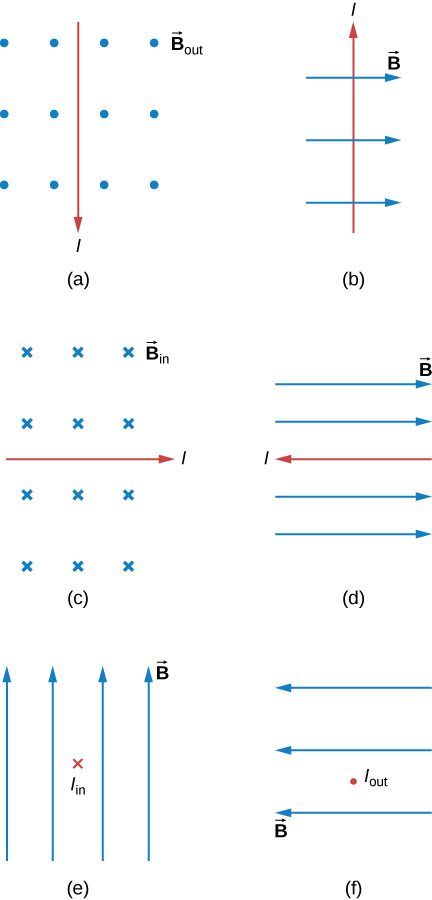
a. left; b. into the page; c. up; d. no force; e. right; f. down
What is the direction of a current that experiences the magnetic force shown in each of the three cases, assuming the current runs perpendicular to ?
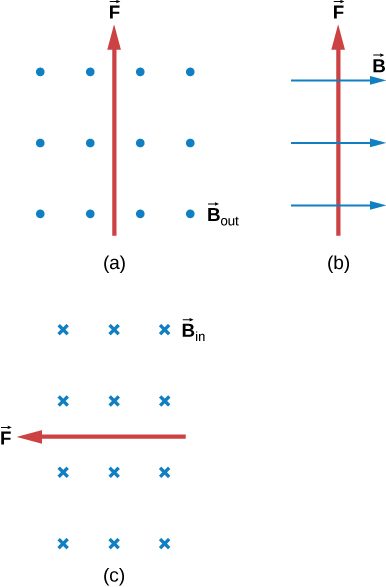
What is the direction of the magnetic field that produces the magnetic force shown on the currents in each of the three cases, assuming is perpendicular to I?
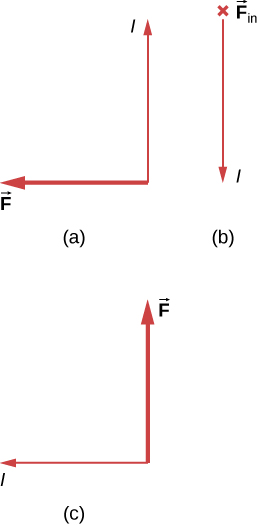
a. into the page; b. left; c. out of the page
(a) What is the force per meter on a lightning bolt at the equator that carries 20,000 A perpendicular to Earth’s field? (b) What is the direction of the force if the current is straight up and Earth’s field direction is due north, parallel to the ground?
(a) A dc power line for a light-rail system carries 1000 A at an angle of 30.0º to Earth’s field. What is the force on a 100-m section of this line? (b) Discuss practical concerns this presents, if any.
a. 2.50 N; b. This means that the light-rail power lines must be attached in order not to be moved by the force caused by Earth’s magnetic field.
A wire carrying a 30.0-A current passes between the poles of a strong magnet that is perpendicular to its field and experiences a 2.16-N force on the 4.00 cm of wire in the field. What is the average field strength?
Adapted from University Physics Volume 2 by OpenStax (openstax.org), licensed under CC BY-NC-SA 4.0. Changes were made. License: CC-BY-NC-SA-4.0.