
7.4 Determining Field from Potential
Recall that we were able, in certain systems, to calculate the potential by integrating over the electric field. As you may already suspect, this means that we may calculate the electric field by taking derivatives of the potential, although going from a scalar to a vector quantity introduces some interesting wrinkles. We frequently need to calculate the force in a system; since it is often simpler to calculate the potential directly, there are systems in which it is useful to calculate V and then derive from it.
In general, regardless of whether the electric field is uniform, it points in the direction of decreasing potential, because the force on a positive charge is in the direction of and also in the direction of lower potential V. Furthermore, the magnitude of equals the rate of decrease of V with distance. The faster V decreases over distance, the greater the electric field. This gives us the following result.
For continually changing potentials, and become infinitesimals, and we need differential calculus to determine the electric field. As shown in Figure 7.27, if we treat the distance as very small so that the electric field is essentially constant over it, we find that
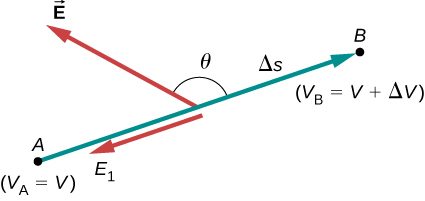
Therefore, the electric field components in the Cartesian directions are given by
This allows us to define the “grad” or “del” vector operator, which allows us to compute the gradient in one step. In Cartesian coordinates, it takes the form
With this notation, we can calculate the electric field from the potential with
a process we call calculating the gradient of the potential.
If we have a system with either cylindrical or spherical symmetry, we only need to use the del operator in the appropriate coordinates:
Summary
- Just as we may integrate over the electric field to calculate the potential, we may take the derivative of the potential to calculate the electric field.
- This may be done for individual components of the electric field, or we may calculate the entire electric field vector with the gradient operator.
Conceptual Questions
If the electric field is zero throughout a region, must the electric potential also be zero in that region?
No. It will be constant, but not necessarily zero.
Explain why knowledge of is not sufficient to determine V(x,y,z). What about the other way around?
Problems
Throughout a region, equipotential surfaces are given by . The surfaces are equally spaced with for for for What is the electric field in this region?
The problem is describing a uniform field, so in the –z-direction.
In a particular region, the electric potential is given by What is the electric field in this region?
Calculate the electric field of an infinite line charge, throughout space.
Apply with to the potential calculated earlier,
as expected.
Adapted from University Physics Volume 2 by OpenStax (openstax.org), licensed under CC BY-NC-SA 4.0. Changes were made. License: CC-BY-NC-SA-4.0.