
7.2 Electric Potential and Potential Difference
Recall that earlier we defined electric field to be a quantity independent of the test charge in a given system, which would nonetheless allow us to calculate the force that would result on an arbitrary test charge. (The default assumption in the absence of other information is that the test charge is positive.) We briefly defined a field for gravity, but gravity is always attractive, whereas the electric force can be either attractive or repulsive. Therefore, although potential energy is perfectly adequate in a gravitational system, it is convenient to define a quantity that allows us to calculate the work on a charge independent of the magnitude of the charge. Calculating the work directly may be difficult, since and the direction and magnitude of can be complex for multiple charges, for odd-shaped objects, and along arbitrary paths. But we do know that because , the work, and hence is proportional to the test charge q. To have a physical quantity that is independent of test charge, we define electric potential V (or simply potential, since electric is understood) to be the potential energy per unit charge:
Since U is proportional to q, the dependence on q cancels. Thus, V does not depend on q. The change in potential energy is crucial, so we are concerned with the difference in potential or potential difference between two points, where
The familiar term voltage is the common name for electric potential difference. Keep in mind that whenever a voltage is quoted, it is understood to be the potential difference between two points. For example, every battery has two terminals, and its voltage is the potential difference between them. More fundamentally, the point you choose to be zero volts is arbitrary. This is analogous to the fact that gravitational potential energy has an arbitrary zero, such as sea level or perhaps a lecture hall floor. It is worthwhile to emphasize the distinction between potential difference and electrical potential energy.
Voltage is not the same as energy. Voltage is the energy per unit charge. Thus, a motorcycle battery and a car battery can both have the same voltage (more precisely, the same potential difference between battery terminals), yet one stores much more energy than the other because The car battery can move more charge than the motorcycle battery, although both are 12-V batteries.
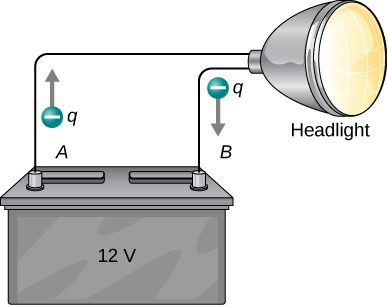
Note that the energies calculated in the previous example are absolute values. The change in potential energy for the battery is negative, since it loses energy. These batteries, like many electrical systems, actually move negative charge—electrons in particular. The batteries repel electrons from their negative terminals (A) through whatever circuitry is involved and attract them to their positive terminals (B), as shown in Figure 7.12. The change in potential is and the charge q is negative, so that is negative, meaning the potential energy of the battery has decreased when q has moved from A to B.
The Electron-Volt
The energy per electron is very small in macroscopic situations like that in the previous example—a tiny fraction of a joule. But on a submicroscopic scale, such energy per particle (electron, proton, or ion) can be of great importance. For example, even a tiny fraction of a joule can be great enough for these particles to destroy organic molecules and harm living tissue. The particle may do its damage by direct collision, or it may create harmful X-rays, which can also inflict damage. It is useful to have an energy unit related to submicroscopic effects.
Figure 7.13 shows a situation related to the definition of such an energy unit. An electron is accelerated between two charged metal plates, as it might be in an old-model television tube or oscilloscope. The electron gains kinetic energy that is later converted into another form—light in the television tube, for example. (Note that in terms of energy, “downhill” for the electron is “uphill” for a positive charge.) Since energy is related to voltage by , we can think of the joule as a coulomb-volt.
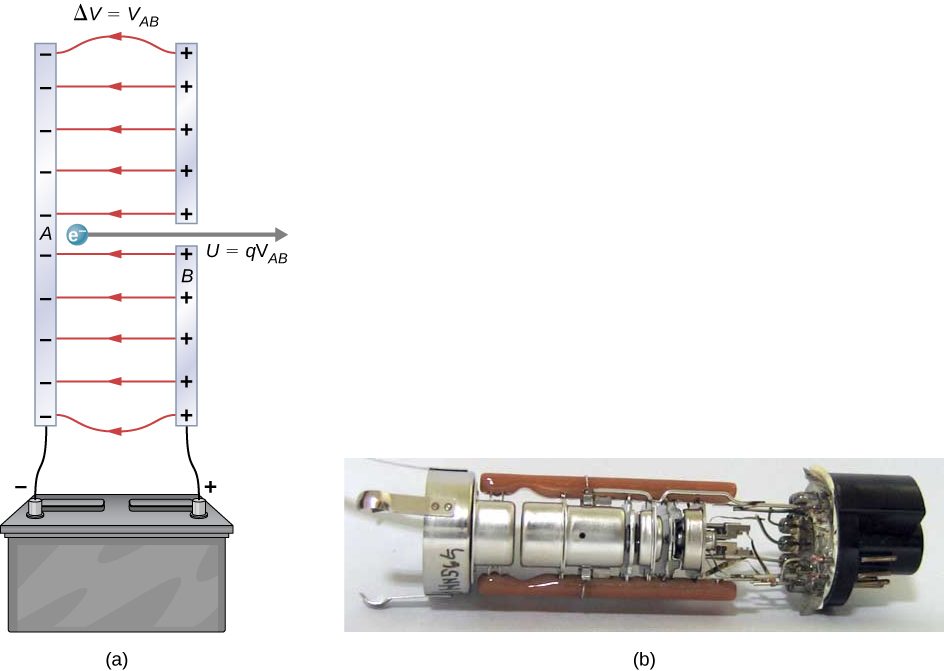
An electron accelerated through a potential difference of 1 V is given an energy of 1 eV. It follows that an electron accelerated through 50 V gains 50 eV. A potential difference of 100,000 V (100 kV) gives an electron an energy of 100,000 eV (100 keV), and so on. Similarly, an ion with a double positive charge accelerated through 100 V gains 200 eV of energy. These simple relationships between accelerating voltage and particle charges make the electron-volt a simple and convenient energy unit in such circumstances.
The electron-volt is commonly employed in submicroscopic processes—chemical valence energies and molecular and nuclear binding energies are among the quantities often expressed in electron-volts. For example, about 5 eV of energy is required to break up certain organic molecules. If a proton is accelerated from rest through a potential difference of 30 kV, it acquires an energy of 30 keV (30,000 eV) and can break up as many as 6000 of these molecules Nuclear decay energies are on the order of 1 MeV (1,000,000 eV) per event and can thus produce significant biological damage.
Conservation of Energy
The total energy of a system is conserved if there is no net addition (or subtraction) due to work or heat transfer. For conservative forces, such as the electrostatic force, conservation of energy states that mechanical energy is a constant.
Mechanical energy is the sum of the kinetic energy and potential energy of a system; that is, A loss of U for a charged particle becomes an increase in its K. Conservation of energy is stated in equation form as
or
where i and f stand for initial and final conditions. As we have found many times before, considering energy can give us insights and facilitate problem solving.
Voltage and Electric Field
So far, we have explored the relationship between voltage and energy. Now we want to explore the relationship between voltage and electric field. We will start with the general case for a non-uniform field. Recall that our general formula for the potential energy of a test charge q at point P relative to reference point R is
When we substitute in the definition of electric field this becomes
Applying our definition of potential to this potential energy, we find that, in general,
From our previous discussion of the potential energy of a charge in an electric field, the result is independent of the path chosen, and hence we can pick the integral path that is most convenient.
Consider the special case of a positive point charge q at the origin. To calculate the potential caused by q at a distance r from the origin relative to a reference of 0 at infinity (recall that we did the same for potential energy), let and with and use When we evaluate the integral
for this system, we have
which simplifies to
This result,
is the standard form of the potential of a point charge. This will be explored further in the next section.
To examine another interesting special case, suppose a uniform electric field is produced by placing a potential difference (or voltage) across two parallel metal plates, labeled A and B (Figure 7.14). Examining this situation will tell us what voltage is needed to produce a certain electric field strength. It will also reveal a more fundamental relationship between electric potential and electric field.
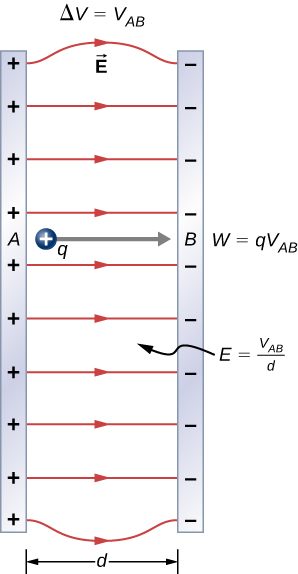
From a physicist’s point of view, either or can be used to describe any interaction between charges. However, is a scalar quantity and has no direction, whereas is a vector quantity, having both magnitude and direction. (Note that the magnitude of the electric field, a scalar quantity, is represented by E.) The relationship between and is revealed by calculating the work done by the electric force in moving a charge from point A to point B. But, as noted earlier, arbitrary charge distributions require calculus. We therefore look at a uniform electric field as an interesting special case.
The work done by the electric field in Figure 7.14 to move a positive charge q from A, the positive plate, higher potential, to B, the negative plate, lower potential, is
Work is ; here , since the path is parallel to the field. Thus, . Since , we see that .
Substituting this expression for work into the previous equation gives
The charge cancels, so we obtain for the voltage between points A and B
where d is the distance from A to B, or the distance between the plates in Figure 7.14. Note that this equation implies that the units for electric field are volts per meter. We already know the units for electric field are newtons per coulomb; thus, the following relation among units is valid:
Furthermore, we may extend this to the integral form. Substituting Equation 7.6 into our definition for the potential difference between points A and B, we obtain
which simplifies to
The potential difference is negative (V is lower at B than at A) when the displacement is in the same direction as the field. In other words, the electric field points toward lower electric potential. We are often only interested in the magnitude of the electric field, in which case you may see instead of and it is understood that all of the variables in the equation represent the magnitudes of the quantities. As a demonstration, from this we may calculate the potential difference between two points (A and B) equidistant from a point charge q at the origin, as shown in Figure 7.15.
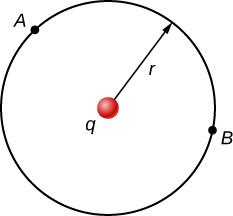
To do this, we integrate around an arc of the circle of constant radius r between A and B, which means we let while using . Thus,
for this system becomes
However, and therefore
This result, that there is no difference in potential along a constant radius from a point charge, will come in handy when we map potentials.
Before presenting problems involving electrostatics, we suggest a problem-solving strategy to follow for this topic.
Summary
- Electric potential is potential energy per unit charge.
- The potential difference between points A and B, that is, the change in potential of a charge q moved from A to B, is equal to the change in potential energy divided by the charge.
- Potential difference is commonly called voltage, represented by the symbol :
- An electron-volt is the energy given to a fundamental charge accelerated through a potential difference of 1 V. In equation form,
Conceptual Questions
Discuss how potential difference and electric field strength are related. Give an example.
What is the strength of the electric field in a region where the electric potential is constant?
The electric field strength is zero because electric potential differences are directly related to the field strength. If the potential difference is zero, then the field strength must also be zero.
If a proton is released from rest in an electric field, will it move in the direction of increasing or decreasing potential? Also answer this question for an electron and a neutron. Explain why.
Voltage is the common word for potential difference. Which term is more descriptive, voltage or potential difference?
Potential difference is more descriptive because it indicates that it is the difference between the electric potential of two points.
If the voltage between two points is zero, can a test charge be moved between them with zero net work being done? Can this necessarily be done without exerting a force? Explain.
What is the relationship between voltage and energy? More precisely, what is the relationship between potential difference and electric potential energy?
They are very similar, but potential difference is a feature of the system; when a charge is introduced to the system, it will have a potential energy which may be calculated by multiplying the magnitude of the charge by the potential difference.
Voltages are always measured between two points. Why?
How are units of volts and electron-volts related? How do they differ?
An electron-volt is a volt multiplied by the charge of an electron. Volts measure potential difference, electron-volts are a unit of energy.
Can a particle move in a direction of increasing electric potential, yet have its electric potential energy decrease? Explain
Problems
Find the ratio of speeds of an electron and a negative hydrogen ion (one having an extra electron) accelerated through the same voltage, assuming non-relativistic final speeds. Take the mass of the hydrogen ion to be
An evacuated tube uses an accelerating voltage of 40 kV to accelerate electrons to hit a copper plate and produce X-rays. Non-relativistically, what would be the maximum speed of these electrons?
Show that units of V/m and N/C for electric field strength are indeed equivalent.
What is the strength of the electric field between two parallel conducting plates separated by 1.00 cm and having a potential difference (voltage) between them of ?
The electric field strength between two parallel conducting plates separated by 4.00 cm is . (a) What is the potential difference between the plates? (b) The plate with the lowest potential is taken to be zero volts. What is the potential 1.00 cm from that plate and 3.00 cm from the other?
a. ; b.
The voltage across a membrane forming a cell wall is 80.0 mV and the membrane is 9.00 nm thick. What is the electric field strength? (The value is surprisingly large, but correct.) You may assume a uniform electric field.
Two parallel conducting plates are separated by 10.0 cm, and one of them is taken to be at zero volts. (a) What is the electric field strength between them, if the potential 8.00 cm from the zero volt plate (and 2.00 cm from the other) is 450 V? (b) What is the voltage between the plates?
a. ;
b.
Find the maximum potential difference between two parallel conducting plates separated by 0.500 cm of air, given the maximum sustainable electric field strength in air to be .
An electron is to be accelerated in a uniform electric field having a strength of (a) What energy in keV is given to the electron if it is accelerated through 0.400 m? (b) Over what distance would it have to be accelerated to increase its energy by 50.0 GeV?
a.
b.
Use the definition of potential difference in terms of electric field to deduce the formula for potential difference between and for a point charge located at the origin. Here r is the spherical radial coordinate.
The electric field in a region is pointed away from the z-axis and the magnitude depends upon the distance s from the axis. The magnitude of the electric field is given as where is a constant. Find the potential difference between points , explicitly stating the path over which you conduct the integration for the line integral.
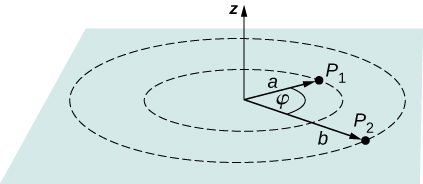
One possibility is to stay at constant radius and go along the arc from to , which will have zero potential due to the path being perpendicular to the electric field. Then integrate from a to b: The potential at point is higher than at since the field points radially outward, and this is consistent with a positive potential difference going from distance to a larger distance .
Singly charged gas ions are accelerated from rest through a voltage of 13.0 V. At what temperature will the average kinetic energy of gas molecules be the same as that given these ions?
Adapted from University Physics Volume 2 by OpenStax (openstax.org), licensed under CC BY-NC-SA 4.0. Changes were made. License: CC-BY-NC-SA-4.0.