
3.1 Position, Displacement, and Average Velocity
When you’re in motion, the basic questions to ask are: Where are you? Where are you going? How fast are you getting there? The answers to these questions require that you specify your position, your displacement, and your average velocity—the terms we define in this section.
Position
To describe the motion of an object, you must first be able to describe its position (x): where it is at any particular time. More precisely, we need to specify its position relative to a convenient frame of reference. A frame of reference is an arbitrary set of axes from which the position and motion of an object are described. Earth is often used as a frame of reference, and we often describe the position of an object as it relates to stationary objects on Earth. For example, a rocket launch could be described in terms of the position of the rocket with respect to Earth as a whole, whereas a cyclist’s position could be described in terms of where she is in relation to the buildings she passes Figure 3.2. In other cases, we use reference frames that are not stationary but are in motion relative to Earth. To describe the position of a person in an airplane, for example, we use the airplane, not Earth, as the reference frame. To describe the position of an object undergoing one-dimensional motion, we often use the variable x. Later in the chapter, during the discussion of free fall, we use the variable y.

Displacement
If an object moves relative to a frame of reference—for example, if a professor moves to the right relative to a whiteboard Figure 3.3—then the object’s position changes. This change in position is called displacement. The word displacement implies that an object has moved, or has been displaced. Although position is the numerical value of x along a straight line where an object might be located, displacement gives the change in position along this line. Since displacement indicates direction, it is a vector and can be either positive or negative, depending on the choice of positive direction. Also, an analysis of motion can have many displacements embedded in it. If right is positive and an object moves 2 m to the right, then 4 m to the left, the individual displacements are 2 m and m, respectively.
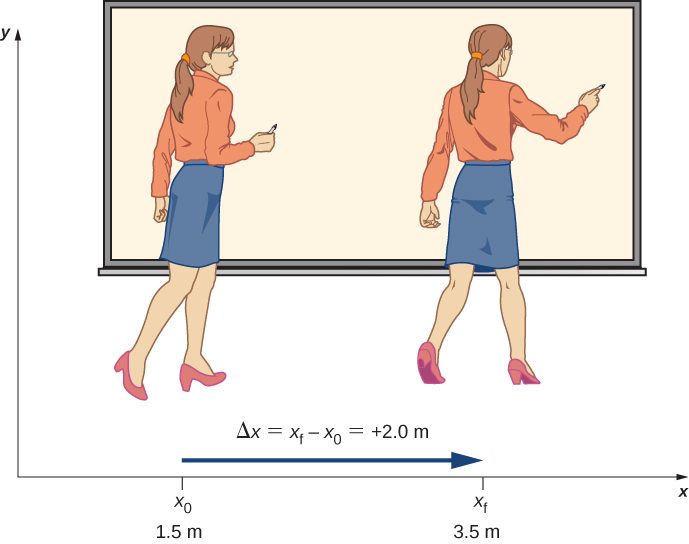
We use the uppercase Greek letter delta (Δ) to mean “change in” whatever quantity follows it; thus, means change in position (final position less initial position). We always solve for displacement by subtracting initial position from final position . Note that the SI unit for displacement is the meter, but sometimes we use kilometers or other units of length. Keep in mind that when units other than meters are used in a problem, you may need to convert them to meters to complete the calculation (see Appendix B).
Objects in motion can also have a series of displacements. In the previous example of the pacing professor, the individual displacements are 2 m and m, giving a total displacement of −2 m. We define total displacement , as the sum of the individual displacements, and express this mathematically with the equation
where are the individual displacements. In the earlier example,
Similarly,
Thus,
The total displacement is 2 − 4 = −2 m along the x-axis. It is also useful to calculate the magnitude of the displacement, or its size. The magnitude of the displacement is always positive. This is the absolute value of the displacement, because displacement is a vector and cannot have a negative value of magnitude. In our example, the magnitude of the total displacement is 2 m, whereas the magnitudes of the individual displacements are 2 m and 4 m.
The magnitude of the total displacement should not be confused with the distance traveled. Distance traveled , is the total length of the path traveled between two positions. In the previous problem, the distance traveled is the sum of the magnitudes of the individual displacements:
Average Velocity
To calculate the other physical quantities in kinematics we must introduce the time variable. The time variable allows us not only to state where the object is (its position) during its motion, but also how fast it is moving. How fast an object is moving is given by the rate at which the position changes with time.
For each position , we assign a particular time . If the details of the motion at each instant are not important, the rate is usually expressed as the average velocity . This vector quantity is simply the total displacement between two points divided by the time taken to travel between them. The time taken to travel between two points is called the elapsed time .
It is important to note that the average velocity is a vector and can be negative, depending on positions and .
Summary
- Kinematics is the description of motion without considering its causes. In this chapter, it is limited to motion along a straight line, called one-dimensional motion.
- Displacement is the change in position of an object. The SI unit for displacement is the meter. Displacement has direction as well as magnitude.
- Distance traveled is the total length of the path traveled between two positions.
- Time is measured in terms of change. The time between two position points and is . Elapsed time for an event is , where is the final time and is the initial time. The initial time is often taken to be zero.
- Average velocity is defined as displacement divided by elapsed time. If and are two position time points, the average velocity between these points is
Conceptual Questions
Give an example in which there are clear distinctions among distance traveled, displacement, and magnitude of displacement. Identify each quantity in your example specifically.
You drive your car into town and return to drive past your house to a friend’s house.
Under what circumstances does distance traveled equal magnitude of displacement? What is the only case in which magnitude of displacement and distance are exactly the same?
Bacteria move back and forth using their flagella (structures that look like little tails). Speeds of up to 50 μm/s (50 × 10−6 m/s) have been observed. The total distance traveled by a bacterium is large for its size, whereas its displacement is small. Why is this?
If the bacteria are moving back and forth, then the displacements are canceling each other and the final displacement is small.
Give an example of a device used to measure time and identify what change in that device indicates a change in time.
Does a car’s odometer measure distance traveled or displacement?
Distance traveled
During a given time interval the average velocity of an object is zero. What can you conclude about its displacement over the time interval?
Problems
Consider a coordinate system in which the positive x axis is directed upward vertically. What are the positions of a particle (a) 5.0 m directly above the origin and (b) 2.0 m below the origin?
A car is 2.0 km west of a traffic light at t = 0 and 5.0 km east of the light at t = 6.0 min. Assume the origin of the coordinate system is the light and the positive x direction is eastward. (a) What are the car’s position vectors at these two times? (b) What is the car’s displacement between 0 min and 6.0 min?
a. , ; b. 7.0 km east
The Shanghai maglev train connects Longyang Road to Pudong International Airport, a distance of 30 km. The journey takes 8 minutes on average. What is the maglev train’s average velocity?
The position of a particle moving along the x-axis is given by m. (a) At what time does the particle cross the origin? (b) What is the displacement of the particle between and
a. s; b.
A cyclist rides 8.0 km east for 20 minutes, then they turn and head west for 8 minutes and 3.2 km. Finally, they ride east for 16 km, which takes 40 minutes. (a) What is the final displacement of the cyclist? (b) What is their average velocity?
On February 15, 2013, a superbolide meteor (brighter than the Sun) entered Earth’s atmosphere over Chelyabinsk, Russia, and exploded at an altitude of 23.5 km. Eyewitnesses could feel the intense heat from the fireball, and the blast wave from the explosion blew out windows in buildings. The blast wave took approximately 2 minutes 30 seconds to reach ground level. The blast wave traveled at 10° above the horizon. (a) What was the average velocity of the blast wave? b) Compare this with the speed of sound, which is 343 m/s at sea level.
a. 150.0 s, ; b. 263% the speed of sound at sea level or about Mach 2.
Adapted from University Physics Volume 1 by OpenStax (openstax.org), licensed under CC BY-NC-SA 4.0. Changes were made. License: CC-BY-NC-SA-4.0.