
2.4 Products of Vectors
A vector can be multiplied by another vector but may not be divided by another vector. There are two kinds of products of vectors used broadly in physics and engineering. One kind of multiplication is a scalar multiplication of two vectors. Taking a scalar product of two vectors results in a number (a scalar), as its name indicates. Scalar products are used to define work and energy relations. For example, the work that a force (a vector) performs on an object while causing its displacement (a vector) is defined as a scalar product of the force vector with the displacement vector. A quite different kind of multiplication is a vector multiplication of vectors. Taking a vector product of two vectors returns as a result a vector, as its name suggests. Vector products are used to define other derived vector quantities. For example, in describing rotations, a vector quantity called torque is defined as a vector product of an applied force (a vector) and its distance from pivot to force (a vector). It is important to distinguish between these two kinds of vector multiplications because the scalar product is a scalar quantity and a vector product is a vector quantity.
The Scalar Product of Two Vectors (the Dot Product)
Scalar multiplication of two vectors yields a scalar product.
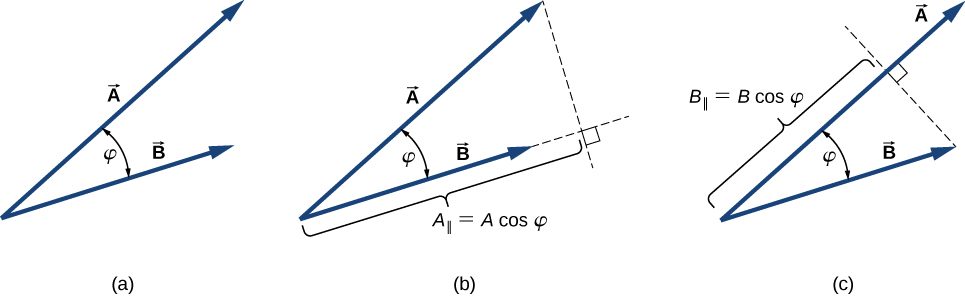
In the definition of the dot product, the direction of angle does not matter, and can be measured from either of the two vectors to the other because . The dot product is a negative number when and is a positive number when . Moreover, the dot product of two parallel vectors is , and the dot product of two antiparallel vectors is . The scalar product of two orthogonal vectors vanishes: . The scalar product of a vector with itself is the square of its magnitude:
In the Cartesian coordinate system, scalar products of the unit vector of an axis with other unit vectors of axes always vanish because these unit vectors are orthogonal:
In these equations, we use the fact that the magnitudes of all unit vectors are one: . For unit vectors of the axes, Equation 2.28 gives the following identities:
The scalar product can also be interpreted as either the product of B with the projection of vector onto the direction of vector (Figure 2.29(b)) or the product of A with the projection of vector onto the direction of vector (Figure 2.29(c)):
For example, in the rectangular coordinate system in a plane, the scalar x-component of a vector is its dot product with the unit vector , and the scalar y-component of a vector is its dot product with the unit vector :
Scalar multiplication of vectors is commutative,
and obeys the distributive law:
We can use the commutative and distributive laws to derive various relations for vectors, such as expressing the dot product of two vectors in terms of their scalar components.
When the vectors in Equation 2.27 are given in their vector component forms,
we can compute their scalar product as follows:
Since scalar products of two different unit vectors of axes give zero, and scalar products of unit vectors with themselves give one (see Equation 2.29 and Equation 2.30), there are only three nonzero terms in this expression. Thus, the scalar product simplifies to
We can use Equation 2.33 for the scalar product in terms of scalar components of vectors to find the angle between two vectors. When we divide Equation 2.27 by AB, we obtain the equation for , into which we substitute Equation 2.33:
Angle between vectors and is obtained by taking the inverse cosine of the expression in Equation 2.34.
The Vector Product of Two Vectors (the Cross Product)
Vector multiplication of two vectors yields a vector product.
According to Equation 2.35, the vector product vanishes for pairs of vectors that are either parallel or antiparallel because .
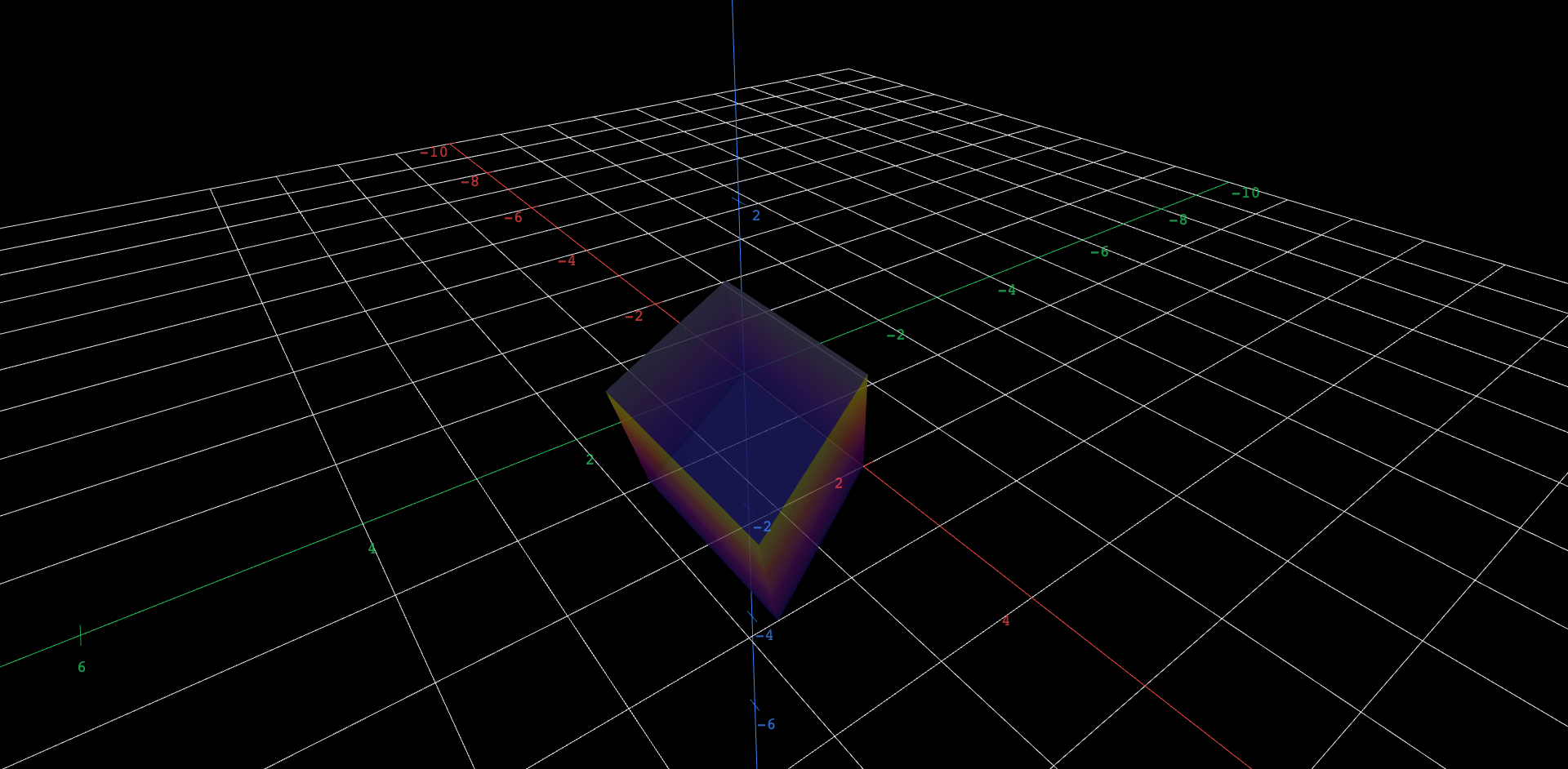 Explore in 3D (opens in a new tab)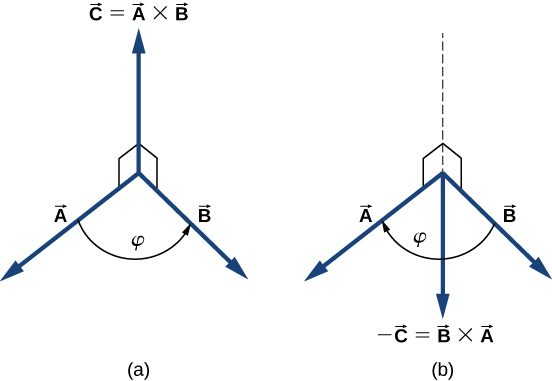
On the line perpendicular to the plane that contains vectors and there are two alternative directions—either up or down, as shown in Figure 2.31—and the direction of the vector product may be either one of them. In the standard right-handed orientation, where the angle between vectors is measured counterclockwise from the first vector, vector points upward, as seen in Figure 2.31(a). If we reverse the order of multiplication, so that now comes first in the product, then vector must point downward, as seen in Figure 2.31(b). This means that vectors and are antiparallel to each other and that vector multiplication is not commutative but anticommutative. The anticommutative property means the vector product reverses the sign when the order of multiplication is reversed:
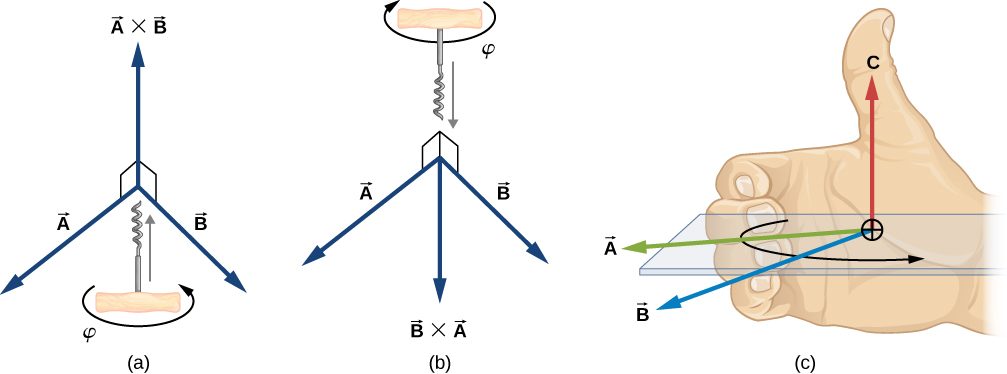
The corkscrew right-hand rule is a common mnemonic used to determine the direction of the vector product. As shown in Figure 2.32, a corkscrew is placed in a direction perpendicular to the plane that contains vectors and , and its handle is turned in the direction from the first to the second vector in the product. The direction of the cross product is given by the progression of the corkscrew.
You can also use your right hand, without the use of a corkscrew, by positioning your right hand so that your fingers point in the direction of A and they curl toward B. The cross product must be perpendicular to both A and B, and so you are choosing from only two possible directions. Your thumb now points toward the correct choice.
Similar to the dot product (Equation 2.32), the cross product has the following distributive property:
The distributive property is applied frequently when vectors are expressed in their component forms, in terms of unit vectors of Cartesian axes.
When we apply the definition of the cross product, Equation 2.35, to unit vectors , , and that define the positive x-, y-, and z-directions in space, we find that
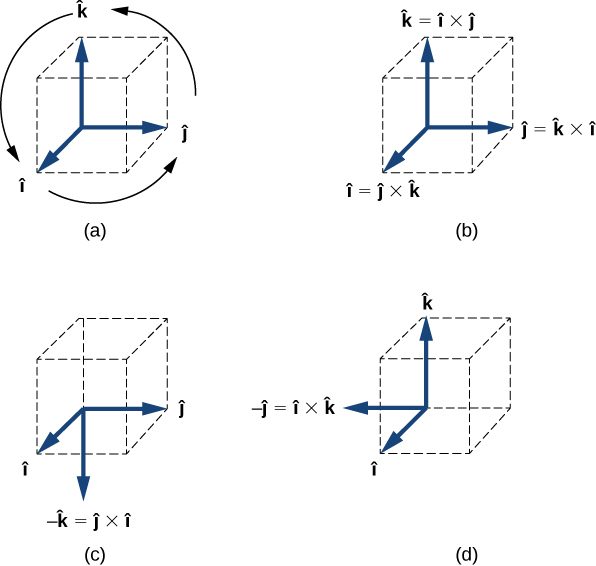
All other cross products of these three unit vectors must be vectors of unit magnitudes because , , and are orthogonal. For example, for the pair and , the magnitude is . The direction of the vector product must be orthogonal to the xy-plane, which means it must be along the z-axis. The only unit vectors along the z-axis are or . By the corkscrew rule, the direction of vector must be parallel to the positive z-axis. Therefore, the result of the multiplication is identical to . We can repeat similar reasoning for the remaining pairs of unit vectors. The results of these multiplications are
Notice that in Equation 2.39, the three unit vectors , , and appear in the cyclic order shown in a diagram in Figure 2.34(a). The cyclic order means that in the product formula, follows and comes before , or follows and comes before , or follows and comes before . The cross product of two different unit vectors is always a third unit vector. When two unit vectors in the cross product appear in the cyclic order, the result of such a multiplication is the remaining unit vector, as illustrated in Figure 2.34(b). When unit vectors in the cross product appear in a different order, the result is a unit vector that is antiparallel to the remaining unit vector (i.e., the result is with the minus sign, as shown by the examples in Figure 2.34(c) and Figure 2.34(d). In practice, when the task is to find cross products of vectors that are given in vector component form, this rule for the cross-multiplication of unit vectors is very useful.
Suppose we want to find the cross product for vectors and . We can use the distributive property (Equation 2.37), the anticommutative property (Equation 2.36), and the results in Equation 2.38 and Equation 2.39 for unit vectors to perform the following algebra:
When performing algebraic operations involving the cross product, be very careful about keeping the correct order of multiplication because the cross product is anticommutative. The last two steps that we still have to do to complete our task are, first, grouping the terms that contain a common unit vector and, second, factoring. In this way we obtain the following very useful expression for the computation of the cross product:
In this expression, the scalar components of the cross-product vector are
When finding the cross product, in practice, we can use either Equation 2.35 or Equation 2.40, depending on which one of them seems to be less complex computationally. They both lead to the same final result. One way to make sure if the final result is correct is to use them both.
In conclusion to this section, we want to stress that “dot product” and “cross product” are entirely different mathematical objects that have different meanings. The dot product is a scalar; the cross product is a vector. Later chapters use the terms dot product and scalar product interchangeably. Similarly, the terms cross product and vector product are used interchangeably.
Summary
- There are two kinds of multiplication for vectors. One kind of multiplication is the scalar product, also known as the dot product. The other kind of multiplication is the vector product, also known as the cross product. The scalar product of vectors is a number (scalar). The vector product of vectors is a vector.
- Both kinds of multiplication have the distributive property, but only the scalar product has the commutative property. The vector product has the anticommutative property, which means that when we change the order in which two vectors are multiplied, the result acquires a minus sign.
- The scalar product of two vectors is obtained by multiplying their magnitudes with the cosine of the angle between them. The scalar product of orthogonal vectors vanishes; the scalar product of antiparallel vectors is negative.
- The vector product of two vectors is a vector perpendicular to both of them. Its magnitude is obtained by multiplying their magnitudes by the sine of the angle between them. The direction of the vector product can be determined by the corkscrew right-hand rule. The vector product of two either parallel or antiparallel vectors vanishes. The magnitude of the vector product is largest for orthogonal vectors.
- The scalar product of vectors is used to find angles between vectors and in the definitions of derived scalar physical quantities such as work or energy.
- The cross product of vectors is used in definitions of derived vector physical quantities such as torque or magnetic force, and in describing rotations.
Key Equations
| Multiplication by a scalar (vector equation) | |
|---|---|
| Multiplication by a scalar (scalar equation for magnitudes) | |
| Resultant of two vectors | |
| Commutative law | |
| Associative law | |
| Distributive law | |
| The component form of a vector in two dimensions | |
| Scalar components of a vector in two dimensions | |
| Magnitude of a vector in a plane | |
| The direction angle of a vector in a plane | |
| Scalar components of a vector in a plane | |
| Polar coordinates in a plane | |
| The component form of a vector in three dimensions | |
| The scalar z-component of a vector in three dimensions | |
| Magnitude of a vector in three dimensions | |
| Distributive property | |
| Antiparallel vector to | |
| Equal vectors | |
| Components of the resultant of N vectors | |
| General unit vector | |
| Definition of the scalar product | |
| Commutative property of the scalar product | |
| Distributive property of the scalar product | |
| Scalar product in terms of scalar components of vectors | |
| Cosine of the angle between two vectors | |
| Dot products of unit vectors | |
| Magnitude of the vector product (definition) | |
| Anticommutative property of the vector product | |
| Distributive property of the vector product | |
| Cross products of unit vectors | |
| The cross product in terms of scalar components of vectors |
Conceptual Questions
What is wrong with the following expressions? How can you correct them? (a) , (b) , (c) , (d) , (e) , (f) , (g) , (h) , (i) , and (j) .
a. , b. or , c. , d. , e. , f. , g. left side is a scalar and right side is a vector, h. , i. , j.
If the cross product of two vectors vanishes, what can you say about their directions?
If the dot product of two vectors vanishes, what can you say about their directions?
They are orthogonal.
What is the dot product of a vector with the cross product that this vector has with another vector?
Problems
Assuming the +x-axis is horizontal to the right for the vectors in the following figure, find the following scalar products: (a) , (b) , (c) , (d) , (e) , (f) , (g) , and (h) .
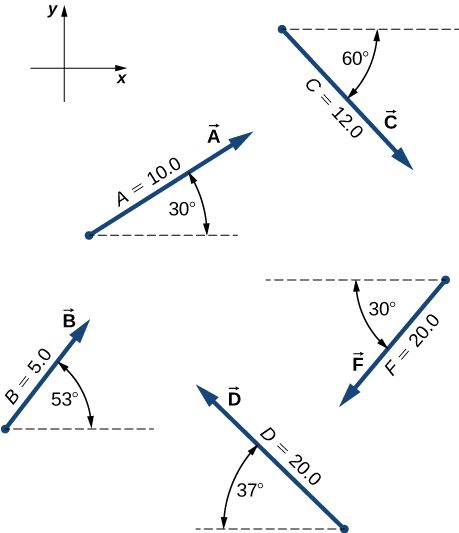
Assuming the +x-axis is horizontal to the right for the vectors in the preceding figure, find (a) the component of vector along vector , (b) the component of vector along vector , (c) the component of vector along vector , and (d) the component of vector along vector .
a. 0, b. 0, c. –0.866, d. –17.32
Find the angle between vectors for (a) and and (b) and .
Find the angles that vector makes with the x-, y-, and z- axes.
Show that the force vector is orthogonal to the force vector .
Assuming the +x-axis is horizontal to the right for the vectors in the previous figure, find the following vector products: (a) , (b) , (c) , (d) , (e) , (f) , (g) , and (h) .
a. , b. , c. , d. , e. , f. , g. , h. 0
Find the cross product for (a) and , (b) and , (c) and , and (d) and .
For the vectors in the earlier figure, find (a) , (b) , and (c) .
a. 0, b. 0, c.
(a) If , can we conclude ? (b) If , can we conclude ? (c) If , can we conclude ? Why or why not?
Additional Problems
You fly in a straight line in still air in the direction south of west. (a) Find the distances you would have to fly due south and then due west to arrive at the same point. (b) Find the distances you would have to fly first in a direction south of west and then in a direction west of north. Note these are the components of the displacement along a different set of axes—namely, the one rotated by with respect to the axes in (a).
a. 18.4 km and 26.2 km, b. 31.5 km and 5.56 km
Rectangular coordinates of a point are given by (2, y) and its polar coordinates are given by . Find y and r.
If the polar coordinates of a point are and its rectangular coordinates are , determine the polar coordinates of the following points: (a) (−x, y), (b) (−2x, −2y), and (c) (3x, −3y).
a. , b. , c.
Vectors and have identical magnitudes of 5.0 units. Find the angle between them if .
Starting at the island of Moi in an unknown archipelago, a fishing boat makes a round trip with two stops at the islands of Noi and Poi. It sails from Moi for 4.76 nautical miles (nmi) in a direction north of east to Noi. From Noi, it sails west of north to Poi. On its return leg from Poi, it sails east of south. What distance does the boat sail between Noi and Poi? What distance does it sail between Moi and Poi? Express your answer both in nautical miles and in kilometers. Note: 1 nmi = 1852 m.
An air traffic controller notices two signals from two planes on the radar monitor. One plane is at altitude 800 m and in a 19.2-km horizontal distance to the tower in a direction south of west. The second plane is at altitude 1100 m and its horizontal distance is 17.6 km and south of west. What is the distance between these planes?
Show that when , then , where is the angle between vectors and .
proof
Four force vectors each have the same magnitude f. What is the largest magnitude the resultant force vector may have when these forces are added? What is the smallest magnitude of the resultant? Make a graph of both situations.
A skater glides along a circular path of radius 5.00 m in clockwise direction. When he coasts around one-half of the circle, starting from the west point, find (a) the magnitude of his displacement vector and (b) how far he actually skated. (c) What is the magnitude of his displacement vector when he skates all the way around the circle and comes back to the west point?
a. 10.00 m, b. , c. 0
A stubborn dog is being walked on a leash by its owner. At one point, the dog encounters an interesting scent at some spot on the ground and wants to explore it in detail, but the owner gets impatient and pulls on the leash with force along the leash. (a) What is the magnitude of the pulling force? (b) What angle does the leash make with the vertical?
If the velocity vector of a polar bear is , how fast and in what geographic direction is it heading? Here, and are directions to geographic east and north, respectively.
22.2 km/h, south of west
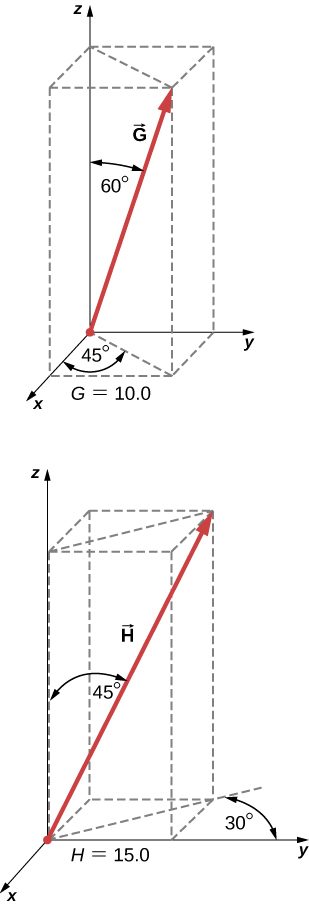
Find the scalar components of three-dimensional vectors and in the following figure and write the vectors in vector component form in terms of the unit vectors of the axes.
A diver explores a shallow reef off the coast of Belize. She initially swims 90.0 m north, makes a turn to the east and continues for 200.0 m, then follows a big grouper for 80.0 m in the direction north of east. In the meantime, a local current displaces her by 150.0 m south. Assuming the current is no longer present, in what direction and how far should she now swim to come back to the point where she started?
270 m, north of west
A force vector has x- and y-components, respectively, of −8.80 units of force and 15.00 units of force. The x- and y-components of force vector are, respectively, 13.20 units of force and −6.60 units of force. Find the components of force vector that satisfies the vector equation .
Vectors and are two orthogonal vectors in the xy-plane and they have identical magnitudes. If , find .
or
For the three-dimensional vectors in the following figure, find (a) , (b) , and (c) .
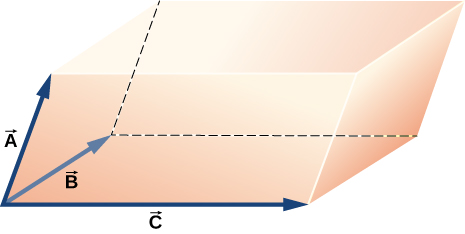
Show that is the volume of the parallelepiped, with edges formed by the three vectors in the following figure.
proof
Challenge Problems
Vector is 5.0 cm long and vector is 4.0 cm long. Find the angle between these two vectors when .
What is the component of the force vector along the force vector ?
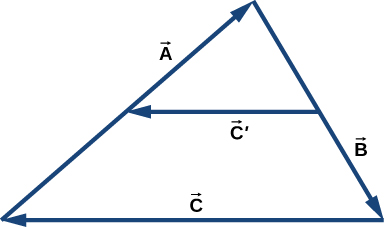
The following figure shows a triangle formed by the three vectors , , and . If vector is drawn between the midpoints of vectors and , show that .
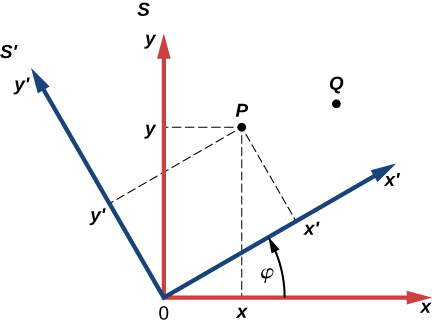
Distances between points in a plane do not change when a coordinate system is rotated. In other words, the magnitude of a vector is invariant under rotations of the coordinate system. Suppose a coordinate system S is rotated about its origin by angle to become a new coordinate system , as shown in the following figure. A point in a plane has coordinates (x, y) in S and coordinates in .
(a) Show that, during the transformation of rotation, the coordinates in are expressed in terms of the coordinates in S by the following relations:
(b) Show that the distance of point P to the origin is invariant under rotations of the coordinate system. Here, you have to show that
(c) Show that the distance between points P and Q is invariant under rotations of the coordinate system. Here, you have to show that
proof
Adapted from University Physics Volume 1 by OpenStax (openstax.org), licensed under CC BY-NC-SA 4.0. Changes were made. License: CC-BY-NC-SA-4.0.