Vectors can be added together and multiplied by scalars. Vector addition is associative (Equation 2.8) and commutative (Equation 2.7), and vector multiplication by a sum of scalars is distributive (Equation 2.9). Also, scalar multiplication by a sum of vectors is distributive:
In this equation, is any number (a scalar). For example, a vector antiparallel to vector can be expressed simply by multiplying by the scalar :
The generalization of the number zero to vector algebra is called the null vector, denoted by . All components of the null vector are zero, , so the null vector has no length and no direction.
Two vectors and are equal vectors if and only if their difference is the null vector:
This vector equation means we must have simultaneously , , and . Hence, we can write if and only if the corresponding components of vectors and are equal:
(2.24)
Two vectors are equal when their corresponding scalar components are equal.
Resolving vectors into their scalar components (i.e., finding their scalar components) and expressing them analytically in vector component form (given by Equation 2.19) allows us to use vector algebra to find sums or differences of many vectors analytically (i.e., without using graphical methods). For example, to find the resultant of two vectors and , we simply add them component by component, as follows:
In this way, using Equation 2.24, scalar components of the resultant vector are the sums of corresponding scalar components of vectors and :
Analytical methods can be used to find components of a resultant of many vectors. For example, if we are to sum up vectors , where each vector is , the resultant vector is
Therefore, scalar components of the resultant vector are
(2.25)
Having found the scalar components, we can write the resultant in vector component form:
Analytical methods for finding the resultant and, in general, for solving vector equations are very important in physics because many physical quantities are vectors. For example, we use this method in kinematics to find resultant displacement vectors and resultant velocity vectors, in mechanics to find resultant force vectors and the resultants of many derived vector quantities, and in electricity and magnetism to find resultant electric or magnetic vector fields.
In many physical situations, we often need to know the direction of a vector. For example, we may want to know the direction of a magnetic field vector at some point or the direction of motion of an object. We have already said direction is given by a unit vector, which is a dimensionless entity—that is, it has no physical units associated with it. When the vector in question lies along one of the axes in a Cartesian system of coordinates, the answer is simple, because then its unit vector of direction is either parallel or antiparallel to the direction of the unit vector of an axis. For example, the direction of vector is unit vector . The general rule of finding the unit vector of direction for any vector is to divide it by its magnitude V:
(2.26)
We see from this expression that the unit vector of direction is indeed dimensionless because the numerator and the denominator in Equation 2.26 have the same physical unit. In this way, Equation 2.26 allows us to express the unit vector of direction in terms of unit vectors of the axes. The following example illustrates this principle.
Summary
Analytical methods of vector algebra allow us to find resultants of sums or differences of vectors without having to draw them. Analytical methods of vector addition are exact, contrary to graphical methods, which are approximate.
Analytical methods of vector algebra are used routinely in mechanics, electricity, and magnetism. They are important mathematical tools of physics.
Problems
For vectors and , calculate (a) and its magnitude and direction angle, and (b) and its magnitude and direction angle.
a. , ; b. ,
A particle undergoes three consecutive displacements given by vectors , , and . (a) Find the resultant displacement vector of the particle. (b) What is the magnitude of the resultant displacement? (c) If all displacements were along one line, how far would the particle travel?
Given two displacement vectors and , find the displacements and their magnitudes for (a) and (b) .
a. ;
b.
A small plane flies in a direction north of east and then flies in a direction north of east. Use the analytical method to find the total distance the plane covers from the starting point, and the geographic direction of its displacement vector. What is its displacement vector?
In an attempt to escape a desert island, a castaway builds a raft and sets out to sea. The wind shifts a great deal during the day, and she is blown along the following straight lines: 2.50 km and north of west, then 4.70 km and south of east, then 1.30 km and south of west, then 5.10 km due east, then 1.70 km and east of north, then 7.20 km and south of west, and finally 2.80 km and north of east. Use the analytical method to find the resultant vector of all her displacement vectors. What is its magnitude and direction?
, is to the east, 7.34 km,
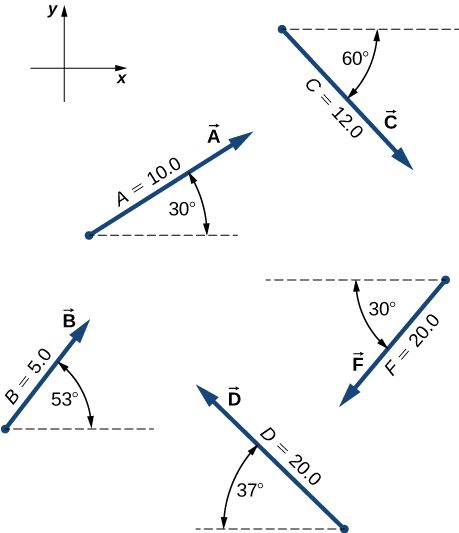
Assuming the +x-axis is horizontal to the right for the vectors given in the following figure, use the analytical method to find the following resultants: (a) , (b) , (c) , (d) , (e) , (f) , (g) , and (h) .
Figure 2.27
Given the vectors in the preceding figure, find vector that solves equations (a) and (b) . Assume the +x-axis is horizontal to the right.
a. , b.
A delivery driver starts at the post office, drives 40 km north, then 20 km west, then 60 km northeast, and finally 50 km north to stop for lunch. Use the analytical method to determine the following: (a) Find his net displacement vector. (b) How far is the restaurant from the post office? (c) If he returns directly from the restaurant to the post office, what is his displacement vector on the return trip? (d) What is his compass heading on the return trip? Assume the +x-axis is to the east.
An adventurous dog strays from home, runs three blocks east, two blocks north, and one block east, one block north, and two blocks west. Assuming that each block is about a 100 yd, use the analytical method to find the dog’s net displacement vector, its magnitude, and its direction. Assume the +x-axis is to the east. How would your answer be affected if each block was about 100 m?
, D = 360.5 yd, north of east; The numerical answers would stay the same but the physical unit would be meters. The physical meaning and distances would be about the same because 1 yd is comparable with 1 m.
If , , and , find the unknown constants a and b such that .
Given the displacement vector find the displacement vector so that .
Find the unit vector of direction for the following vector quantities: (a) Force , (b) displacement , and (c) velocity .
At one point in space, the direction of the electric field vector is given in the Cartesian system by the unit vector . If the magnitude of the electric field vector is E = 400.0 V/m, what are the scalar components , , and of the electric field vector at this point? What is the direction angle of the electric field vector at this point?
, , , ,
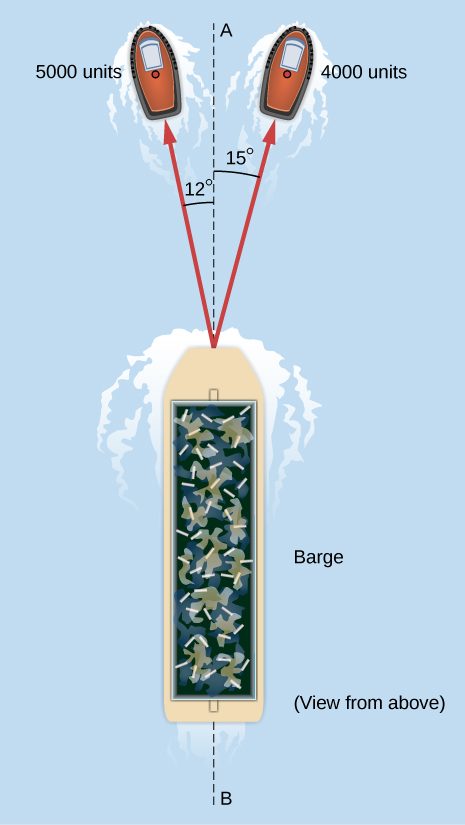
A barge is pulled by the two tugboats shown in the following figure. One tugboat pulls on the barge with a force of magnitude 4000 units of force at above the line AB (see the figure) and the other tugboat pulls on the barge with a force of magnitude 5000 units of force at below the line AB. Resolve the pulling forces to their scalar components and find the components of the resultant force pulling on the barge. What is the magnitude of the resultant pull? What is its direction relative to the line AB?
Figure 2.28
In the control tower at a regional airport, an air traffic controller monitors two aircraft that travel in straight paths directly away from the control tower. One plane is a cargo carrier Boeing 747 climbing at above the horizontal, and moving north of west. At some moment in time, the controller notes that the Boeing is at an altitude of 2500 m and the DC-3 is at an altitude of 3000 m. The other plane is a Douglas DC-3 climbing at above the horizontal, and cruising directly west. (a) Find the position vectors of the planes relative to the control tower at this time. (b) What is the distance between the planes at this time?
a. , ; b.
Adapted from University Physics Volume 1 by OpenStax (openstax.org), licensed under CC BY-NC-SA 4.0. Changes were made. License: CC-BY-NC-SA-4.0.
These eBooks are a prerelease and are not yet certified conformant with WCAG 2.1 AA or ADA Title II. Every page is built against an automated accessibility gate, and the published editions will meet ADA Title II requirements when they release in late September 2026. If something is unusable, please tell us.