3.3 Inequalities involving Rational Functions and Applications
In this section, we solve equations and inequalities involving rational functions and explore associated application problems. Our first example showcases the critical difference in procedure between solving equations and inequalities.
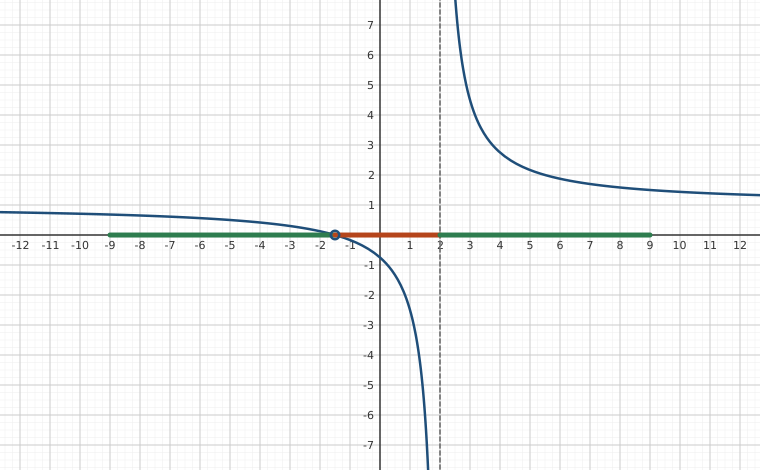
Interactive figureSolving (x − a)/(x − b) > 0: the sign changes only at a zero or an asymptoteDrag the Zero a and Asymptote b sliders.
XYZ Graph · viewer build 5edf91b
The curve is r(x) = (x − a)/(x − b) with a < b enforced by the sliders. Its sign can change only at the zero x = a (marked) and at the vertical asymptote x = b (dashed), so the axis is painted in three pieces: green where r is positive, rust where it is negative. The solution of r(x) > 0 is the green part, and of r(x) < 0 the rust part, with the endpoint a included or excluded by the inequality sign and b never included. Slide a and b and the painted pieces follow the zero and the asymptote, never the curve's shape between them.
The important take-away from Example 3.3.1 is not to clear fractions when working with an inequality unless you know for certain the sign of the denominators. We offer another example.
One thing to note about Example 3.3.2 is that the quantity for all values of . Hence, as long as we remember is excluded from consideration, we could actually multiply both sides of the inequality in Example 3.3.2 by to obtain . We could then solve this (slightly easier) inequality using the methods of Section 1.4 as long as we remember to exclude from our solution. Once again, the more you understand, the less you have to memorize. If you know the `why' behind an algorithm instead of just the `how,' you will know when you can short-cut it.
Our next example is an application of average cost. Recall from Definition 3.8 if represents the cost to make items then the average cost per item is given by , for .
Note that number in Example 3.3.3 is another opportunity to short-cut the standard algorithm and obtain the solution more quickly if we take stock of the situation. Since the applied domain is , we can multiply through the inequality by without worrying about changing the sense of the inequality. This reduces the problem to , a basic linear inequality whose solution is readily seen to be . It is absolutely critical here that . Indeed, any time you decide to multiply an inequality by a variable expression, it is necessary to justify why the inequality is preserved. Our next example is another classic `box with no top' problem. The reader is encouraged to compare and contrast this problem with Example 2.1.4 in Section 2.1.
Our last example uses regression to verify a very famous scientific law.
Exercises
(Review of Solving Equations):7 In Exercises -, solve the rational equation. Be sure to check for extraneous solutions.
Answer
Answer
Answer
Answer
Answer
No solution
Answer
In Exercises -, solve the rational inequality. Express your answer using interval notation.
Answer
Answer
Answer
Answer
Answer
Answer
Answer
Answer
Answer
Answer
Answer
Answer
No solution
Answer
Answer
Answer
Answer
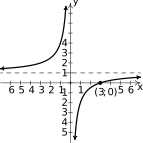
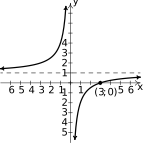
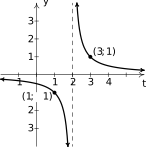
In Exercises -, use the the graph of the given rational function to solve the stated inequality.
Solve .
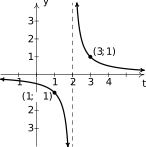
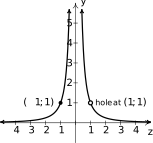
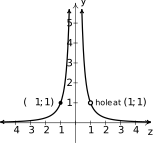
Figure 3.92, asymptotes: , .Answer
on .
Solve .
Figure 3.93, asymptotes: , .Answer
on .
Solve .
Figure 3.94, asymptotes: , .Answer
on .
Solve .
Figure 3.95, asymptotes: , .Answer
on .
Solve
Figure 3.96, asymptotes: , .Answer
on .
Solve .
Figure 3.97, asymptotes: , .Answer
on .
In Exercise in Section 2.1, the function , for was used to model the cost (in dollars) to produce PortaBoy game systems. Using this cost function, find the number of PortaBoys which should be produced to minimize the average cost . Round your answer to the nearest number of systems. Answer
The absolute minimum of occurs at . Since represents the number of game systems, we check and . Hence, to minimize the average cost, systems should be produced at an average cost of per system.
Suppose we are in the same situation as Example 3.3.4. If the volume of the box is to be cubic centimeters, use a graphing utility to find the dimensions of the box which minimize the surface area. What is the minimum surface area? Round your answers to two decimal places.Answer
The width (and depth) should be centimeters, the height should be centimeters. The minimum surface area is square centimeters.
The box for the new Sasquatch-themed cereal, `Crypt-Os', is to have a volume of cubic inches. For aesthetic reasons, the height of the box needs to be times the width of the base of the box.8 Find the dimensions of the box which will minimize the surface area of the box. What is the minimum surface area? Round your answers to two decimal places. Answer
The width of the base of the box should be approximately inches, the height of the box should be approximately inches, and the depth of the base of the box should be approximately inches. The minimum surface area is approximately square inches.
Sally is Skippy's neighbor from Exercise in Section 1.4. Sally also wants to plant a vegetable garden along the side of her home. She doesn't have any fencing, but wants to keep the size of the garden to 100 square feet. What are the dimensions of the garden which will minimize the amount of fencing she needs to buy? What is the minimum amount of fencing she needs to buy? Round your answers to the nearest foot. (Note: Since one side of the garden will border the house, Sally doesn't need fencing along that side.)Answer
The dimensions are approximately feet by feet. Hence, the minimum amount of fencing required is approximately feet.
Another Classic Problem: A can is made in the shape of a right circular cylinder and is to hold one pint. (For dry goods, one pint is equal to cubic inches.)9
Find an expression for the volume of the can in terms of the height and the base radius .
Find an expression for the surface area of the can in terms of the height and the base radius . (Hint: The top and bottom of the can are circles of radius and the side of the can is really just a rectangle that has been bent into a cylinder.)
Using the fact that , write as a function of and state its applied domain.
Use your graphing calculator to find the dimensions of the can which has minimal surface area.
Answer
Domain
in. and in.
A right cylindrical drum is to hold 7.35 cubic feet of liquid. Find the dimensions (radius of the base and height) of the drum which would minimize the surface area. What is the minimum surface area? Round your answers to two decimal places.Answer
The radius of the drum should be approximately feet and the height of the drum should be approximately feet. The minimum surface area of the drum is approximately cubic feet.
In Exercise in Section 3.1, the population of Sasquatch in Portage County is modeled by
where corresponds to the year 1803. According to this model, when were there fewer than 100 Sasquatch in Portage County?
Answer
on , and the portion of this which lies in the applied domain is . Since corresponds to the year 1803, from 1803 through the end of 1832, there were fewer than 100 Sasquatch in Portage County.
Adapted from Precalculus with Integrated Calculus, edition 4i, by Carl Stitz and Jeff Zeager (stitz-zeager.com), licensed under CC BY-NC-SA 3.0. Changes were made: reformatted as an accessible XYZ web edition. License: CC-BY-NC-SA-3.0.
These eBooks are a prerelease and are not yet certified conformant with WCAG 2.1 AA or any other accessibility standard. Every page is built against an automated accessibility gate, and our target for the published editions is WCAG 2.2 Level AA. If something is unusable, please tell us.