
9.1 Sequences
When we first introduced a function as a special type of relation in Section 1.3, we did not put any restrictions on the domain of the function. All we said was that the set of -coordinates of the points in the function is called the domain, and it turns out that any subset of the real numbers, regardless of how weird that subset may be, can be the domain of a function. As our exploration of functions continued beyond Section 1.3, we saw fewer and fewer functions with `weird' domains. It is worth your time to go back through the text to see that the domains of the polynomial, rational, exponential, logarithmic and algebraic functions discussed thus far have fairly predictable domains which almost always consist of just a collection of intervals on the real line. This may lead some readers to believe that the only important functions in a College Algebra text have domains which consist of intervals and everything else was just introductory nonsense. In this section, we introduce sequences which are an important class of functions whose domains are the set of natural numbers.1 Before we get to far ahead of ourselves, let's look at what the term `sequence' means mathematically. Informally, we can think of a sequence as an infinite list of numbers. For example, consider the sequence
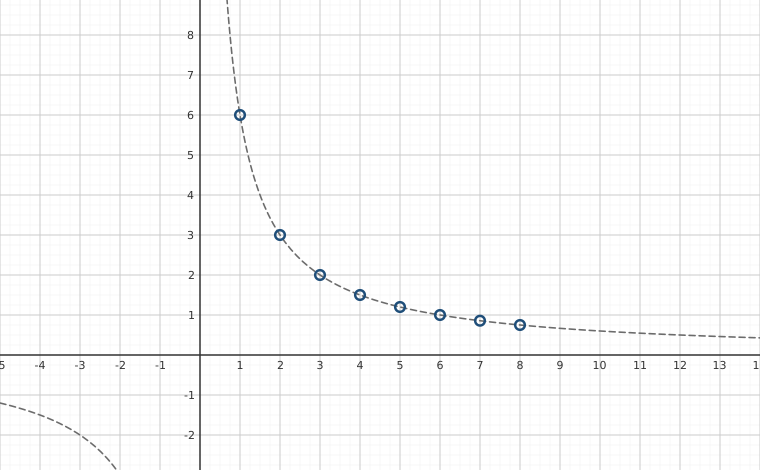
As usual, the periods of ellipsis, , indicate that the proposed pattern continues forever. Each of the numbers in the list is called a term, and we call the `first term', the `second term', the `third term' and so forth. In numbering them this way, we are setting up a function, which we'll call per tradition, between the natural numbers and the terms in the sequence.
In other words, is the term in the sequence. We formalize these ideas in our definition of a sequence and introduce some accompanying notation.
Applying the notation provided in Definition 9.1 to the sequence given (Equation 9.1), we have , , and so forth. Now suppose we wanted to know , that is, the term in the sequence. While the pattern of the sequence is apparent, it would benefit us greatly to have an explicit formula for . Unfortunately, there is no general algorithm that will produce a formula for every sequence, so any formulas we do develop will come from that greatest of teachers, experience. In other words, it is time for an example.
Some remarks about Example 9.1.1 are in order. We first note that since sequences are functions, we can graph them in the same way we graph functions. For example, if we wish to graph the sequence from Example 9.1.1, we graph the equation for the values . That is, we plot the points for the values of in the domain, . The resulting collection of points is the graph of the sequence. Note that we do not connect the dots in a pleasing fashion as we are used to doing, because the domain is just the whole numbers in this case, not a collection of intervals of real numbers. If you feel a sense of nostalgia, you should see Section 1.2.
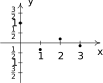
Graphing ,
Speaking of , the astute and mathematically minded reader will correctly note that this technically isn't a sequence, since according to Definition 9.1, sequences are functions whose domains are the natural numbers, not the whole numbers, as is the case with . In other words, to satisfy Definition 9.1, we need to shift the variable so it starts at instead of . To see how we can do this, it helps to think of the problem graphically. What we want is to shift the graph of to the right one unit, and thinking back to Section 1.7, we can accomplish this by replacing with in the definition of . Specifically, let where . We get , where now . We leave to the reader to verify that generates the same list of numbers as does , but the former satisfies Definition 9.1, while the latter does not. Like so many things in this text, we acknowledge that this point is pedantic and join the vast majority of authors who adopt a more relaxed view of Definition 9.1 to include any function which generates a list of numbers which can then be matched up with the natural numbers.2 Finally, we wish to note the sequences in parts and are examples of sequences described recursively. In each instance, an initial value of the sequence is given which is then followed by a recursion equation a formula which enables us to use known terms of the sequence to determine other terms. The terms of the sequence in part are given a special name: is called -factorial. Using the `!' notation, we can describe the factorial sequence as: and for . After the next four terms, written out in detail, are , , and . From this, we see a more informal way of computing , which is with as a special case. (We will study factorials in greater detail in Section 9.4.) The world famous Fibonacci Numbers are defined recursively and are explored in the exercises. While none of the sequences worked out to be the sequence in (Equation 9.1), they do give us some insight into what kinds of patterns to look for. Two patterns in particular are given in the next definition.
Both arithmetic and geometric sequences are defined in terms of recursion equations. In English, an arithmetic sequence is one in which we proceed from one term to the next by always adding the fixed number . The name `common difference' comes from a slight rewrite of the recursion equation from to . Analogously, a geometric sequence is one in which we proceed from one term to the next by always multiplying by the same fixed number . If , we can rearrange the recursion equation to get , hence the name `common ratio.' Some sequences are arithmetic, some are geometric and some are neither as the next example illustrates.4
We are now one step away from determining an explicit formula for the sequence given in (Equation 9.1). We know that it is a geometric sequence and our next result gives us the explicit formula we require.
While the formal proofs of the formulas in Equation 9.1 require the techniques set forth in Section 9.3, we attempt to motivate them here. According to Definition 9.2, given an arithmetic sequence with first term and common difference , the way we get from one term to the next is by adding . Hence, the terms of the sequence are: , , , , …. We see that to reach the th term, we add to exactly times, which is what the formula says. The derivation of the formula for geometric series follows similarly. Here, we start with and go from one term to the next by multiplying by . We get and so forth. The th term results from multiplying by exactly times. We note here that the reason is excluded from Equation 9.1 is to avoid an instance of which is an indeterminant form.5 With Equation 9.1 in place, we finally have the tools required to find an explicit formula for the th term of the sequence given in (Equation 9.1). We know from Example 9.1.2 that it is geometric with common ratio . The first term is so by Equation 9.1 we get for . After a touch of simplifying, we get for . Note that we can easily check our answer by substituting in values of and seeing that the formula generates the sequence given in (Equation 9.1). We leave this to the reader. Our next example gives us more practice finding patterns.
While the last problem in Example 9.1.3 was neither geometric nor arithmetic, it did resolve into a combination of these two kinds of sequences. If handed the sequence , we would be hard-pressed to find a formula for if we restrict our attention to these two archetypes. We said before that there is no general algorithm for finding the explicit formula for the th term of a given sequence, and it is only through experience gained from evaluating sequences from explicit formulas that we learn to begin to recognize number patterns. The pattern is rather recognizable as the squares, so the formula , may not be too hard to determine. With this in mind, it's possible to see as the sequence , so that , . Of course, since we are given only a small sample of the sequence, we shouldn't be too disappointed to find out this isn't the only formula which generates this sequence. For example, consider the sequence defined by , . The reader is encouraged to verify that it also produces the terms . In fact, it can be shown that given any finite sample of a sequence, there are infinitely many explicit formulas all of which generate those same finite points. This means that there will be infinitely many correct answers to some of the exercises in this section.7 Just because your answer doesn't match ours doesn't mean it's wrong. As always, when in doubt, write your answer out. As long as it produces the same terms in the same order as what the problem wants, your answer is correct.
Sequences play a major role in the Mathematics of Finance, as we have already seen with Equation 6.2 in Section 6.5. Recall that if we invest dollars at an annual percentage rate and compound the interest times per year, the formula for , the amount in the account after compounding periods, is , . We now spot this as a geometric sequence with first term and common ratio . In retirement planning, it is seldom the case that an investor deposits a set amount of money into an account and waits for it to grow. Usually, additional payments of principal are made at regular intervals and the value of the investment grows accordingly. This kind of investment is called an annuity and will be discussed in the next section once we have developed more mathematical machinery.
Exercises
In Exercises -, write out the first four terms of the given sequence.
- ,
- ,
- , ,
- , ,
- , ,
- , ,
- , ,
- , ,
- , , , (This is the famous Fibonacci Sequence )
In Exercises - determine if the given sequence is arithmetic, geometric or neither. If it is arithmetic, find the common difference ; if it is geometric, find the common ratio .
- ,
- , , , , …
- , , , , …
- , , , , …
- , , , , …
- , .
In Exercises -, find an explicit formula for the term of the given sequence. Use the formulas in Equation 9.1 as needed.
- , , , , …
- , , , , …
- , , , , …
- , , , , …
- , , , , …
- , , , , …
- Find a sequence which is both arithmetic and geometric. (Hint: Start with for all .)
- Show that a geometric sequence can be transformed into an arithmetic sequence by taking the natural logarithm of the terms.
- Thomas Robert Malthus is credited with saying, “The power of population is indefinitely greater than the power in the earth to produce subsistence for man. Population, when unchecked, increases in a geometrical ratio. Subsistence increases only in an arithmetical ratio. A slight acquaintance with numbers will show the immensity of the first power in comparison with the second.” (See this webpage for more information.) Discuss this quote with your classmates from a sequences point of view.
- This classic problem involving sequences shows the power of geometric sequences. Suppose that a wealthy benefactor agrees to give you one penny today and then double the amount she gives you each day for 30 days. So, for example, you get two pennies on the second day and four pennies on the third day. How many pennies do you get on the day? What is the total dollar value of the gift you have received?
- Research the terms `arithmetic mean' and `geometric mean.' With the help of your classmates, show that a given term of a arithmetic sequence , is the arithmetic mean of the term immediately preceding, it and immediately following it, . State and prove an analogous result for geometric sequences.
- Discuss with your classmates how the results of this section might change if we were to examine sequences of other mathematical things like complex numbers or matrices. Find an explicit formula for the term of the sequence . List out the first four terms of the matrix sequences we discussed in Exercise in Section 8.3.
Answers
- arithmetic,
- neither
- geometric,
- geometric,
- arithmetic,
- neither
- geometric,
- neither
Adapted from Precalculus, 3rd corrected edition, by Carl Stitz and Jeff Zeager (stitz-zeager.com), licensed under CC BY-NC-SA 3.0. Changes were made: reformatted as an accessible XYZ web edition. License: CC-BY-NC-SA-3.0.