
5.2 Inverse Functions
Thinking of a function as a process like we did in Section 1.4, in this section we seek another function which might reverse that process. As in real life, we will find that some processes (like putting on socks and shoes) are reversible while some (like cooking a steak) are not. We start by discussing a very basic function which is reversible, . Thinking of as a process, we start with an input and apply two steps, as we saw in Section 1.4
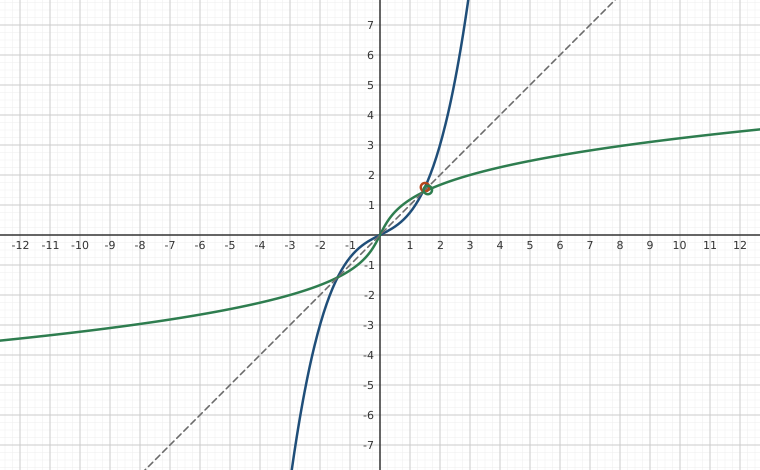
- multiply by
- add
To reverse this process, we seek a function which will undo each of these steps and take the output from , , and return the input . If we think of the real-world reversible two-step process of first putting on socks then putting on shoes, to reverse the process, we first take off the shoes, and then we take off the socks. In much the same way, the function should undo the second step of first. That is, the function should
- subtract
- divide by
Following this procedure, we get . Let's check to see if the function does the job. If , then . Taking the output from , we substitute it into to get , which is our original input to . To check that does the job for all in the domain of , we take the generic output from , , and substitute that into . That is, , which is our original input to . If we carefully examine the arithmetic as we simplify , we actually see first `undoing' the addition of , and then `undoing' the multiplication by . Not only does undo , but also undoes . That is, if we take the output from , , and put that into , we get . Using the language of function composition developed in Section 5.1, the statements and can be written as and , respectively. Abstractly, we can visualize the relationship between and in the diagram below.
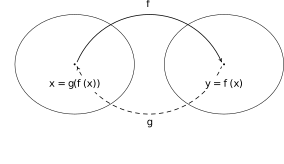
The main idea to get from the diagram is that takes the outputs from and returns them to their respective inputs, and conversely, takes outputs from and returns them to their respective inputs. We now have enough background to state the central definition of the section.
We now formalize the concept that inverse functions exchange inputs and outputs.
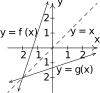
Theorem 5.2 is a consequence of Definition 5.2 and the Fundamental Graphing Principle for Functions. We note the third property in Theorem 5.2 tells us that the graphs of inverse functions are reflections about the line . For a proof of this, see Example 1.1.7 in Section 1.1 and Exercise in Section 2.1. For example, we plot the inverse functions and below.
If we abstract one step further, we can express the sentiment in Definition 5.2 by saying that and are inverses if and only if and where is the identity function restricted2 to the domain of and is the identity function restricted to the domain of . In other words, for all in the domain of and for all in the domain of . Using this description of inverses along with the properties of function composition listed in Theorem 5.1, we can show that function inverses are unique.3 Suppose and are both inverses of a function . By Theorem 5.2, the domain of is equal to the domain of , since both are the range of . This means the identity function applies both to the domain of and the domain of . Thus , as required.4 We summarize the discussion of the last two paragraphs in the following theorem.5
The notation is an unfortunate choice since you've been programmed since Elementary Algebra to think of this as . This is most definitely not the case since, for instance, has as its inverse , which is certainly different than . Why does this confusing notation persist? As we mentioned in Section 5.1, the identity function is to function composition what the real number is to real number multiplication. The choice of notation alludes to the property that and , in much the same way as and .
Let's turn our attention to the function . Is invertible? A likely candidate for the inverse is the function . Checking the composition yields , which is not equal to for all in the domain . For example, when , , but , which means failed to return the input from its output . What did, however, is match the output to a different input, namely , which satisfies . This issue is presented schematically in the picture below.
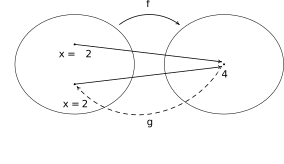
We see from the diagram that since both and are , it is impossible to construct a function which takes back to both and . (By definition, a function matches a real number with exactly one other real number.) From a graphical standpoint, we know that if exists, its graph can be obtained by reflecting about the line , in accordance with Theorem 5.3. Doing so produces
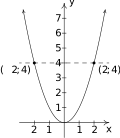
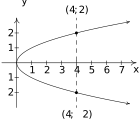
We see that the line intersects the graph of the supposed inverse twice - meaning the graph fails the Vertical Line Test, Theorem 1.1, and as such, does not represent as a function of . The vertical line on the graph on the right corresponds to the horizontal line on the graph of . The fact that the horizontal line intersects the graph of twice means two different inputs, namely and , are matched with the same output, , which is the cause of all of the trouble. In general, for a function to have an inverse, different inputs must go to different outputs, or else we will run into the same problem we did with . We give this property a name.
Graphically, we detect one-to-one functions using the test below.
We say that the graph of a function passes the Horizontal Line Test if no horizontal line intersects the graph more than once; otherwise, we say the graph of the function fails the Horizontal Line Test. We have argued that if is invertible, then must be one-to-one, otherwise the graph given by reflecting the graph of about the line will fail the Vertical Line Test. It turns out that being one-to-one is also enough to guarantee invertibility. To see this, we think of as the set of ordered pairs which constitute its graph. If switching the - and -coordinates of the points results in a function, then is invertible and we have found . This is precisely what the Horizontal Line Test does for us: it checks to see whether or not a set of points describes as a function of . We summarize these results below.
We put this result to work in the next example.
We have shown that the functions and in Example 5.2.1 are one-to-one. This means they are invertible, so it is natural to wonder what and would be. For , we can think our way through the inverse since there is only one occurrence of . We can track step-by-step what is done to and reverse those steps as we did at the beginning of the chapter. The function is a bit trickier since occurs in two places. When one evaluates for a specific value of , which is first, the or the ? We can imagine functions more complicated than these so we need to develop a general methodology to attack this problem. Theorem 5.2 tells us equation is equivalent to and this is the basis of our algorithm.
Steps for finding the Inverse of a One-to-one Function
- Write
- Interchange and
- Solve for to obtain
Note that we could have simply written `Solve for ' and be done with it. The act of interchanging the and is there to remind us that we are finding the inverse function by switching the inputs and outputs.
We now return to . We know that is not one-to-one, and thus, is not invertible. However, if we restrict the domain of , we can produce a new function which is one-to-one. If we define , , then we have
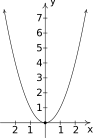
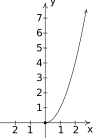
The graph of passes the Horizontal Line Test. To find an inverse of , we proceed as usual
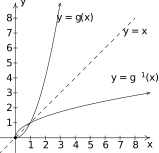
We get . At first it looks like we'll run into the same trouble as before, but when we check the composition, the domain restriction on saves the day. We get , since . Checking . Graphing7 and on the same set of axes shows that they are reflections about the line .
Our next example continues the theme of domain restriction.
Our last example of the section gives an application of inverse functions.
Exercises
In Exercises -, show that the given function is one-to-one and find its inverse. Check your answers algebraically and graphically. Verify that the range of is the domain of and vice-versa.
- ,
- ,
With help from your classmates, find the inverses of the functions in Exercises -.
- where .
- (See Exercise below.)
In Example 1.5.3, the price of a dOpi media player, in dollars per dOpi, is given as a function of the weekly sales according to the formula for .
- Find and state its domain.
- Find and interpret .
- In Example 1.5.3, we determined that the profit (in dollars) made from producing and selling dOpis per week is , for . Find and determine what price per dOpi would yield the maximum profit. What is the maximum profit? How many dOpis need to be produced and sold to achieve the maximum profit?
- Show that the Fahrenheit to Celsius conversion function found in Exercise in Section 2.1 is invertible and that its inverse is the Celsius to Fahrenheit conversion function.
- Analytically show that the function is one-to-one. Since finding a formula for its inverse is beyond the scope of this textbook, use Theorem 5.2 to help you compute and .
- Let . Using the techniques in Section 4.2, graph . Verify that is one-to-one on the interval . Use the procedure outlined on Page Section 5.2 and your graphing calculator to find the formula for . Note that since , it should be the case that . What goes wrong when you attempt to substitute into ? Discuss with your classmates how this problem arose and possible remedies.
- With the help of your classmates, explain why a function which is either strictly increasing or strictly decreasing on its entire domain would have to be one-to-one, hence invertible.
- If is odd and invertible, prove that is also odd.
- Let and be invertible functions. With the help of your classmates show that is one-to-one, hence invertible, and that .
- What graphical feature must a function possess for it to be its own inverse?
- What conditions must you place on the values of and in Exercise in order to guarantee that the function is invertible?
Answers
- ,
- ,
- ,
- ,
- . The domain of is the range of which is
- . This means that if the price is set to then dOpis will be sold.
- , . The graph of is a parabola opening downwards with vertex . This means that the maximum profit is a whopping when the price per dOpi is set to . At this price, we can produce and sell dOpis. Since we cannot sell part of a system, we need to adjust the price to sell either dOpis or dOpis. We find and , which means we set the price per dOpi at either or , respectively. The profits at these prices are and , so it looks as if the maximum profit is and it is made by producing and selling dOpis a week at a price of per dOpi.
- Given that , we have . Similarly and
Adapted from Precalculus, 3rd corrected edition, by Carl Stitz and Jeff Zeager (stitz-zeager.com), licensed under CC BY-NC-SA 3.0. Changes were made: reformatted as an accessible XYZ web edition. License: CC-BY-NC-SA-3.0.