
1.3 Quadric Surfaces and Their Traces
Quadric surfaces are the graphs of second-degree equations in , , and — the three-dimensional relatives of ellipses, parabolas, and hyperbolas. There are only a handful of shapes, but memorizing pictures of them is fragile knowledge. The durable skill is slicing: intersect the surface with a plane on which one variable is constant and identify the resulting curve, called a trace. Fix and you get horizontal traces; fix or and you get vertical ones. The traces are ordinary conics, and the way the family changes as varies is the surface's fingerprint.
Our specimen is the hyperbolic paraboloid
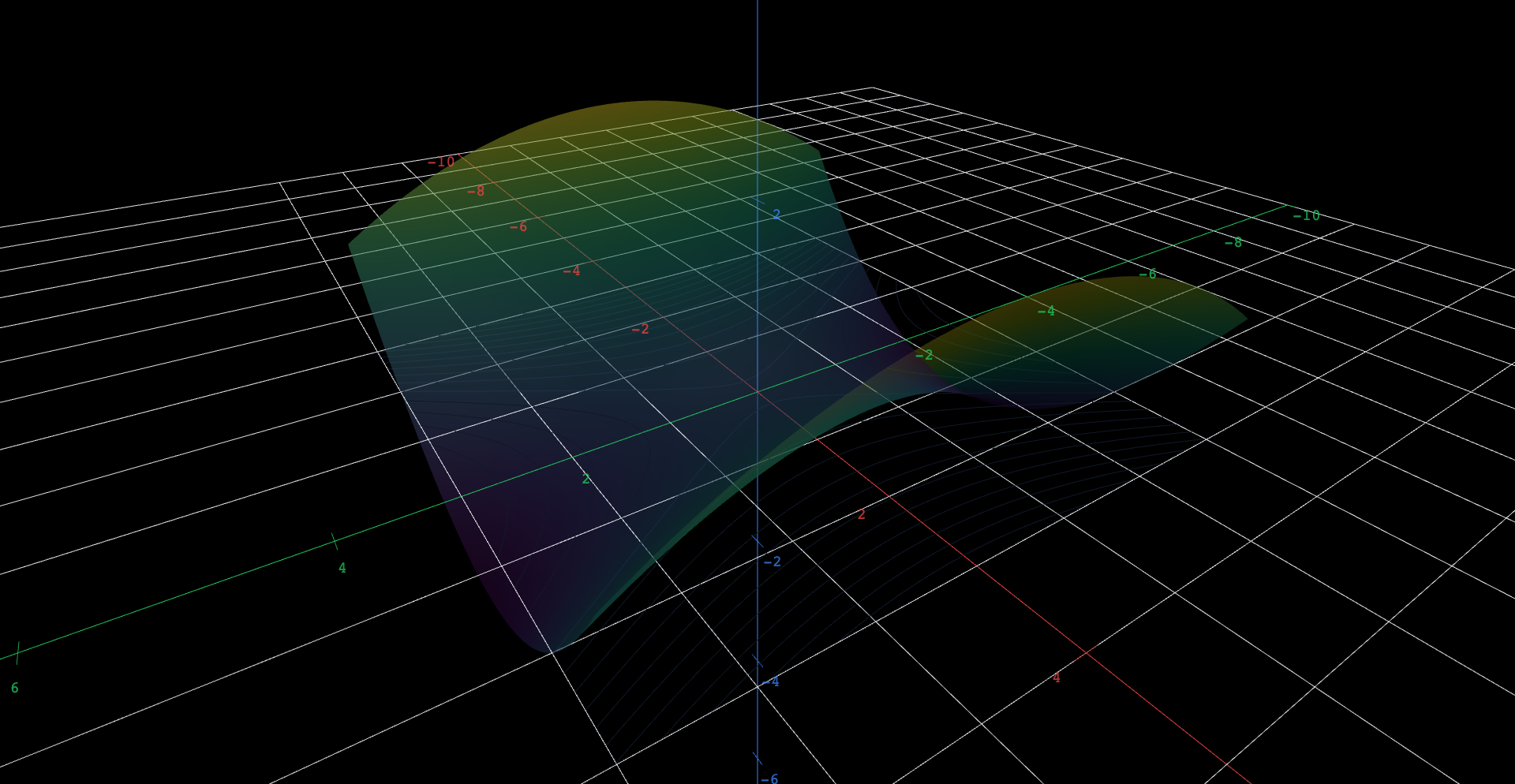
the saddle. In the figure below it comes with a movable slicing plane: a sheet of level curves whose height you can drag, so the whole trace family plays like a film.
 Explore in 3D (opens in a new tab)
Explore
- Orbit to look straight down the -axis so the level curves read as a flat map. You should see two families of curved lines and, separating them, something not curved at all. Which family occupies the east–west sectors, and which the north–south?
- Predict the shape of the trace at and at : circle, ellipse, parabola, hyperbola, or lines? Which way does each open?
- Select the slicing plane and drag its height slowly from 0 up toward 1, then down through 0 to . Watch the cut flip from one hyperbola family to the other. At exactly which height is the cut not a hyperbola at all?
- Vertical traces next: predict what the planes and cut from the saddle, then orbit to look straight down the -axis and the -axis and read each answer off the surface's silhouette. Why does one parabola open up and the other down?
- Reveal the hidden wireframe surface. Its components involve and , and the identity is the key. Predict its horizontal traces before orbiting, then check: at every height the cross-section is a circle, smallest at the waist. What is this surface called?
Reading the algebra of a slice
Setting in the saddle's equation gives . For this is a hyperbola opening along the -direction; for , dividing by flips the roles and the hyperbolas open along . The flip you drove through in the figure above happens at , where the equation factors:
a degenerate pair of crossing lines . The vertical traces explain the name: gives the upward parabola , and gives the downward parabola . Two parabolas of opposite temperament through one point — that is what a saddle is.
An original work of XYZ Homework, built around interactive XYZ 3D figures. Aligned to OpenStax Calculus Volume 3 (Strang & Herman), © OpenStax (Rice University), licensed CC BY-NC-SA 4.0; no OpenStax content is reproduced, and this work is not affiliated with or endorsed by OpenStax or Rice University. License: CC-BY-NC-SA-4.0.