
1.1 Points and Octants
A point in space is an ordered triple : walk units along the first axis, along the second, then climb . The three coordinate planes slice space into eight rooms called octants, and the fastest way to name a point's room is its sign pattern — the octant where all three coordinates are positive is the pattern , and there are seven others.
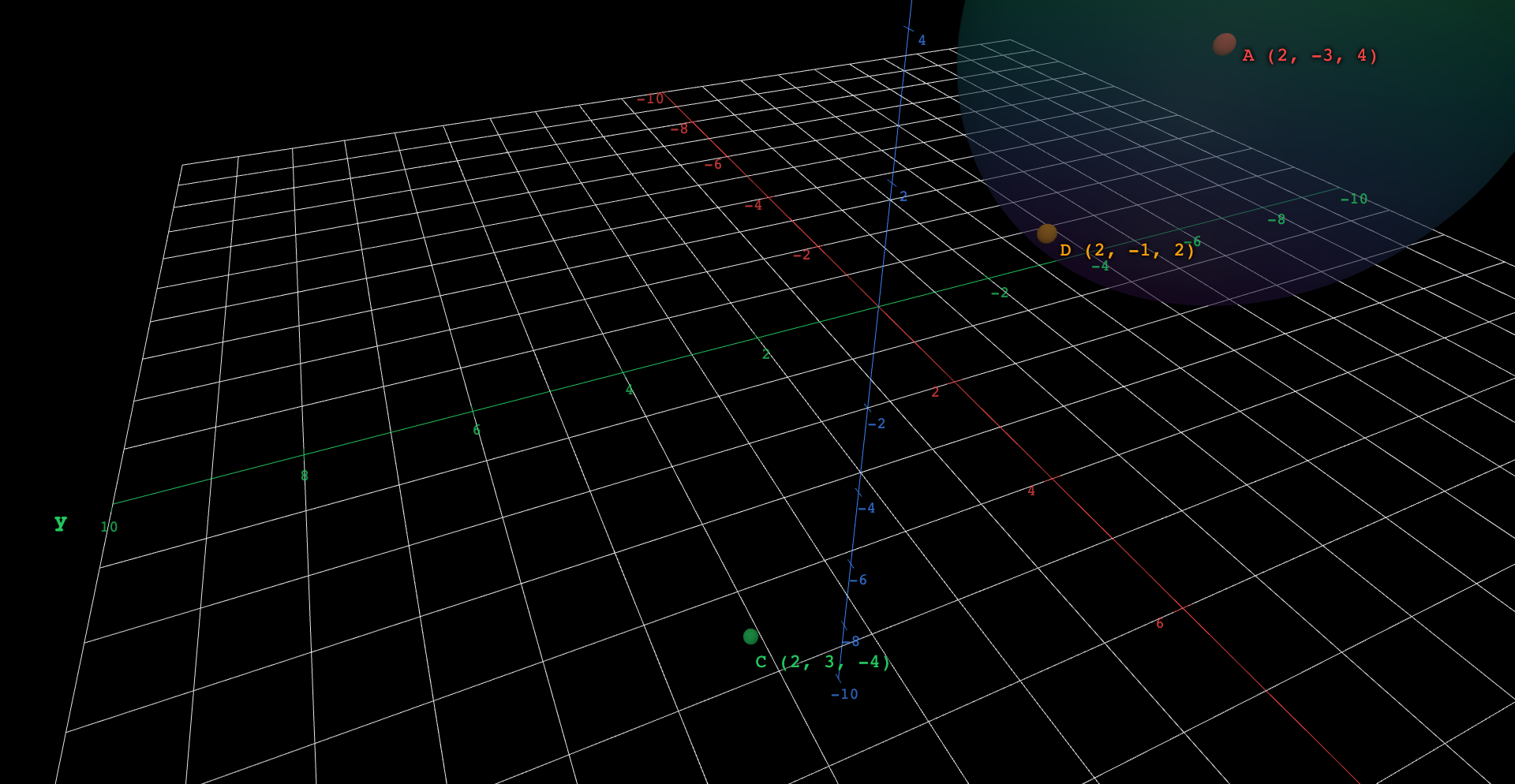
Here is the uncomfortable truth about pictures of space: a printed diagram shows you two of those three coordinates honestly and asks you to take the third on faith. Two different points can occupy the same spot on the page. The interactive figure below turns that defect into the lesson.
 Explore in 3D (opens in a new tab)
Explore
Work through these with the figure above active. Commit to each prediction in writing before you test it.
- Without orbiting, assign each of the four points a sign pattern such as . At least two of them are genuinely ambiguous from the opening camera. Which two are you least sure of, and what information is the flat view withholding?
- Now orbit until every point is unambiguous. A good technique: look straight down the -axis to settle the and signs, then swing low to settle . Which of your calls were wrong? Two of the four points share an octant — which two?
- The sphere is centered at A with radius 3. Before computing anything, predict whether B, C, and D are each inside, on, or outside the sphere. Orbit to check by eye — B is deceptive from some angles.
- Settle it with algebra: compute the distances from A to each point using the distance formula. Which of your predictions survive?
- Select the sphere and read its three component expressions. The center's coordinates appear as the added constants and the radius as the multiplier on the trigonometric parts. Where exactly do you see the 2, the , the 4, and the 3?
The distance formula wears every costume
Everything in the figure is one formula. The distance between and is
which is the Pythagorean theorem applied twice. A sphere is defined by distance alone: it is the set of points at distance exactly from a center , so "inside, on, outside" translates directly to "distance less than, equal to, greater than ", and squaring the distance condition gives the standard equation
The parametric expressions you inspected in the figure above build the same sphere constructively — start at the center, move a distance in every direction — and the identity , applied twice, collapses them back to the standard equation.
An original work of XYZ Homework, built around interactive XYZ 3D figures. Aligned to OpenStax Calculus Volume 3 (Strang & Herman), © OpenStax (Rice University), licensed CC BY-NC-SA 4.0; no OpenStax content is reproduced, and this work is not affiliated with or endorsed by OpenStax or Rice University. License: CC-BY-NC-SA-4.0.