
1.2 Lines That Miss: Skew or Cross
A line in space is easiest to describe by motion: start at a point, travel along a fixed direction vector. The line through with direction is
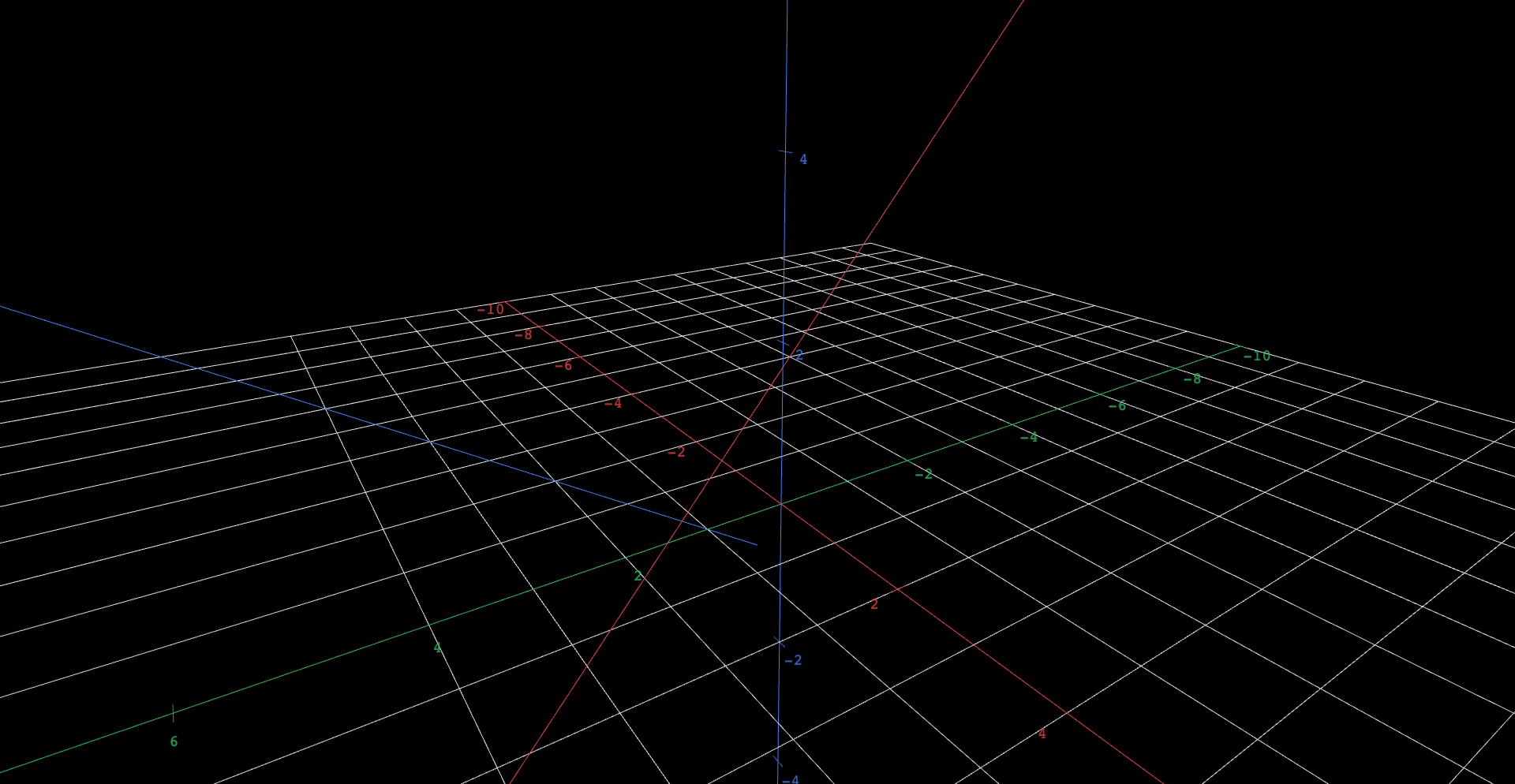
one free parameter sweeping out the whole line. In the plane, two lines that are not parallel must cross. Space is roomier. Two lines can be non-parallel and still never touch, simply by passing at different depths — such lines are called skew. The figure below stages exactly this deception.
 Explore in 3D (opens in a new tab)
Explore
- From the opening view, read the approximate coordinates of the apparent crossing against the grid. How confident are you that the lines touch there?
- Orbit slowly. At some angle the crossing dissolves into a visible gap, one line passing in front of the other. Orbit until the gap is as wide as you can make it. Were the lines ever touching?
- Read a direction vector off each line's components. Could these lines be parallel? Answer from the direction vectors alone.
- The scene hides a point P at , which lies on L1. What single edit to L2's -component would drag the blue line until it truly passes through P? Predict, then try it: edit the constant in
2 + tdownward and watch the gap close like a dial. Reveal P to confirm. - After the repair, find the parameter value that puts L1 at P and the value that puts L2 there. They are different numbers. Does that matter?
Three equations, two unknowns
The visual test has an exact algebraic mirror. Give each line its own parameter — on L1, on L2, and this independence matters — and demand that all three coordinates agree:
Three equations, two unknowns: an overdetermined system. The first two force a unique candidate — subtracting them gives and then — and the third equation becomes the verdict. Here it reads , that is , which is false. No parameter pair works, and that failure is the skewness. The lines are not parallel (their directions and are not proportional), so they are skew: non-parallel lines that never meet.
Parallel lines fail the test earlier and differently — proportional direction vectors degenerate the system before any candidate appears. And when the third equation does agree, the lines intersect at the point both reach, even though they generally reach it at different parameter values: the parameters are private clocks, one per line, and an intersection is a shared place, not a shared time.
An original work of XYZ Homework, built around interactive XYZ 3D figures. Aligned to OpenStax Calculus Volume 3 (Strang & Herman), © OpenStax (Rice University), licensed CC BY-NC-SA 4.0; no OpenStax content is reproduced, and this work is not affiliated with or endorsed by OpenStax or Rice University. License: CC-BY-NC-SA-4.0.