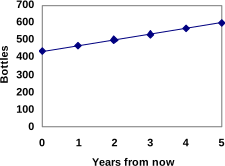
Marco is a collector of antique soda bottles. His collection currently contains 437 bottles. Every year, he budgets enough money to buy 32 new bottles. Can we determine how many bottles he will have in 5 years, and how long it will take for his collection to reach 1000 bottles?
# Ch 8.2 - linear growth: Marco's antique soda bottle collection.
P0 = 437        # bottles he owns now          TRY IT: change any of these three
D = 32          # bottles he buys every year
TARGET = 1000   # the size he is aiming for

print(f"recursive form:  P0 = {P0},   Pn = P(n-1) + {D}")
print(f"explicit  form:  Pn = {P0} + {D}n\n")
print(" n    recursive        explicit")
running = P0
for n in range(9):
    if n:
        running += D
    print(f"{n:>2}    {running:>9}    {P0} + {D}({n}) = {P0 + D * n}")

if D == 0:
    print(f"\nwith d = 0 the collection never changes, so {TARGET} never arrives")
else:
    n_star = (TARGET - P0) / D
    print(f"\nreaching {TARGET}:  {TARGET} = {P0} + {D}n")
    print(f"   n = ({TARGET} - {P0}) / {D} = {n_star:.2f}")
    print(f"   n has to be a whole year, so it happens in year {-(-n_star // 1):.0f}")

# The same equation from TWO measurements instead of a stated rate: the elk
# population was 12,000 in 2003 and 15,000 in 2007.
Y1, V1, Y2, V2 = 2003, 12000, 2007, 15000   # TRY IT: use 2003 and 2014 data
d = (V2 - V1) / (Y2 - Y1)
print(f"\nelk: d = ({V2} - {V1}) / ({Y2} - {Y1}) = {d:g} elk per year")
print(f"     Pn = {V1} + {d:g}n  with n = 0 at {Y1}")
for year in (2014, 2020):
    print(f"     {year}: n = {year - Y1}, Pn = {V1 + d * (year - Y1):,.0f} elk")
print("\nConstant CHANGE per step is what makes growth linear. Compare this with")
print("section 8.4, where the growth is a constant PERCENT instead.")
While both of these questions you could probably solve without an equation or formal mathematics, we are going to formalize our approach to this problem to provide a means to answer more complicated questions.
Suppose that represents the number, or population, of bottles Marco has after years. So would represent the number of bottles now, would represent the number of bottles after 1 year, would represent the number of bottles after 2 years, and so on. We could describe how Marco’s bottle collection is changing using:
This is called a recursive relationship. A recursive relationship is a formula which relates the next value in a sequence to the previous values. Here, the number of bottles in year can be found by adding 32 to the number of bottles in the previous year, . Using this relationship, we could calculate:
We have answered the question of how many bottles Marco will have in 5 years. However, solving how long it will take for his collection to reach 1000 bottles would require a lot more calculations.
While recursive relationships are excellent for describing simply and cleanly how a quantity is changing, they are not convenient for making predictions or solving problems that stretch far into the future. For that, a closed or explicit form for the relationship is preferred. An explicit equation allows us to calculate Pndirectly, without needing to know Pn-1. While you may already be able to guess the explicit equation, let us derive it from the recursive formula. We can do so by selectively not simplifying as we go:
You can probably see the pattern now, and generalize that
Using this equation, we can calculate how many bottles he’ll have after 5 years:
We can now also solve for when the collection will reach 1000 bottles by substituting in 1000 for and solving for .
So Marco will reach 1000 bottles in 18 years.
In the previous example, Marco’s collection grew by the same number of bottles every year. This constant change is the defining characteristic of linear growth. Plotting the values we calculated for Marco’s collection, we can see the values form a straight line, the shape of linear growth.
Adapted from Math in Society by David Lippman, hosted on LibreTexts (math.libretexts.org) and licensed under CC BY-SA 3.0. Changes were made. License: CC-BY-SA-3.0.
These eBooks are a prerelease and are not yet certified conformant with WCAG 2.1 AA or any other accessibility standard. Every page is built against an automated accessibility gate, and our target for the published editions is WCAG 2.2 Level AA. If something is unusable, please tell us.