
12.4 Binomial Theorem
Use Pascal’s Triangle to Expand a Binomial
In our previous work, we have squared binomials either by using FOIL or by using the Binomial Squares Pattern. We can also say that we expanded
To expand we recognize that this is and multiply.
To find a method that is less tedious that will work for higher expansions like we again look for patterns in some expansions.
| Number of terms | First term | Last term | |
|---|---|---|---|
| 2 | |||
| 3 | |||
| 4 | |||
| 5 | |||
| 6 | |||
Notice the first and last terms show only one variable. Recall that so we could rewrite the first and last terms to include both variables. For example, we could expand to show each term with both variables.

Generally, we don’t show the zero exponents, just as we usually write x rather than 1x.
Let’s look at an example to highlight the last three patterns.
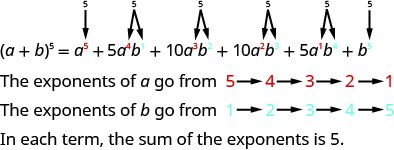
From the patterns we identified, we see the variables in the expansion of would be
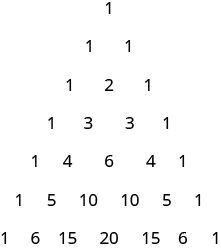
To find the coefficients of the terms, we write our expansions again focusing on the coefficients. We rewrite the coefficients to the right forming an array of coefficients.
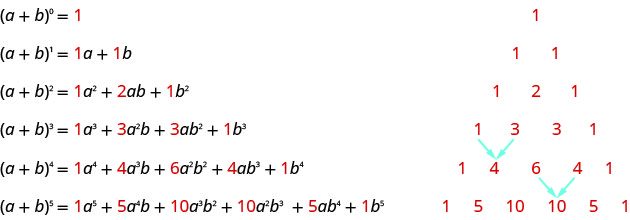
The array to the right is called Pascal’s Triangle. Notice each number in the array is the sum of the two closest numbers in the row above. We can find the next row by starting and ending with one and then adding two adjacent numbers.
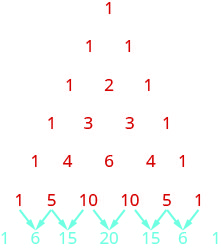
This triangle gives the coefficients of the terms when we expand binomials.
In the next example, we will use this triangle and the patterns we recognized to expand the binomial.
In the next example we want to expand a binomial with one variable and one constant. We need to identify the a and b to carefully apply the pattern.
In the next example, the binomial is a difference and the first term has a constant times the variable. Once we identify the a and b of the pattern, we must once again carefully apply the pattern.
Evaluate a Binomial Coefficient
While Pascal’s Triangle is one method to expand a binomial, we will also look at another method. Before we get to that, we need to introduce some more factorial notation. This notation is not only used to expand binomials, but also in the study and use of probability.
To find the coefficients of the terms of expanded binomials, we will need to be able to evaluate the notation which is called a binomial coefficient. We read as “n choose r” or “n taken r at a time”.
In the previous example, parts (a), (b), (c) demonstrate some special properties of binomial coefficients.
Use the Binomial Theorem to Expand a Binomial
We are now ready to use the alternate method of expanding binomials. The Binomial Theorem uses the same pattern for the variables, but uses the binomial coefficient for the coefficient of each term.
Notice that when we expanded in the last example, using the Binomial Theorem, we got the same coefficients we would get from using Pascal’s Triangle.
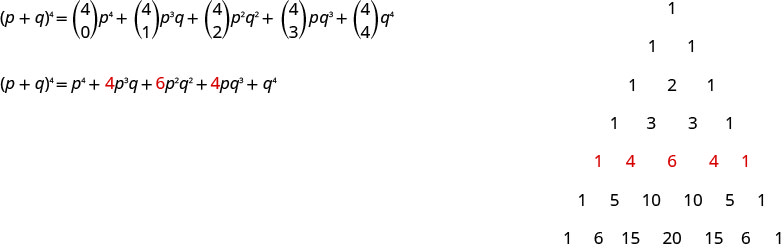
The next example, the binomial is a difference. When the binomial is a difference, we must be careful in identifying the values we will use in the pattern.
Things can get messy when both terms have a coefficient and a variable.
The real beauty of the Binomial Theorem is that it gives a formula for any particular term of the expansion without having to compute the whole sum. Let’s look for a pattern in the Binomial Theorem.
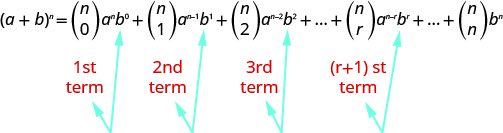
Notice, that in each case the exponent on the b is one less than the number of the term. The term is the term where the exponent of b is r. So we can use the format of the term to find the value of a specific term.
Key Concepts
- Patterns in the expansion of
- The number of terms is
- The first term is and the last term is
- The exponents on a decrease by one on each term going left to right.
- The exponents on b increase by one on each term going left to right.
- The sum of the exponents on any term is n.
- Pascal’s Triangle
- Binomial Coefficient
: A binomial coefficient where r and n are integers with is defined as
We read as “n choose r” or “n taken r at a time”. - Properties of Binomial Coefficients
- Binomial Theorem: For any real numbers a, b, and positive integer n,
Section Exercises
Practice Makes Perfect
Use Pascal’s Triangle to Expand a Binomial
In the following exercises, expand each binomial using Pascal’s Triangle.
Evaluate a Binomial Coefficient
In the following exercises, evaluate.
ⓐ ⓑ ⓒ ⓓ
ⓐ ⓑ ⓒ ⓓ
ⓐ 7 ⓑ 1 ⓒ 1 ⓓ 45
ⓐ ⓑ ⓒ ⓓ
ⓐ ⓑ ⓒ ⓓ
ⓐ 4 ⓑ 1 ⓒ 1 ⓓ 55
Use the Binomial Theorem to Expand a Binomial
In the following exercises, expand each binomial.
In the following exercises, find the indicated term in the expansion of the binomial.
Sixth term of
Fifth term of
Fourth term of
Seventh term of
In the following exercises, find the coefficient of the indicated term in the expansion of the binomial.
term of
term of
112
term of
term of
324
term of
term of
30,618
Writing Exercises
In your own words explain how to find the rows of the Pascal’s Triangle. Write the first five rows of Pascal’s Triangle.
In your own words, explain the pattern of exponents for each variable in the expansion of.
Answers will vary.
In your own words, explain the difference between and
In your own words, explain how to find a specific term in the expansion of a binomial without expanding the whole thing. Use an example to help explain.
Answers will vary.
Self Check
ⓐ After completing the exercises, use this checklist to evaluate your mastery of the objectives of this section.

ⓑ On a scale of 1-10, how would you rate your mastery of this section in light of your responses on the checklist? How can you improve this?
Chapter Review Exercises
Sequences
Write the First Few Terms of a Sequence
In the following exercises, write the first five terms of the sequence whose general term is given.
Find a Formula for the General Term (nth Term) of a Sequence
In the following exercises, find a general term for the sequence whose first five terms are shown.
Use Factorial Notation
In the following exercises, using factorial notation, write the first five terms of the sequence whose general term is given.
Find the Partial Sum
In the following exercises, expand the partial sum and find its value.
Use Summation Notation to write a Sum
In the following exercises, write each sum using summation notation.
Arithmetic Sequences
Determine if a Sequence is Arithmetic
In the following exercises, determine if each sequence is arithmetic, and if so, indicate the common difference.
The sequence is arithmetic with common difference
In the following exercises, write the first five terms of each arithmetic sequence with the given first term and common difference.
and
and
and
Find the General Term (nth Term) of an Arithmetic Sequence
In the following exercises, find the term described using the information provided.
Find the twenty-fifth term of a sequence where the first term is five and the common difference is three.
Find the thirtieth term of a sequence where the first term is 16 and the common difference is
Find the seventeenth term of a sequence where the first term is and the common difference is two.
In the following exercises, find the indicated term and give the formula for the general term.
Find the eighteenth term of a sequence where the fifth term is and the common difference is seven.
The general term is
Find the twenty-first term of a sequence where the seventh term is and the common difference is
In the following exercises, find the first term and common difference of the sequence with the given terms. Give the formula for the general term.
The fifth term is 17 and the fourteenth term is 53.
The general term is
The third term is and the sixteenth term is
Find the Sum of the First n Terms of an Arithmetic Sequence
In the following exercises, find the sum of the first 30 terms of each arithmetic sequence.
In the following exercises, find the sum of the first fifteen terms of the arithmetic sequence whose general term is given.
In the following exercises, find each sum.
Geometric Sequences and Series
Determine if a Sequence is Geometric
In the following exercises, determine if the sequence is geometric, and if so, indicate the common ratio.
The sequence is not geometric.
The sequence is geometric with common ratio
In the following exercises, write the first five terms of each geometric sequence with the given first term and common ratio.
and
and
and
Find the General Term (nth Term) of a Geometric Sequence
In the following exercises, find the indicated term of a sequence where the first term and the common ratio is given.
Find given and
Find given and
In the following exercises, find the indicated term of the given sequence. Find the general term of the sequence.
Find of the sequence,
The general term is
Find of the sequence,
Find the Sum of the First n terms of a Geometric Sequence
In the following exercises, find the sum of the first fifteen terms of each geometric sequence.
−43,692
In the following exercises, find the sum
Find the Sum of an Infinite Geometric Series
In the following exercises, find the sum of each infinite geometric series.
In the following exercises, write each repeating decimal as a fraction.
Apply Geometric Sequences and Series in the Real World
In the following exercises, solve the problem.
What is the total effect on the economy of a government tax rebate of to each household in order to stimulate the economy if each household will spend of the rebate in goods and services?
Adam just got his first full-time job after graduating from high school at age 17. He decided to invest per month in an IRA (an annuity). The interest on the annuity is which is compounded monthly. How much will be in Adam’s account when he retires at his sixty-seventh birthday?
Binomial Theorem
Use Pascal’s Triangle to Expand a Binomial
In the following exercises, expand each binomial using Pascal’s Triangle.
Evaluate a Binomial Coefficient
In the following exercises, evaluate.
ⓐ
ⓑ
ⓒ
ⓓ
ⓐ 11 ⓑ 1 ⓒ 1 ⓓ 56
ⓐ
ⓑ
ⓒ
ⓓ
ⓐ
ⓑ
ⓒ
ⓓ
ⓐ 1 ⓑ 1 ⓒ 1 ⓓ 55
Use the Binomial Theorem to Expand a Binomial
In the following exercises, expand each binomial, using the Binomial Theorem.
In the following exercises, find the indicated term in the expansion of the binomial.
Seventh term of
Third term of
In the following exercises, find the coefficient of the indicated term in the expansion of the binomial.
term of
135
term of
term of
280
Practice Test
In the following exercises, write the first five terms of the sequence whose general term is given.
Find a general term for the sequence,
Expand the partial sum and find its value.
Write the following using summation notation.
Write the first five terms of the arithmetic sequence with the given first term and common difference. and
Find the twentieth term of an arithmetic sequence where the first term is two and the common difference is
Find the twenty-third term of an arithmetic sequence whose seventh term is and common difference is three. Then find a formula for the general term.
The general term is
Find the first term and common difference of an arithmetic sequence whose ninth term is and the sixteenth term is Then find a formula for the general term.
Find the sum of the first 25 terms of the arithmetic sequence,
Find the sum of the first 50 terms of the arithmetic sequence whose general term is
Find the sum.
In the following exercises, determine if the sequence is arithmetic, geometric, or neither. If arithmetic, then find the common difference. If geometric, then find the common ratio.
The sequence is geometric with common ratio
Write the first five terms of the geometric sequence with the given first term and common ratio. and
In the geometric sequence whose first term and common ratio are and find
Find of the geometric sequence, Then find a formula for the general term.
Find the sum of the first thirteen terms of the geometric sequence,
In the following exercises, find the sum.
Write the repeating decimal as a fraction.
Dave just got his first full-time job after graduating from high school at age 18. He decided to invest $450 per month in an IRA (an annuity). The interest on the annuity is 6% which is compounded monthly. How much will be in Adam’s account when he retires at his sixty-fifth birthday?
Expand the binomial using Pascal’s Triangle.
Evaluate each binomial coefficient. ⓐ
ⓑ ⓒ ⓓ
ⓐ 8 ⓑ 1 ⓒ 1 ⓓ 210
Expand the binomial using the Binomial Theorem.
Adapted from Intermediate Algebra 2e by OpenStax (openstax.org), licensed under CC BY-NC-SA 4.0. Changes were made. License: CC-BY-NC-SA-4.0.