
12.3 Geometric Sequences and Series
Determine if a Sequence is Geometric
We are now ready to look at the second special type of sequence, the geometric sequence.
A sequence is called a geometric sequence if the ratio between consecutive terms is always the same. The ratio between consecutive terms in a geometric sequence is r, the common ratio, where n is greater than or equal to two.
Consider these sequences.
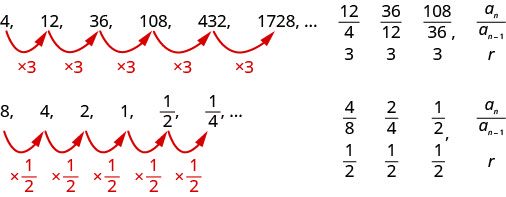
If we know the first term, and the common ratio, r, we can list a finite number of terms of the sequence.
Find the General Term (nth Term) of a Geometric Sequence
Just as we found a formula for the general term of a sequence and an arithmetic sequence, we can also find a formula for the general term of a geometric sequence.
Let’s write the first few terms of the sequence where the first term is and the common ratio is r. We will then look for a pattern.
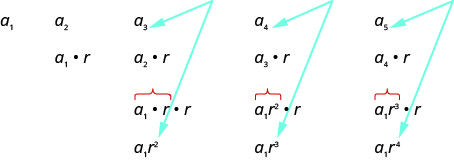
As we look for a pattern in the five terms above, we see that each of the terms starts with
The first term, is not multiplied by any r. In the second term, the is multiplied by r. In the third term, the is multiplied by r two times ( or ). In the fourth term, the is multiplied by r three times ( or ) and in the fifth term, the is multiplied by r four times. In each term, the number of times is multiplied by r is one less than the number of the term. This leads us to the following
We will use this formula in the next example to find the fourteenth term of a sequence.
Sometimes we do not know the common ratio and we must use the given information to find it before we find the requested term.
Find the Sum of the First n Terms of a Geometric Sequence
We found the sum of both general sequences and arithmetic sequence. We will now do the same for geometric sequences. The sum, of the first n terms of a geometric sequence is written as We can write this sum by starting with the first term, and keep multiplying by r to get the next term as:
Let’s also multiply both sides of the equation by r.
Next, we subtract these equations. We will see that when we subtract, all but the first term of the top equation and the last term of the bottom equation subtract to zero.
| We factor both sides. | |
| To obtain the formula for divide both sides by |
We apply this formula in the next example where the first few terms of the sequence are given. Notice the sum of a geometric sequence typically gets very large when the common ratio is greater than one.
In the next example, we are given the sum in summation notation. While adding all the terms might be possible, most often it is easiest to use the formula to find the sum of the first n terms.
To use the formula, we need r. We can find it by writing out the first few terms of the sequence and find their ratio. Another option is to realize that in summation notation, a sequence is written in the form where r is the common ratio.
Find the Sum of an Infinite Geometric Series
If we take a geometric sequence and add the terms, we have a sum that is called a geometric series. An infinite geometric series is an infinite sum whose first term is and common ratio is r and is written
We know how to find the sum of the first n terms of a geometric series using the formula, But how do we find the sum of an infinite sum?
Let’s look at the infinite geometric series Each term gets larger and larger so it makes sense that the sum of the infinite number of terms gets larger. Let’s look at a few partial sums for this series. We see and
As n gets larger and larger, the sum gets larger and larger. This is true when and we call the series divergent. We cannot find a sum of an infinite geometric series when
Let’s look at an infinite geometric series whose common ratio is a fraction less than one,
. Here the terms get smaller and smaller as n gets larger. Let’s look at a few finite sums for this series. We see and
Notice the sum gets larger and larger but also gets closer and closer to one. When the expression gets smaller and smaller. In this case, we call the series convergent. As n approaches infinity, (gets infinitely large), gets closer and closer to zero. In our sum formula, we can replace the with zero and then we get a formula for the sum, S, for an infinite geometric series when
This formula gives us the sum of the infinite geometric sequence. Notice the S does not have the subscript n as in as we are not adding a finite number of terms.
An interesting use of infinite geometric series is to write a repeating decimal as a fraction.
Apply Geometric Sequences and Series in the Real World
One application of geometric sequences has to do with consumer spending. If a tax rebate is given to each household, the effect on the economy is many times the amount of the individual rebate.
We have looked at a compound interest formula where a principal, P, is invested at an interest rate, r, for t years. The new balance, A, is when interest is compounded n times a year. This formula applies when a lump sum was invested upfront and tells us the value after a certain time period.
An annuity is an investment that is a sequence of equal periodic deposits. We will be looking at annuities that pay the interest at the time of the deposits. As we develop the formula for the value of an annuity, we are going to let That means there is one deposit per year.
| Let | |
| Simplify. |
Suppose P dollars is invested at the end of each year. One year later that deposit is worth dollars, and another year later it is worth dollars. After t years, it will be worth dollars.
| End of year 1 | End of year 2 | End of year 3 | |
|---|---|---|---|
| First Deposit P @ end of year 1 | P | Amount 1 year later | Amount 2 years later |
| 2nd Deposit P @ end of year 2 | P | Amount 1 year later | |
| 3rd Deposit P @ end of year 3 | P |
After three years, the value of the annuity is
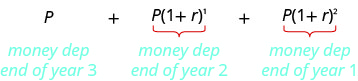
This a sum of the terms of a geometric sequence where the first term is P and the common ratio is We substitute these values into the sum formula. Be careful, we have two different uses of r. The r in the sum formula is the common ratio of the sequence. In this case, that is where r is the interest rate.
| Substitute in the values. | |
| Simplify. | |
Remember our premise was that one deposit was made at the end of each year.
We can adapt this formula for n deposits made per year and the interest is compounded n times a year.
Key Concepts
- General Term (nth term) of a Geometric Sequence: The general term of a geometric sequence with first term and the common ratio r is
- Sum of the First n Terms of a Geometric Series: The sum, of the n terms of a geometric sequence is
where is the first term and r is the common ratio. - Infinite Geometric Series: An infinite geometric series is an infinite sum whose first term is and common ratio is r and is written
- Sum of an Infinite Geometric Series: For an infinite geometric series whose first term is and common ratio r,
- Value of an Annuity with Interest Compounded Times a Year: For a principal, P, invested at the end of a compounding period, with an interest rate, r, which is compounded n times a year, the new balance, A, after t years, is
Practice Makes Perfect
Determine if a Sequence is Geometric
In the following exercises, determine if the sequence is geometric, and if so, indicate the common ratio.
The sequence is geometric with common ratio
The sequence is geometric with common ratio
The sequence is geometric with a common ratio
In the following exercises, determine if each sequence is arithmetic, geometric or neither. If arithmetic, indicate the common difference. If geometric, indicate the common ratio.
The sequence is geometric with common ratio
The sequence is arithmetic with common difference
The sequence is geometric with common ratio
In the following exercises, write the first five terms of each geometric sequence with the given first term and common ratio.
and
and
and
and
and
and
Find the General Term (nth Term) of a Geometric Sequence
In the following exercises, find the indicated term of a sequence where the first term and the common ratio is given.
Find given and
Find given and
Find given and
3,072
Find given and
Find given and
Find given and
In the following exercises, find the indicated term of the given sequence. Find the general term for the sequence.
Find of the sequence,
The general term is
Find of the sequence,
Find of the sequence,
The general term is
Find of the sequence,
Find of the sequence,
The general term is
Find of the sequence,
Find the Sum of the First n terms of a Geometric Sequence
In the following exercises, find the sum of the first fifteen terms of each geometric sequence.
In the following exercises, find the sum of the geometric sequence.
Find the Sum of an Infinite Geometric Series
In the following exercises, find the sum of each infinite geometric series.
no sum as
2,048
In the following exercises, write each repeating decimal as a fraction.
Apply Geometric Sequences and Series in the Real World
In the following exercises, solve the problem.
Find the total effect on the economy of each government tax rebate to each household in order to stimulate the economy if each household will spend the indicated percent of the rebate in goods and services.
| Tax rebate to each household | Percent spent on goods and services | Total Effect on the economy | |
|---|---|---|---|
| ⓐ | |||
| ⓑ | |||
| ⓒ | |||
| ⓓ |
ⓐ ⓑ ⓒ ⓒ
New grandparents decide to invest per month in an annuity for their grandchild. The account will pay interest per year which is compounded monthly (12 times a year). How much will be in the child’s account at their twenty-first birthday?
Berenice just got her first full-time job after graduating from college at age 30. She decided to invest per quarter in an IRA (an annuity). The interest on the annuity is which is compounded quarterly (4 times a year). How much will be in the Berenice’s account when she retires at age 65?
Alice wants to purchase a home in about five years. She is depositing a month into an annuity that earns per year that is compounded monthly (12 times a year). How much will Alice have for her down payment in five years?
Myra just got her first full-time job after graduating from college. She plans to get a master’s degree, and so is depositing a year from her year-end bonus into an annuity. The annuity pays per year and is compounded yearly. How much will she have saved in five years to pursue her master’s degree?
Writing Exercises
In your own words, explain how to determine whether a sequence is geometric.
In your own words, explain how to find the general term of a geometric sequence.
Answers will vary.
In your own words, explain the difference between a geometric sequence and a geometric series.
In your own words, explain how to determine if an infinite geometric series has a sum and how to find it.
Answers will vary.
Self Check
ⓐ After completing the exercises, use this checklist to evaluate your mastery of the objectives of this section.
ⓑ What does this checklist tell you about your mastery of this section? What steps will you take to improve?
Adapted from Intermediate Algebra 2e by OpenStax (openstax.org), licensed under CC BY-NC-SA 4.0. Changes were made. License: CC-BY-NC-SA-4.0.