
12.1 Sequences
Write the First Few Terms of a Sequence
Let’s look at the function and evaluate it for just the counting numbers.
| 1 | 2 |
| 2 | 4 |
| 3 | 6 |
| 4 | 8 |
| 5 | 10 |
| … | … |
If we list the function values in order as 2, 4, 6, 8, and 10, … we have a sequence. A sequence is a function whose domain is the counting numbers.
A sequence can also be seen as an ordered list of numbers and each number in the list is a term. A sequence may have an infinite number of terms or a finite number of terms. Our sequence has three dots (ellipsis) at the end which indicates the list never ends. If the domain is the set of all counting numbers, then the sequence is an infinite sequence. Its domain is all counting numbers and there is an infinite number of counting numbers.
If we limit the domain to a finite number of counting numbers, then the sequence is a finite sequence. If we use only the first four counting numbers, 1, 2, 3, 4 our sequence would be the finite sequence,
Often when working with sequences we do not want to write out all the terms. We want more compact way to show how each term is defined. When we worked with functions, we wrote and we said the expression was the rule that defined values in the range. While a sequence is a function, we do not use the usual function notation. Instead of writing the function as we would write it as The is the nth term of the sequence, the term in the nth position where n is a value in the domain. The formula for writing the nth term of the sequence is called the general term or formula of the sequence.
When we are given the general term of the sequence, we can find the terms by replacing n with the counting numbers in order. For
| 1 | 2 | 3 | 4 | 5 | ||
|---|---|---|---|---|---|---|
| 2n |
To find the values of a sequence, we substitute in the counting numbers in order into the general term of the sequence.
For some sequences, the variable is an exponent.
It is not uncommon to see the expressions or in the general term for a sequence. If we evaluate each of these expressions for a few values, we see that this expression alternates the sign for the terms.
| 1 | 2 | 3 | 4 | 5 | |
|---|---|---|---|---|---|
The terms in the next example will alternate signs as a result of the powers of
Find a Formula for the General Term (nth Term) of a Sequence
Sometimes we have a few terms of a sequence and it would be helpful to know the general term or nth term. To find the general term, we look for patterns in the terms. Often the patterns involve multiples or powers. We also look for a pattern in the signs of the terms.
Use Factorial Notation
Sequences often have terms that are products of consecutive integers. We indicate these products with a special notation called factorial notation. For example,, read 5 factorial, means The exclamation point is not punctuation here; it indicates the factorial notation.
The values of for the first 5 positive integers are shown.
When there is a fraction with factorials in the numerator and denominator, we line up the factors vertically to make our calculations easier.
Find the Partial Sum
Sometimes in applications, rather than just list the terms, it is important for us to add the terms of a sequence. Rather than just connect the terms with plus signs, we can use summation notation.
For example, can be written as We read this as “the sum of a sub i from i equals one to five.” The symbol means to add and the i is the index of summation. The 1 tells us where to start (initial value) and the 5 tells us where to end (terminal value).
When we add a finite number of terms, we call the sum a partial sum.
The index does not always have to be i we can use any letter, but i and k are commonly used. The index does not have to start with 1 either—it can start and end with any positive integer.
Use Summation Notation to Write a Sum
In the last two examples, we went from summation notation to writing out the sum. Now we will start with a sum and change it to summation notation. This is very similar to finding the general term of a sequence. We will need to look at the terms and find a pattern. Often the patterns involve multiples or powers.
When the terms of a sum have negative coefficients, we must carefully analyze the pattern of the signs.
Key Concepts
- Factorial Notation
If n is a positive integer, then is
We define as 1, so - Summation Notation
The sum of the first n terms of a sequence whose nth term is written in summation notation as:
The i is the index of summation and the 1 tells us where to start and the n tells us where to end.
Practice Makes Perfect
Write the First Few Terms of a Sequence
In the following exercises, write the first five terms of the sequence whose general term is given.
Find a Formula for the General Term (nth Term) of a Sequence
In the following exercises, find a general term for the sequence whose first five terms are shown.
Use Factorial Notation
In the following exercises, using factorial notation, write the first five terms of the sequence whose general term is given.
Find the Partial Sum
In the following exercises, expand the partial sum and find its value.
Use Summation Notation to write a Sum
In the following exercises, write each sum using summation notation.
Writing Exercises
In your own words, explain how to write the terms of a sequence when you know the formula. Show an example to illustrate your explanation.
Answers will vary.
Which terms of the sequence are negative when the nth term of the sequence is
In your own words, explain what is meant by Show some examples to illustrate your explanation.
Answers will vary.
Explain what each part of the notation means.
Self Check
ⓐ After completing the exercises, use this checklist to evaluate your mastery of the objectives of this section.
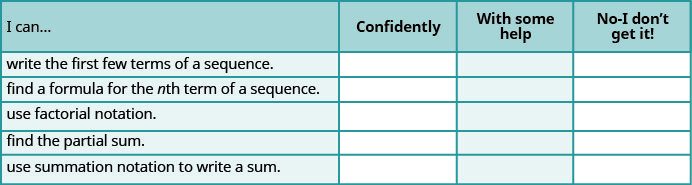
ⓑ If most of your checks were:
…confidently. Congratulations! You have achieved the objectives in this section. Reflect on the study skills you used so that you can continue to use them. What did you do to become confident of your ability to do these things? Be specific.
…with some help. This must be addressed quickly because topics you do not master become potholes in your road to success. In math, every topic builds upon previous work. It is important to make sure you have a strong foundation before you move on. Whom can you ask for help?Your fellow classmates and instructor are good resources. Is there a place on campus where math tutors are available? Can your study skills be improved?
…no - I don’t get it! This is a warning sign and you must not ignore it. You should get help right away or you will quickly be overwhelmed. See your instructor as soon as you can to discuss your situation. Together you can come up with a plan to get you the help you need.
Adapted from Intermediate Algebra 2e by OpenStax (openstax.org), licensed under CC BY-NC-SA 4.0. Changes were made. License: CC-BY-NC-SA-4.0.