
10.5 Solve Exponential and Logarithmic Equations
Solve Logarithmic Equations Using the Properties of Logarithms
In the section on logarithmic functions, we solved some equations by rewriting the equation in exponential form. Now that we have the properties of logarithms, we have additional methods we can use to solve logarithmic equations.
If our equation has two logarithms we can use a property that says that if then it is true that This is the One-to-One Property of Logarithmic Equations.
To use this property, we must be certain that both sides of the equation are written with the same base.
Remember that logarithms are defined only for positive real numbers. Check your results in the original equation. You may have obtained a result that gives a logarithm of zero or a negative number.
Another strategy to use to solve logarithmic equations is to condense sums or differences into a single logarithm.
When there are logarithms on both sides, we condense each side into a single logarithm. Remember to use the Power Property as needed.
Solve Exponential Equations Using Logarithms
In the section on exponential functions, we solved some equations by writing both sides of the equation with the same base. Next we wrote a new equation by setting the exponents equal.
It is not always possible or convenient to write the expressions with the same base. In that case we often take the common logarithm or natural logarithm of both sides once the exponential is isolated.
When we take the logarithm of both sides we will get the same result whether we use the common or the natural logarithm (try using the natural log in the last example. Did you get the same result?) When the exponential has base e, we use the natural logarithm.
Use Exponential Models in Applications
In previous sections we were able to solve some applications that were modeled with exponential equations. Now that we have so many more options to solve these equations, we are able to solve more applications.
We will again use the Compound Interest Formulas and so we list them here for reference.
We have seen that growth and decay are modeled by exponential functions. For growth and decay we use the formula Exponential growth has a positive rate of growth or growth constant, , and exponential decay has a negative rate of growth or decay constant, k.
We can now solve applications that give us enough information to determine the rate of growth. We can then use that rate of growth to predict other situations.
Radioactive substances decay or decompose according to the exponential decay formula. The amount of time it takes for the substance to decay to half of its original amount is called the half-life of the substance.
Similar to the previous example, we can use the given information to determine the constant of decay, and then use that constant to answer other questions.
Key Concepts
- One-to-One Property of Logarithmic Equations: For and is any real number:
- Compound Interest:
For a principal, P, invested at an interest rate, r, for t years, the new balance, A, is:
- Exponential Growth and Decay: For an original amount, that grows or decays at a rate, r, for a certain time t, the final amount, A, is
Section Exercises
Practice Makes Perfect
Solve Logarithmic Equations Using the Properties of Logarithms
In the following exercises, solve for x.
Solve Exponential Equations Using Logarithms
In the following exercises, solve each exponential equation. Find the exact answer and then approximate it to three decimal places.
In the following exercises, solve each equation.
In the following exercises, solve for x, giving an exact answer as well as an approximation to three decimal places.
Use Exponential Models in Applications
In the following exercises, solve.
Sung Lee invests at age 18. He hopes the investments will be worth when he turns 25. If the interest compounds continuously, approximately what rate of growth will he need to achieve his goal? Is that a reasonable expectation?
Alice invests at age 30 from the signing bonus of her new job. She hopes the investments will be worth when she turns 40. If the interest compounds continuously, approximately what rate of growth will she need to achieve her goal?
Coralee invests in an account that compounds interest monthly and earns How long will it take for her money to double?
Simone invests in an account that compounds interest quarterly and earns How long will it take for his money to double?
13.9 years
Researchers recorded that a certain bacteria population declined from 100,000 to 100 in 24 hours. At this rate of decay, how many bacteria will there be in 16 hours?
Researchers recorded that a certain bacteria population declined from 800,000 to 500,000 in 6 hours after the administration of medication. At this rate of decay, how many bacteria will there be in 24 hours?
122,070 bacteria
A virus takes 6 days to double its original population How long will it take to triple its population?
A bacteria doubles its original population in 24 hours How big will its population be in 72 hours?
8 times as large as the original population
Carbon-14 is used for archeological carbon dating. Its half-life is 5,730 years. How much of a 100-gram sample of Carbon-14 will be left in 1000 years?
Radioactive technetium-99m is often used in diagnostic medicine as it has a relatively short half-life but lasts long enough to get the needed testing done on the patient. If its half-life is 6 hours, how much of the radioactive material form a 0.5 ml injection will be in the body in 24 hours?
0.03 ml
Writing Exercises
Explain the method you would use to solve these equations: Does your method require logarithms for both equations? Why or why not?
What is the difference between the equation for exponential growth versus the equation for exponential decay?
Answers will vary.
Self Check
ⓐ After completing the exercises, use this checklist to evaluate your mastery of the objectives of this section.
ⓑ After looking at the checklist, do you think you are well-prepared for the next section? Why or why not?
Chapter Review Exercises
Finding Composite and Inverse Functions
Find and Evaluate Composite Functions
In the following exercises, for each pair of functions, find ⓐ (f ∘ g)(x), ⓑ (g ∘ f)(x), and ⓒ (f · g)(x).
and
and
ⓐ ⓑ ⓒ
In the following exercises, evaluate the composition.
For functions
and
find
ⓐ
ⓑ
ⓒ
For functions
and
find
ⓐ
ⓑ
ⓒ
ⓐ ⓑ 356 ⓒ 41
Determine Whether a Function is One-to-One
In the following exercises, for each set of ordered pairs, determine if it represents a function and if so, is the function one-to-one.
Function; not one-to-one
In the following exercises, determine whether each graph is the graph of a function and if so, is it one-to-one.
ⓐ
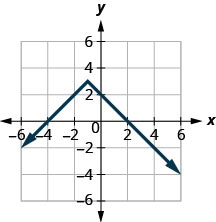
ⓑ
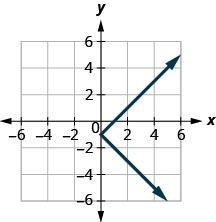
ⓐ Function; not one-to-one ⓑ Not a function
ⓐ
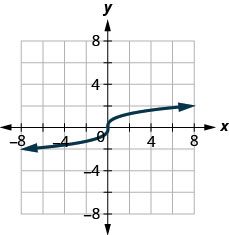
ⓑ
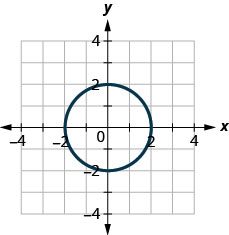
Find the Inverse of a Function
In the following exercise, find the inverse of the function. Determine the domain and range of the inverse function.
Inverse function: Domain: Range:
In the following exercise, graph the inverse of the one-to-one function shown.
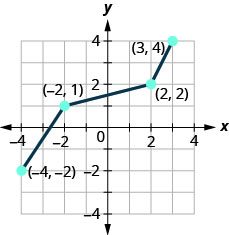
In the following exercises, verify that the functions are inverse functions.
and
and so they are inverses.
and
In the following exercises, find the inverse of each function.
Evaluate and Graph Exponential Functions
Graph Exponential Functions
In the following exercises, graph each of the following functions.
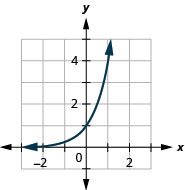
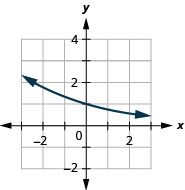
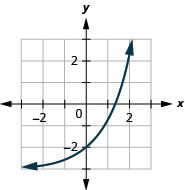
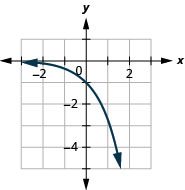
Solve Exponential Equations
In the following exercises, solve each equation.
Use Exponential Models in Applications
In the following exercises, solve.
Felix invested in a savings account. If the interest rate is how much will be in the account in 12 years by each method of compounding?
ⓐ compound quarterly
ⓑ compound monthly
ⓒ compound continuously.
Sayed deposits in an investment account. What will be the value of his investment in 30 years if the investment is earning per year and is compounded continuously?
A researcher at the Center for Disease Control and Prevention is studying the growth of a bacteria. She starts her experiment with 150 of the bacteria that grows at a rate of per hour. She will check on the bacteria every 24 hours. How many bacteria will he find in 24 hours?
In the last five years the population of the United States has grown at a rate of per year to about 318,900,000. If this rate continues, what will be the population in 5 more years?
330,259,000
Evaluate and Graph Logarithmic Functions
Convert Between Exponential and Logarithmic Form
In the following exercises, convert from exponential to logarithmic form.
In the following exercises, convert each logarithmic equation to exponential form.
Evaluate Logarithmic Functions
In the following exercises, solve for x.
In the following exercises, find the exact value of each logarithm without using a calculator.
0
Graph Logarithmic Functions
In the following exercises, graph each logarithmic function.
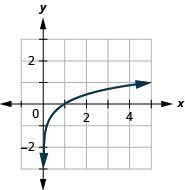
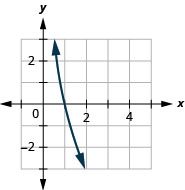
Solve Logarithmic Equations
In the following exercises, solve each logarithmic equation.
Use Logarithmic Models in Applications
What is the decibel level of a train whistle with intensity watts per square inch?
90 dB
Use the Properties of Logarithms
Use the Properties of Logarithms
In the following exercises, use the properties of logarithms to evaluate.
ⓐ ⓑ
ⓐ ⓑ
ⓐ 13 ⓑ
ⓐ ⓑ
ⓐ ⓑ
ⓐ 8 ⓑ 5
In the following exercises, use the Product Property of Logarithms to write each logarithm as a sum of logarithms. Simplify if possible.
In the following exercises, use the Quotient Property of Logarithms to write each logarithm as a sum of logarithms. Simplify, if possible.
In the following exercises, use the Power Property of Logarithms to expand each logarithm. Simplify, if possible.
In the following exercises, use properties of logarithms to write each logarithm as a sum of logarithms. Simplify if possible.
In the following exercises, use the Properties of Logarithms to condense the logarithm. Simplify if possible.
Use the Change-of-Base Formula
In the following exercises, rounding to three decimal places, approximate each logarithm.
5.047
Solve Exponential and Logarithmic Equations
Solve Logarithmic Equations Using the Properties of Logarithms
In the following exercises, solve for x.
Solve Exponential Equations Using Logarithms
In the following exercises, solve each exponential equation. Find the exact answer and then approximate it to three decimal places.
Use Exponential Models in Applications
Jerome invests at age 17. He hopes the investments will be worth when he turns 26. If the interest compounds continuously, approximately what rate of growth will he need to achieve his goal? Is that a reasonable expectation?
Elise invests in an account that compounds interest monthly and earns How long will it take for her money to double?
11.6 years
Researchers recorded that a certain bacteria population grew from 100 to 300 in 8 hours. At this rate of growth, how many bacteria will there be in 24 hours?
Mouse populations can double in 8 months How long will it take for a mouse population to triple?
12.7 months
The half-life of radioactive iodine is 60 days. How much of a 50 mg sample will be left in 40 days?
Practice Test
For the functions, and find ⓐ ⓑ and ⓒ
ⓐ ⓑ
ⓒ
Determine if the following set of ordered pairs represents a function and if so, is the function one-to-one.
Determine whether each graph is the graph of a function and if so, is it one-to-one.
ⓐ
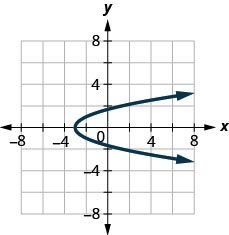
ⓑ
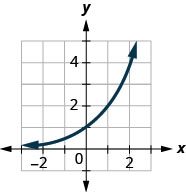
ⓐ Not a function ⓑ One-to-one function
Graph, on the same coordinate system, the inverse of the one-to-one function shown.
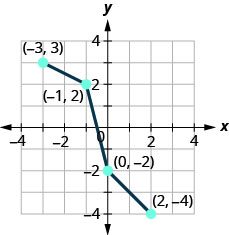
Find the inverse of the function
Graph the function
Solve the equation
Solve the equation
Megan invested in a savings account. If the interest rate is how much will be in the account in 8 years by each method of compounding?
ⓐ compound quarterly
ⓑ compound monthly
ⓒ compound continuously.
ⓐ ⓑ ⓒ
Convert the equation from exponential to logarithmic form:
Convert the equation from logarithmic equation to exponential form:
Solve for x:
Evaluate
0
Evaluate
Graph the function
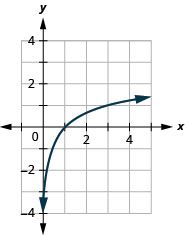
Solve for x:
What is the decibel level of a small fan with intensity watts per square inch?
40 dB
Evaluate each. ⓐ
ⓑ
In the following exercises, use properties of logarithms to write each expression as a sum of logarithms, simplifying if possible.
In the following exercises, use the Properties of Logarithms to condense the logarithm, simplifying if possible.
Rounding to three decimal places, approximate
Solve for x:
In the following exercises, solve each exponential equation. Find the exact answer and then approximate it to three decimal places.
Jacob invests $14,000 in an account that compounds interest quarterly and earns How long will it take for his money to double?
Researchers recorded that a certain bacteria population grew from 500 to 700 in 5 hours. At this rate of growth, how many bacteria will there be in 20 hours?
1,921 bacteria
A certain beetle population can double in 3 months How long will it take for that beetle population to triple?
Adapted from Intermediate Algebra 2e by OpenStax (openstax.org), licensed under CC BY-NC-SA 4.0. Changes were made. License: CC-BY-NC-SA-4.0.