
10.1 Finding Composite and Inverse Functions
In this chapter, we will introduce two new types of functions, exponential functions and logarithmic functions. These functions are used extensively in business and the sciences as we will see.
Find and Evaluate Composite Functions
Before we introduce the functions, we need to look at another operation on functions called composition. In composition, the output of one function is the input of a second function. For functions and the composition is written and is defined by
We read as of of

To do a composition, the output of the first function, becomes the input of the second function, f, and so we must be sure that it is part of the domain of f.
We have actually used composition without using the notation many times before. When we graphed quadratic functions using translations, we were composing functions. For example, if we first graphed as a parabola and then shifted it down vertically four units, we were using the composition defined by where

The next example will demonstrate that and usually result in different outputs.
In the next example we will evaluate a composition for a specific value.
Determine Whether a Function is One-to-One
When we first introduced functions, we said a function is a relation that assigns to each element in its domain exactly one element in the range. For each ordered pair in the relation, each x-value is matched with only one y-value.
We used the birthday example to help us understand the definition. Every person has a birthday, but no one has two birthdays and it is okay for two people to share a birthday. Since each person has exactly one birthday, that relation is a function.
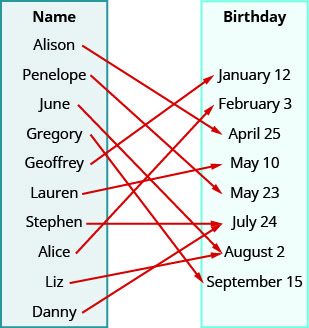
A function is one-to-one if each value in the range has exactly one element in the domain. For each ordered pair in the function, each y-value is matched with only one x-value.
Our example of the birthday relation is not a one-to-one function. Two people can share the same birthday. The range value August 2 is the birthday of Liz and June, and so one range value has two domain values. Therefore, the function is not one-to-one.
To help us determine whether a relation is a function, we use the vertical line test. A set of points in a rectangular coordinate system is the graph of a function if every vertical line intersects the graph in at most one point. Also, if any vertical line intersects the graph in more than one point, the graph does not represent a function.
The vertical line is representing an x-value and we check that it intersects the graph in only one y-value. Then it is a function.
To check if a function is one-to-one, we use a similar process. We use a horizontal line and check that each horizontal line intersects the graph in only one point. The horizontal line is representing a y-value and we check that it intersects the graph in only one x-value. If every horizontal line intersects the graph of a function in at most one point, it is a one-to-one function. This is the horizontal line test.
We can test whether a graph of a relation is a function by using the vertical line test. We can then tell if the function is one-to-one by applying the horizontal line test.
Find the Inverse of a Function
Let’s look at a one-to one function, , represented by the ordered pairs For each -value, adds 5 to get the -value. To ‘undo’ the addition of 5, we subtract 5 from each -value and get back to the original -value. We can call this “taking the inverse of ” and name the function
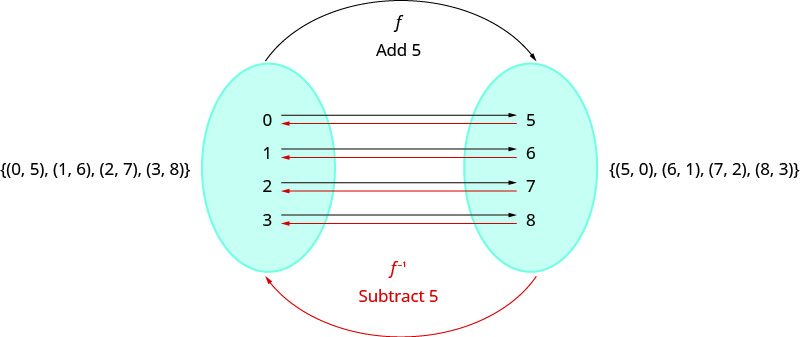
Notice that that the ordered pairs of and have their -values and -values reversed. The domain of is the range of and the domain of is the range of
In the next example we will find the inverse of a function defined by ordered pairs.
We just noted that if is a one-to-one function whose ordered pairs are of the form then its inverse function is the set of ordered pairs
So if a point is on the graph of a function then the ordered pair is on the graph of See Figure 10.2.
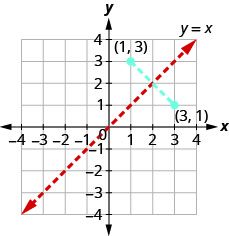
The distance between any two pairs and is cut in half by the line So we say the points are mirror images of each other through the line
Since every point on the graph of a function is a mirror image of a point on the graph of we say the graphs are mirror images of each other through the line We will use this concept to graph the inverse of a function in the next example.
When we began our discussion of an inverse function, we talked about how the inverse function ‘undoes’ what the original function did to a value in its domain in order to get back to the original x-value.

We can use this property to verify that two functions are inverses of each other.
We have found inverses of function defined by ordered pairs and from a graph. We will now look at how to find an inverse using an algebraic equation. The method uses the idea that if is a one-to-one function with ordered pairs then its inverse function is the set of ordered pairs
If we reverse the x and y in the function and then solve for y, we get our inverse function.
We summarize the steps below.
Key Concepts
- Composition of Functions: The composition of functions and is written and is defined by
We read as of of - Horizontal Line Test: If every horizontal line, intersects the graph of a function in at most one point, it is a one-to-one function.
- Inverse of a Function Defined by Ordered Pairs: If is a one-to-one function whose ordered pairs are of the form then its inverse function is the set of ordered pairs
- Inverse Functions: For every in the domain of one-to-one function and
- How to Find the Inverse of a One-to-One Function:
- Substitute y for
- Interchange the variables x and y.
- Solve for y.
- Substitute for
- Verify that the functions are inverses.
Practice Makes Perfect
Find and Evaluate Composite Functions
In the following exercises, find ⓐ (f ∘ g)(x), ⓑ (g ∘ f)(x), and ⓒ (f · g)(x).
and
ⓐ ⓑ ⓒ
and
and
ⓐ ⓑ
ⓒ
and
and
ⓐ ⓑ
ⓒ
and
and
ⓐ ⓑ
ⓒ
and
In the following exercises, find the values described.
For functions and find ⓐ ⓑ ⓒ
ⓐ 245 ⓑ 104 ⓒ 53
For functions and find ⓐ ⓑ ⓒ
For functions and find ⓐ ⓑ ⓒ
ⓐ 250 ⓑ 14 ⓒ 77
For functions and find ⓐ ⓑ ⓒ
Determine Whether a Function is One-to-One
In the following exercises, determine if the set of ordered pairs represents a function and if so, is the function one-to-one.
,
Function; not one-to-one
,
,
One-to-one function
,
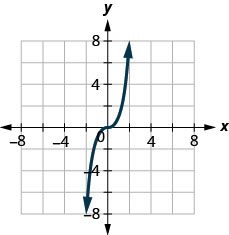
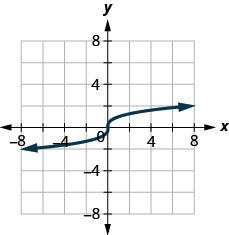
In the following exercises, determine whether each graph is the graph of a function and if so, is it one-to-one.
ⓐ
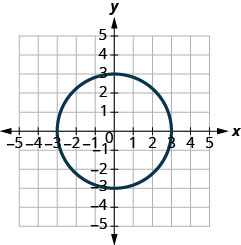
ⓑ
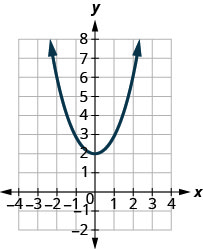
ⓐ Not a function ⓑ Function; not one-to-one
ⓐ
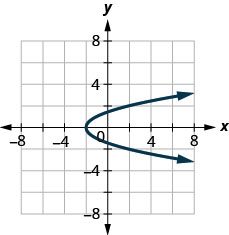
ⓑ
ⓐ
ⓑ
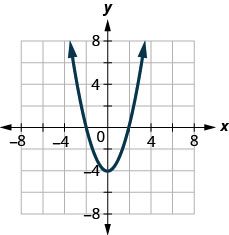
ⓐ One-to-one function
ⓑ Function; not one-to-one
ⓐ
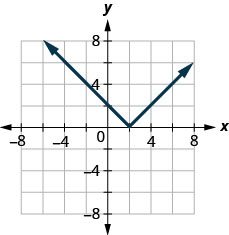
ⓑ
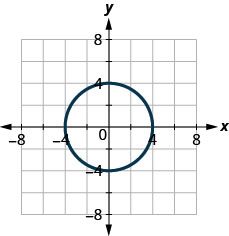
In the following exercises, find the inverse of each function. Determine the domain and range of the inverse function.
Inverse function: Domain: Range:
Inverse function: Domain: Range:
Inverse function: Domain: Range:
In the following exercises, graph, on the same coordinate system, the inverse of the one-to-one function shown.
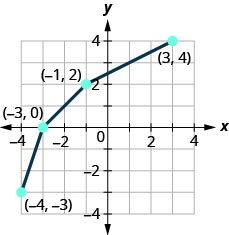
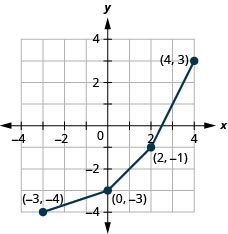
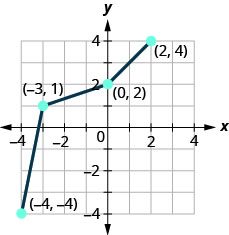
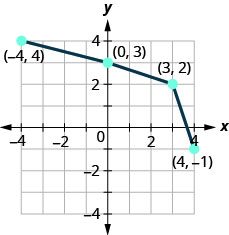
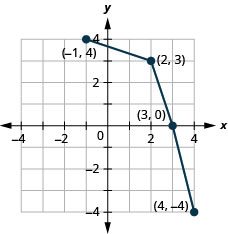
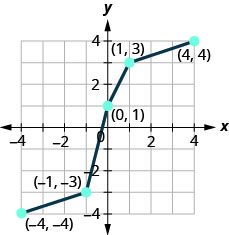
In the following exercises, determine whether or not the given functions are inverses.
and
and so they are inverses.
and
and
and so they are inverses.
and
and
and so they are inverses.
and
and
and so they are inverses (for nonnegative
and
In the following exercises, find the inverse of each function.
,
,
Writing Exercises
Explain how the graph of the inverse of a function is related to the graph of the function.
Answers will vary.
Explain how to find the inverse of a function from its equation. Use an example to demonstrate the steps.
Self Check
ⓐ After completing the exercises, use this checklist to evaluate your mastery of the objectives of this section.
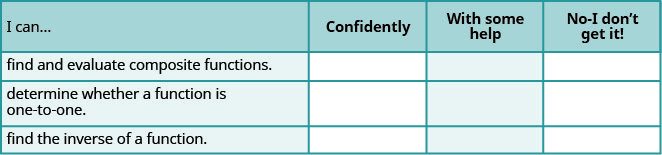
ⓑ If most of your checks were:
…confidently. Congratulations! You have achieved the objectives in this section. Reflect on the study skills you used so that you can continue to use them. What did you do to become confident of your ability to do these things? Be specific.
…with some help. This must be addressed quickly because topics you do not master become potholes in your road to success. In math every topic builds upon previous work. It is important to make sure you have a strong foundation before you move on. Whom can you ask for help?Your fellow classmates and instructor are good resources. Is there a place on campus where math tutors are available? Can your study skills be improved?
…no—I don’t get it! This is a warning sign and you must not ignore it. You should get help right away or you will quickly be overwhelmed. See your instructor as soon as you can to discuss your situation. Together you can come up with a plan to get you the help you need.
Adapted from Intermediate Algebra 2e by OpenStax (openstax.org), licensed under CC BY-NC-SA 4.0. Changes were made. License: CC-BY-NC-SA-4.0.