Login
📚 Intermediate Algebra 2e
Chapters ▾
⇩ Download ▾

8.7 Use Radicals in Functions

Evaluate a Radical Function

In this section we will extend our previous work with functions to include radicals. If a function is defined by a radical expression, we call it a radical function.

The square root function is f(x)=x.

The cube root function is f(x)=x3.

To evaluate a radical function, we find the value of f(x) for a given value of x just as we did in our previous work with functions.

We follow the same procedure to evaluate cube roots.

The next example has fourth roots.

Find the Domain of a Radical Function

To find the domain and range of radical functions, we use our properties of radicals. For a radical with an even index, we said the radicand had to be greater than or equal to zero as even roots of negative numbers are not real numbers. For an odd index, the radicand can be any real number. We restate the properties here for reference.

So, to find the domain of a radical function with even index, we set the radicand to be greater than or equal to zero. For an odd index radical, the radicand can be any real number.

The next example involves a cube root and so will require different thinking.

Graph Radical Functions

Before we graph any radical function, we first find the domain of the function. For the function, f(x)=x, the index is even, and so the radicand must be greater than or equal to 0.

This tells us the domain is x0 and we write this in interval notation as [0,).

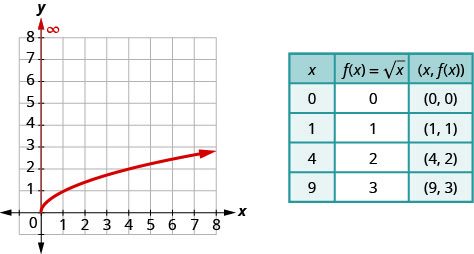
Previously we used point plotting to graph the function, f(x)=x. We chose x-values, substituted them in and then created a chart. Notice we chose points that are perfect squares in order to make taking the square root easier.

The figure shows the square root function graph on the x y-coordinate plane. The x-axis of the plane runs from 0 to 7. The y-axis runs from 0 to 7. The function has a starting point at (0, 0) and goes through the points (1, 1) and (4, 2). A table is shown beside the graph with 3 columns and 5 rows. The first row is a header row with the expressions “x”, “f (x) = square root of x”, and “(x, f (x))”. The second row has the numbers 0, 0, and (0, 0). The third row has the numbers 1, 1, and (1, 1). The fourth row has the numbers 4, 2, and (4, 2). The fifth row has the numbers 9, 3, and (9, 3).

Once we see the graph, we can find the range of the function. The y-values of the function are greater than or equal to zero. The range then is [0,).

In our previous work graphing functions, we graphed f(x)=x3 but we did not graph the function f(x)=x3. We will do this now in the next example.

Key Concepts

  • Properties of an
    • When n is an even number and:
      a0, then an is a real number.
      a<0, then an is not a real number.
    • When n is an odd number, an is a real number for all values of a.
  • Domain of a Radical Function
    • When the index of the radical is even, the radicand must be greater than or equal to zero.
    • When the index of the radical is odd, the radicand can be any real number.

Practice Makes Perfect

Evaluate a Radical Function

In the following exercises, evaluate each function.

f(x)=4x4, find ⓐ f(5)f(0).

f(5)=4 ⓑ no value at x=0

f(x)=6x5, find ⓐ f(5)f(−1).

g(x)=6x+1, find ⓐ g(4)g(8).

g(4)=5g(8)=7

g(x)=3x+1, find ⓐ g(8)g(5).

F(x)=32x, find ⓐ F(1)F(−11).

F(1)=1F(−11)=5

F(x)=84x, find ⓐ F(1)F(−2).

G(x)=5x1, find ⓐ G(5)G(2).

G(5)=26G(2)=3

G(x)=4x+1, find ⓐ G(11)G(2).

g(x)=2x43, find ⓐ g(6)g(−2).

g(6)=2g(−2)=−2

g(x)=7x13, find ⓐ g(4)g(−1).

h(x)=x243, find ⓐ h(−2)h(6).

h(−2)=0h(6)=243

h(x)=x2+43, find ⓐ h(−2)h(6).

For the function f(x)=2x34, find ⓐ f(0)f(2).

f(0)=0f(2)=2

For the function f(x)=3x34, find ⓐ f(0)f(3).

For the function g(x)=44x4, find ⓐ g(1)g(−3).

g(1)=0g(−3)=2

For the function g(x)=84x4, find ⓐ g(−6)g(2).

Find the Domain of a Radical Function

In the following exercises, find the domain of the function and write the domain in interval notation.

f(x)=3x1

[13,)

f(x)=4x2

g(x)=23x

(,23]

g(x)=8x

h(x)=5x2

(2,)

h(x)=6x+3

f(x)=x+3x2

(,−3](2,)

f(x)=x1x+4

g(x)=8x13

(,)

g(x)=6x+53

f(x)=4x2163

(,)

f(x)=6x2253

F(x)=8x+34

[38,)

F(x)=107x4

G(x)=2x15

(,)

G(x)=6x35

Graph Radical Functions

In the following exercises, ⓐ find the domain of the function ⓑ graph the function ⓒ use the graph to determine the range.

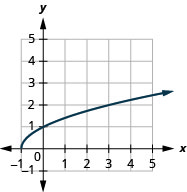
f(x)=x+1

ⓐ domain: [−1,)

The figure shows a square root function graph on the x y-coordinate plane. The x-axis of the plane runs from negative 1 to 7. The y-axis runs from negative 2 to 10. The function has a starting point at (negative 1, 0) and goes through the points (0, 1) and (3, 2).

[0,)

f(x)=x1

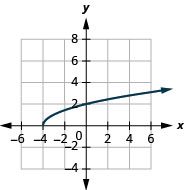
g(x)=x+4

ⓐ domain: [−4,)

The figure shows a square root function graph on the x y-coordinate plane. The x-axis of the plane runs from negative 4 to 4. The y-axis runs from negative 2 to 6. The function has a starting point at (negative 4, 0) and goes through the points (negative 3, 1) and (0, 2).

[0,)

g(x)=x4

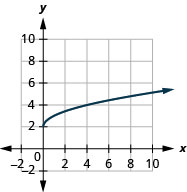
f(x)=x+2

ⓐ domain: [0,)

The figure shows a square root function graph on the x y-coordinate plane. The x-axis of the plane runs from 0 to 8. The y-axis runs from 0 to 8. The function has a starting point at (0, 2) and goes through the points (1, 3) and (4, 4).

[2,)

f(x)=x2

g(x)=2x

ⓐ domain: [0,)

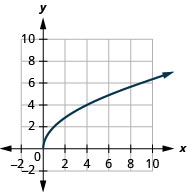
The figure shows a square root function graph on the x y-coordinate plane. The x-axis of the plane runs from 0 to 8. The y-axis runs from 0 to 8. The function has a starting point at (0, 0) and goes through the points (1, 2) and (4, 4).

[0,)

g(x)=3x

f(x)=3x

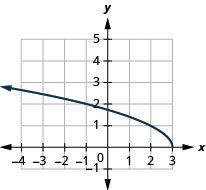
ⓐ domain: (,3]

The figure shows a square root function graph on the x y-coordinate plane. The x-axis of the plane runs from negative 6 to 4. The y-axis runs from 0 to 8. The function has a starting point at (3, 0) and goes through the points (2, 1), (negative 1, 2), and (negative 6, 3).

[0,)

f(x)=4x

g(x)=x

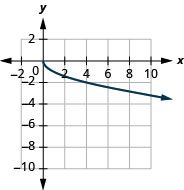
ⓐ domain: [0,)

The figure shows a square root function graph on the x y-coordinate plane. The x-axis of the plane runs from 0 to 8. The y-axis runs from negative 8 to 0. The function has a starting point at (0, 0) and goes through the points (1, negative 1) and (4, negative 2).

(,0]

g(x)=x+1

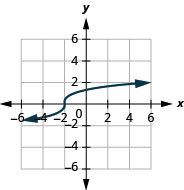
f(x)=x+13

ⓐ domain: (,)

The figure shows a cube root function graph on the x y-coordinate plane. The x-axis of the plane runs from negative 4 to 4. The y-axis runs from negative 4 to 4. The function has a center point at (negative 1, 0) and goes through the points (negative 2, negative 1) and (0, 1).

(,)

f(x)=x13

g(x)=x+23

ⓐ domain: (,)

The figure shows a cube root function graph on the x y-coordinate plane. The x-axis of the plane runs from negative 4 to 4. The y-axis runs from negative 4 to 4. The function has a center point at (negative 4, 0) and goes through the points (negative 3, negative 1) and (negative 1, 1).

(,)

g(x)=x23

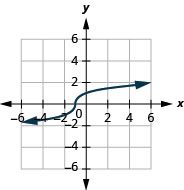
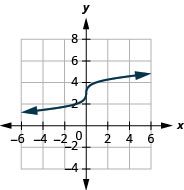
f(x)=x3+3

ⓐ domain: (,)

The figure shows a cube root function graph on the x y-coordinate plane. The x-axis of the plane runs from negative 4 to 4. The y-axis runs from negative 2 to 6. The function has a center point at (0, 3) and goes through the points (negative 1, 2) and (1, 4).

(,)

f(x)=x33

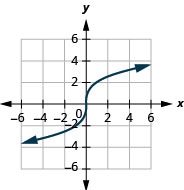
g(x)=x3

ⓐ domain: (,)

The figure shows a cube root function graph on the x y-coordinate plane. The x-axis of the plane runs from negative 4 to 4. The y-axis runs from negative 4 to 4. The function has a center point at (0, 0) and goes through the points (1, 1) and (negative 1, negative 1).

(,)

g(x)=x3

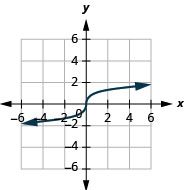
f(x)=2x3

ⓐ domain: (,)

The figure shows a cube root function graph on the x y-coordinate plane. The x-axis of the plane runs from negative 4 to 4. The y-axis runs from negative 4 to 4. The function has a center point at (0, 0) and goes through the points (1, 2) and (negative 1, negative 2).

(,)

f(x)=−2x3

Writing Exercises

Explain how to find the domain of a fourth root function.

Answers will vary.

Explain how to find the domain of a fifth root function.

Explain why y=x3 is a function.

Answers will vary.

Explain why the process of finding the domain of a radical function with an even index is different from the process when the index is odd.

Self Check

ⓐ After completing the exercises, use this checklist to evaluate your mastery of the objectives of this section.

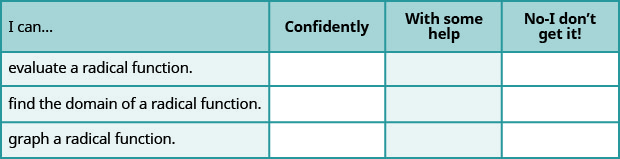
The table has 4 columns and 4 rows. The first row is a header row with the headers “I can…”, “Confidently”, “With some help.”, and “No – I don’t get it!”. The first column contains the phrases “evaluate a radical function”, “find the domain of a radical function”, and “graph a radical function”. The other columns are left blank so the learner can indicate their level of understanding.

ⓑ What does this checklist tell you about your mastery of this section? What steps will you take to improve?