
8.3 Simplify Rational Exponents
Simplify Expressions with
Rational exponents are another way of writing expressions with radicals. When we use rational exponents, we can apply the properties of exponents to simplify expressions.
The Power Property for Exponents says that when m and n are whole numbers. Let’s assume we are now not limited to whole numbers.
Suppose we want to find a number p such that We will use the Power Property of Exponents to find the value of p.
So But we know also Then it must be that
This same logic can be used for any positive integer exponent n to show that
The denominator of the rational exponent is the index of the radical.
There will be times when working with expressions will be easier if you use rational exponents and times when it will be easier if you use radicals. In the first few examples, you’ll practice converting expressions between these two notations.
In the next example, we will write each radical using a rational exponent. It is important to use parentheses around the entire expression in the radicand since the entire expression is raised to the rational power.
In the next example, you may find it easier to simplify the expressions if you rewrite them as radicals first.
Be careful of the placement of the negative signs in the next example. We will need to use the property in one case.
Simplify Expressions with
We can look at in two ways. Remember the Power Property tells us to multiply the exponents and so and both equal If we write these expressions in radical form, we get
This leads us to the following definition.
Which form do we use to simplify an expression? We usually take the root first—that way we keep the numbers in the radicand smaller, before raising it to the power indicated.
Remember that The negative sign in the exponent does not change the sign of the expression.
Use the Properties of Exponents to Simplify Expressions with Rational Exponents
The same properties of exponents that we have already used also apply to rational exponents. We will list the Properties of Exponents here to have them for reference as we simplify expressions.
We will apply these properties in the next example.
Sometimes we need to use more than one property. In the next example, we will use both the Product to a Power Property and then the Power Property.
We will use both the Product Property and the Quotient Property in the next example.
Key Concepts
- Rational Exponent
- If is a real number and then
- Rational Exponent
- For any positive integers m and n,
and
- For any positive integers m and n,
- Properties of Exponents
- If a, b are real numbers and m, n are rational numbers, then
- Product Property
- Power Property
- Product to a Power
- Quotient Property
- Zero Exponent Definition
- Quotient to a Power Property
- Negative Exponent Property
- If a, b are real numbers and m, n are rational numbers, then
Practice Makes Perfect
Simplify expressions with
In the following exercises, write as a radical expression.
ⓐ ⓑ ⓒ
ⓐ ⓑ ⓒ
ⓐ ⓑ ⓒ
ⓐ ⓑ ⓒ
ⓐ ⓑ ⓒ
ⓐ ⓑ ⓒ
In the following exercises, write with a rational exponent.
ⓐ ⓑ ⓒ
ⓐ ⓑ ⓒ
ⓐ ⓑ ⓒ
ⓐ ⓑ ⓒ
ⓐ ⓑ
ⓒ
ⓐ ⓑ ⓒ
ⓐ ⓑ ⓒ
ⓐ ⓑ
ⓒ
ⓐ ⓑ ⓒ
In the following exercises, simplify.
ⓐ ⓑ ⓒ
ⓐ 9 ⓑ 5 ⓒ 8
ⓐ ⓑ ⓒ
ⓐ ⓑ ⓒ
ⓐ 2 ⓑ 4 ⓒ 5
ⓐ ⓑ ⓒ
ⓐ ⓑ ⓒ
ⓐ ⓑ ⓒ
ⓐ ⓑ ⓒ
ⓐ ⓑ ⓒ
ⓐ not real ⓑ ⓒ
ⓐ ⓑ ⓒ
ⓐ ⓑ ⓒ
ⓐ not real ⓑ ⓒ
ⓐ ⓑ ⓒ
ⓐ ⓑ ⓒ
ⓐ not real ⓑ ⓒ
ⓐ ⓑ ⓒ
Simplify Expressions with
In the following exercises, write with a rational exponent.
ⓐ ⓑ ⓒ
ⓐ ⓑ ⓒ
ⓐ ⓑ ⓒ
ⓐ ⓑ ⓒ
ⓐ ⓑ ⓒ
ⓐ ⓑ ⓒ
In the following exercises, simplify.
ⓐ ⓑ ⓒ
ⓐ 32,768 ⓑ ⓒ 9
ⓐ ⓑ ⓒ
ⓐ ⓑ ⓒ
ⓐ 4 ⓑ ⓒ not real
ⓐ ⓑ ⓒ
ⓐ ⓑ ⓒ
ⓐ ⓑ ⓒ not real
ⓐ ⓑ ⓒ
Use the Laws of Exponents to Simplify Expressions with Rational Exponents
In the following exercises, simplify. Assume all variables are positive.
ⓐ ⓑ ⓒ
ⓐ ⓑ ⓒ
ⓐ ⓑ ⓒ
ⓐ ⓑ ⓒ
ⓐ ⓑ ⓒ
ⓐ ⓑ ⓒ
ⓐ ⓑ
ⓐ ⓑ
ⓐ ⓑ
ⓐ ⓑ
ⓐ ⓑ
ⓐ ⓑ
ⓐ ⓑ
ⓐ ⓑ
ⓐ ⓑ
ⓐ ⓑ
ⓐ ⓑ
ⓐ ⓑ
Writing Exercises
Show two different algebraic methods to simplify Explain all your steps.
Answers will vary.
Explain why the expression cannot be evaluated.
Self Check
ⓐ After completing the exercises, use this checklist to evaluate your mastery of the objectives of this section.
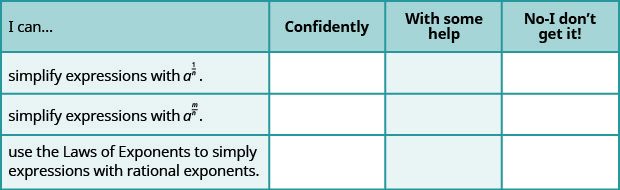
ⓑ What does this checklist tell you about your mastery of this section? What steps will you take to improve?
Adapted from Intermediate Algebra 2e by OpenStax (openstax.org), licensed under CC BY-NC-SA 4.0. Changes were made. License: CC-BY-NC-SA-4.0.