
8.4 Add, Subtract, and Multiply Radical Expressions
Add and Subtract Radical Expressions
Adding radical expressions with the same index and the same radicand is just like adding like terms. We call radicals with the same index and the same radicand like radicals to remind us they work the same as like terms.
We add and subtract like radicals in the same way we add and subtract like terms. We know that is Similarly we add and the result is
Think about adding like terms with variables as you do the next few examples. When you have like radicals, you just add or subtract the coefficients. When the radicals are not like, you cannot combine the terms.
For radicals to be like, they must have the same index and radicand. When the radicands contain more than one variable, as long as all the variables and their exponents are identical, the radicands are the same.
Remember that we always simplify radicals by removing the largest factor from the radicand that is a power of the index. Once each radical is simplified, we can then decide if they are like radicals.
In the next example, we will remove both constant and variable factors from the radicals. Now that we have practiced taking both the even and odd roots of variables, it is common practice at this point for us to assume all variables are greater than or equal to zero so that absolute values are not needed. We will use this assumption throughout the rest of this chapter.
Multiply Radical Expressions
We have used the Product Property of Roots to simplify square roots by removing the perfect square factors. We can use the Product Property of Roots ‘in reverse’ to multiply square roots. Remember, we assume all variables are greater than or equal to zero.
We will rewrite the Product Property of Roots so we see both ways together.
When we multiply two radicals they must have the same index. Once we multiply the radicals, we then look for factors that are a power of the index and simplify the radical whenever possible.
Multiplying radicals with coefficients is much like multiplying variables with coefficients. To multiply we multiply the coefficients together and then the variables. The result is 12xy. Keep this in mind as you do these examples.
We follow the same procedures when there are variables in the radicands.
Use Polynomial Multiplication to Multiply Radical Expressions
In the next a few examples, we will use the Distributive Property to multiply expressions with radicals. First we will distribute and then simplify the radicals when possible.
When we worked with polynomials, we multiplied binomials by binomials. Remember, this gave us four products before we combined any like terms. To be sure to get all four products, we organized our work—usually by the FOIL method.
Recognizing some special products made our work easier when we multiplied binomials earlier. This is true when we multiply radicals, too. The special product formulas we used are shown here.
We will use the special product formulas in the next few examples. We will start with the Product of Binomial Squares Pattern.
In the next example, we will use the Product of Conjugates Pattern. Notice that the final product has no radical.
Key Concepts
- Product Property of Roots
- For any real numbers, and and for any integer
and
- For any real numbers, and and for any integer
- Special Products
Practice Makes Perfect
Add and Subtract Radical Expressions
In the following exercises, simplify.
ⓐ ⓑ ⓒ
ⓐ ⓑ ⓒ
ⓐ ⓑ ⓒ
ⓐ ⓑ ⓒ
ⓐ ⓑ ⓒ
ⓐ ⓑ ⓒ
ⓐ ⓑ
ⓐ ⓑ 0
ⓐ ⓑ
ⓐ ⓑ
ⓐ ⓑ
ⓐ ⓑ
ⓐ ⓑ ⓒ
ⓐ ⓑ ⓒ
ⓐ ⓑ ⓒ
ⓐ ⓑ ⓒ
ⓐ ⓑ ⓒ
ⓐ ⓑ ⓒ
ⓐ ⓑ
ⓐ ⓑ 0
ⓐ ⓑ
ⓐ ⓑ
ⓐ ⓑ
ⓐ ⓑ
Multiply Radical Expressions
In the following exercises, simplify.
ⓐ ⓑ
ⓐ ⓑ
ⓐ ⓑ
ⓐ ⓑ
ⓐ ⓑ
ⓐ ⓑ
ⓐ ⓑ
ⓐ ⓑ
ⓐ ⓑ
ⓐ ⓑ
ⓐ ⓑ
ⓐ ⓑ
Use Polynomial Multiplication to Multiply Radical Expressions
In the following exercises, multiply.
ⓐ ⓑ
ⓐ ⓑ
ⓐ ⓑ
ⓐ ⓑ
ⓐ ⓑ
ⓐ ⓑ
ⓐ ⓑ
ⓐ ⓑ
ⓐ ⓑ
ⓐ ⓑ
ⓐ
ⓑ
ⓐ ⓑ
ⓐ ⓑ
ⓐ ⓑ
ⓐ ⓑ
ⓐ ⓑ
ⓐ
ⓑ
ⓐ ⓑ
14
Mixed Practice
29
Writing Exercises
Explain when a radical expression is in simplest form.
Answers will vary.
Explain the process for determining whether two radicals are like or unlike. Make sure your answer makes sense for radicals containing both numbers and variables.
ⓐ Explain why is always non-negative, for
ⓑ Explain why is always non-positive, for
Answers will vary.
Use the binomial square pattern to simplify Explain all your steps.
Self Check
ⓐ After completing the exercises, use this checklist to evaluate your mastery of the objectives of this section.
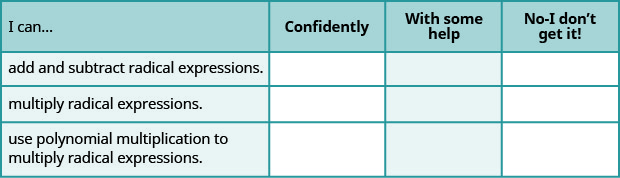
ⓑ On a scale of 1-10, how would you rate your mastery of this section in light of your responses on the checklist? How can you improve this?
Adapted from Intermediate Algebra 2e by OpenStax (openstax.org), licensed under CC BY-NC-SA 4.0. Changes were made. License: CC-BY-NC-SA-4.0.