
2.6 Solve Compound Inequalities
Solve Compound Inequalities with “and”
Now that we know how to solve linear inequalities, the next step is to look at compound inequalities. A compound inequality is made up of two inequalities connected by the word “and” or the word “or.” For example, the following are compound inequalities.
To solve a compound inequality means to find all values of the variable that make the compound inequality a true statement. We solve compound inequalities using the same techniques we used to solve linear inequalities. We solve each inequality separately and then consider the two solutions.
To solve a compound inequality with the word “and,” we look for all numbers that make both inequalities true. To solve a compound inequality with the word “or,” we look for all numbers that make either inequality true.
Let’s start with the compound inequalities with “and.” Our solution will be the numbers that are solutions to both inequalities known as the intersection of the two inequalities. Consider the intersection of two streets—the part where the streets overlap—belongs to both streets.

To find the solution of the compound inequality, we look at the graphs of each inequality and then find the numbers that belong to both graphs—where the graphs overlap.
For the compound inequality and we graph each inequality. We then look for where the graphs “overlap”. The numbers that are shaded on both graphs, will be shaded on the graph of the solution of the compound inequality. See Figure 2.5.
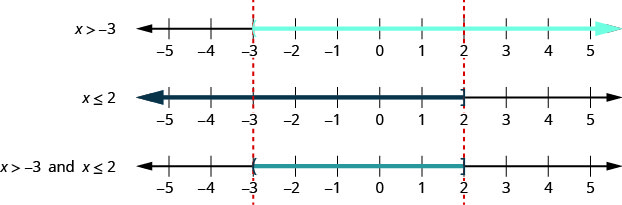
We can see that the numbers between and are shaded on both of the first two graphs. They will then be shaded on the solution graph.
The number is not shaded on the first graph and so since it is not shaded on both graphs, it is not included on the solution graph.
The number two is shaded on both the first and second graphs. Therefore, it is be shaded on the solution graph.
This is how we will show our solution in the next examples.
Sometimes we have a compound inequality that can be written more concisely. For example, and can be written simply as and then we call it a double inequality. The two forms are equivalent.
To solve a double inequality we perform the same operation on all three “parts” of the double inequality with the goal of isolating the variable in the center.
When written as a double inequality, it is easy to see that the solutions are the numbers caught between one and five, including one, but not five. We can then graph the solution immediately as we did above.
Another way to graph the solution of is to graph both the solution of and the solution of We would then find the numbers that make both inequalities true as we did in previous examples.
Solve Compound Inequalities with “or”
To solve a compound inequality with “or”, we start out just as we did with the compound inequalities with “and”—we solve the two inequalities. Then we find all the numbers that make either inequality true.
Just as the United States is the union of all of the 50 states, the solution will be the union of all the numbers that make either inequality true. To find the solution of the compound inequality, we look at the graphs of each inequality, find the numbers that belong to either graph and put all those numbers together.
To write the solution in interval notation, we will often use the union symbol, to show the union of the solutions shown in the graphs.
Solve Applications with Compound Inequalities
Situations in the real world also involve compound inequalities. We will use the same problem solving strategy that we used to solve linear equation and inequality applications.
Recall the problem solving strategies are to first read the problem and make sure all the words are understood. Then, identify what we are looking for and assign a variable to represent it. Next, restate the problem in one sentence to make it easy to translate into a compound inequality. Last, we will solve the compound inequality.
Key Concepts
- How to solve a compound inequality with “and”
- Solve each inequality.
- Graph each solution. Then graph the numbers that make both inequalities true. This graph shows the solution to the compound inequality.
- Write the solution in interval notation.
- Double Inequality
- A double inequality is a compound inequality such as . It is equivalent to and
- A double inequality is a compound inequality such as . It is equivalent to and
- How to solve a compound inequality with “or”
- Solve each inequality.
- Graph each solution. Then graph the numbers that make either inequality true.
- Write the solution in interval notation.
Practice Makes Perfect
Solve Compound Inequalities with “and”
In the following exercises, solve each inequality, graph the solution, and write the solution in interval notation.
and
and
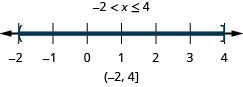
and
and
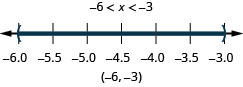
and
and
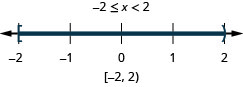
and
and
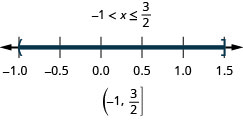
and
and
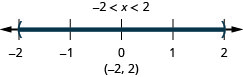
and
and
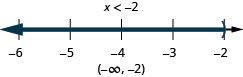
and
and
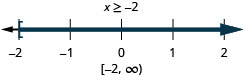
and
and
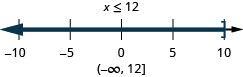
and
and
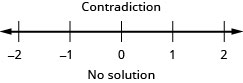
and
and
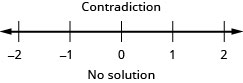
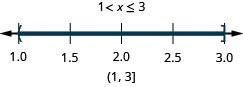
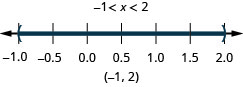
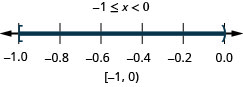
Solve Compound Inequalities with “or”
In the following exercises, solve each inequality, graph the solution on the number line, and write the solution in interval notation.
or
or
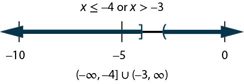
or
or
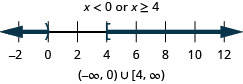
or
or
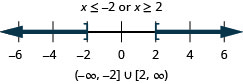
or
or
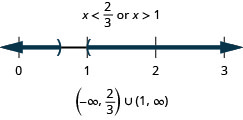
or
or
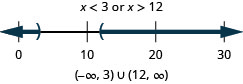
or
or
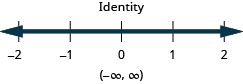
or
or
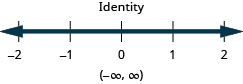
Mixed practice
In the following exercises, solve each inequality, graph the solution on the number line, and write the solution in interval notation.
and
and
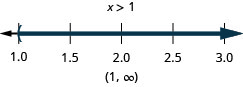
or
or
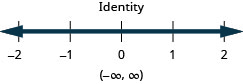
and
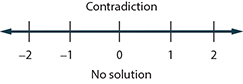
or
and
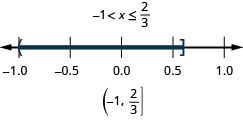
and
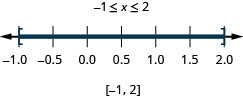
Solve Applications with Compound Inequalities
In the following exercises, solve.
Penelope is playing a number game with her sister June. Penelope is thinking of a number and wants June to guess it. Five more than three times her number is between 2 and 32. Write a compound inequality that shows the range of numbers that Penelope might be thinking of.
Gregory is thinking of a number and he wants his sister Lauren to guess the number. His first clue is that six less than twice his number is between four and forty-two. Write a compound inequality that shows the range of numbers that Gregory might be thinking of.
Andrew is creating a rectangular dog run in his back yard. The length of the dog run is 18 feet. The perimeter of the dog run must be at least 42 feet and no more than 72 feet. Use a compound inequality to find the range of values for the width of the dog run.
Elouise is creating a rectangular garden in her back yard. The length of the garden is 12 feet. The perimeter of the garden must be at least 36 feet and no more than 48 feet. Use a compound inequality to find the range of values for the width of the garden.
Everyday Math
Blood Pressure A person’s blood pressure is measured with two numbers. The systolic blood pressure measures the pressure of the blood on the arteries as the heart beats. The diastolic blood pressure measures the pressure while the heart is resting.
ⓐ Let x be your systolic blood pressure. Research and then write the compound inequality that shows you what a normal systolic blood pressure should be for someone your age.
ⓑ Let y be your diastolic blood pressure. Research and then write the compound inequality that shows you what a normal diastolic blood pressure should be for someone your age.
Body Mass Index (BMI) is a measure of body fat is determined using your height and weight.
ⓐ Let x be your BMI. Research and then write the compound inequality to show the BMI range for you to be considered normal weight.
ⓑ Research a BMI calculator and determine your BMI. Is it a solution to the inequality in part (a)?
ⓐ answers vary ⓑ answers vary
Writing Exercises
In your own words, explain the difference between the properties of equality and the properties of inequality.
Explain the steps for solving the compound inequality or
Answers will vary.
Self Check
ⓐ After completing the exercises, use this checklist to evaluate your mastery of the objectives of this section.
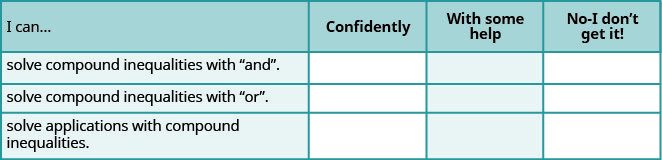
ⓑ What does this checklist tell you about your mastery of this section? What steps will you take to improve?
Adapted from Intermediate Algebra 2e by OpenStax (openstax.org), licensed under CC BY-NC-SA 4.0. Changes were made. License: CC-BY-NC-SA-4.0.