
2.5 Solve Linear Inequalities
Graph Inequalities on the Number Line
What number would make the inequality true? Are you thinking, “x could be four”? That’s correct, but x could be 6, too, or 37, or even 3.001. Any number greater than three is a solution to the inequality
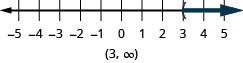
We show all the solutions to the inequality on the number line by shading in all the numbers to the right of three, to show that all numbers greater than three are solutions. Because the number three itself is not a solution, we put an open parenthesis at three.
We can also represent inequalities using interval notation. There is no upper end to the solution to this inequality. In interval notation, we express as The symbol is read as “infinity.” It is not an actual number.
Figure 2.2 shows both the number line and the interval notation.

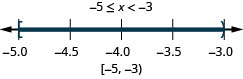
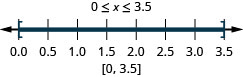
We use the left parenthesis symbol, (, to show that the endpoint of the inequality is not included. The left bracket symbol, [, shows that the endpoint is included.
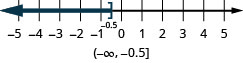
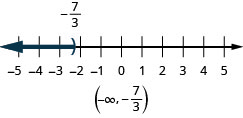
The inequality means all numbers less than or equal to one. Here we need to show that one is a solution, too. We do that by putting a bracket at We then shade in all the numbers to the left of one, to show that all numbers less than one are solutions. See Figure 2.3.
There is no lower end to those numbers. We write in interval notation as The symbol is read as “negative infinity.” Figure 2.3 shows both the number line and interval notation.

The notation for inequalities on a number line and in interval notation use the same symbols to express the endpoints of intervals.
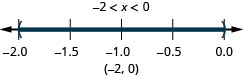
What numbers are greater than two but less than five? Are you thinking say, ? We can represent all the numbers between two and five with the inequality We can show on the number line by shading all the numbers between two and five. Again, we use the parentheses to show the numbers two and five are not included. See Figure 2.4.

Solve Linear Inequalities
A linear inequality is much like a linear equation—but the equal sign is replaced with an inequality sign. A linear inequality is an inequality in one variable that can be written in one of the forms, or
When we solved linear equations, we were able to use the properties of equality to add, subtract, multiply, or divide both sides and still keep the equality. Similar properties hold true for inequalities.
We can add or subtract the same quantity from both sides of an inequality and still keep the inequality. For example:
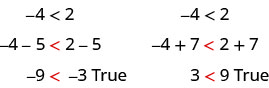
Notice that the inequality sign stayed the same.
This leads us to the Addition and Subtraction Properties of Inequality.
What happens to an inequality when we divide or multiply both sides by a constant?
Let’s first multiply and divide both sides by a positive number.
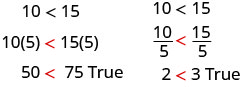
The inequality signs stayed the same.
Does the inequality stay the same when we divide or multiply by a negative number?
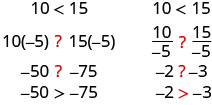
Notice that when we filled in the inequality signs, the inequality signs reversed their direction.
When we divide or multiply an inequality by a positive number, the inequality sign stays the same. When we divide or multiply an inequality by a negative number, the inequality sign reverses.
This gives us the Multiplication and Division Property of Inequality.
When we divide or multiply an inequality by a:
- positive number, the inequality stays the same.
- negative number, the inequality reverses.
Sometimes when solving an inequality, as in the next example, the variable ends upon the right. We can rewrite the inequality in reverse to get the variable to the left.
Think about it as “If Xander is taller than Andy, then Andy is shorter than Xander.”
Be careful when you multiply or divide by a negative number—remember to reverse the inequality sign.
Most inequalities will take more than one step to solve. We follow the same steps we used in the general strategy for solving linear equations, but make sure to pay close attention when we multiply or divide to isolate the variable.
When solving inequalities, it is usually easiest to collect the variables on the side where the coefficient of the variable is largest. This eliminates negative coefficients and so we don’t have to multiply or divide by a negative—which means we don’t have to remember to reverse the inequality sign.
Just like some equations are identities and some are contradictions, inequalities may be identities or contradictions, too. We recognize these forms when we are left with only constants as we solve the inequality. If the result is a true statement, we have an identity. If the result is a false statement, we have a contradiction.
We can clear fractions in inequalities much as we did in equations. Again, be careful with the signs when multiplying or dividing by a negative.
Translate to an Inequality and Solve
To translate English sentences into inequalities, we need to recognize the phrases that indicate the inequality. Some words are easy, like “more than” and “less than.” But others are not as obvious. Table 2.2 shows some common phrases that indicate inequalities.
| is greater than is more than is larger than exceeds | is greater than or equal to is at least is no less than is the minimum | is less than is smaller than has fewer than is lower than | is less than or equal to is at most is no more than is the maximum |
Solve Applications with Linear Inequalities
Many real-life situations require us to solve inequalities. The method we will use to solve applications with linear inequalities is very much like the one we used when we solved applications with equations.
We will read the problem and make sure all the words are understood. Next, we will identify what we are looking for and assign a variable to represent it. We will restate the problem in one sentence to make it easy to translate into an inequality. Then, we will solve the inequality.
Sometimes an application requires the solution to be a whole number, but the algebraic solution to the inequality is not a whole number. In that case, we must round the algebraic solution to a whole number. The context of the application will determine whether we round up or down.
Profit is the money that remains when the costs have been subtracted from the revenue. In the next example, we will find the number of jobs a small businesswoman needs to do every month in order to make a certain amount of profit.
There are many situations in which several quantities contribute to the total expense. We must make sure to account for all the individual expenses when we solve problems like this.
Key Concepts
- Inequalities, Number Lines, and Interval Notation

- Linear Inequality
- A linear inequality is an inequality in one variable that can be written in one of the following forms where a, b, and c are real numbers and
- A linear inequality is an inequality in one variable that can be written in one of the following forms where a, b, and c are real numbers and
- Addition and Subtraction Property of Inequality
- For any numbers a, b, and c, if
- We can add or subtract the same quantity from both sides of an inequality and still keep the inequality.
- For any numbers a, b, and c, if
- Multiplication and Division Property of Inequality
- For any numbers a, b, and c,
- For any numbers a, b, and c,
- Phrases that indicate inequalities
is greater than
is more than
is larger than
exceedsis greater than or equal to
is at least
is no less than
is the minimumis less than
is smaller than
has fewer than
is lower thanis less than or equal to
is at most
is no more than
is the maximum
Practice Makes Perfect
Graph Inequalities on the Number Line
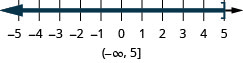
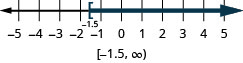
In the following exercises, graph each inequality on the number line and write in interval notation.
ⓐ
ⓑ
ⓒ
ⓐ
ⓑ
ⓒ
ⓐ 
ⓑ 
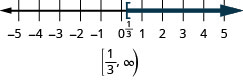
ⓐ
ⓑ
ⓒ
ⓐ
ⓑ
ⓒ
ⓐ 
ⓑ 
ⓒ 
ⓐ
ⓑ
ⓒ
ⓐ
ⓑ
ⓒ
ⓐ 
ⓑ
ⓒ
ⓐ
ⓑ
ⓒ
ⓐ
ⓑ
ⓒ
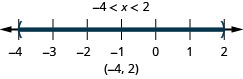
ⓐ 
ⓑ
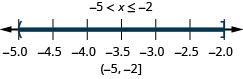
ⓒ
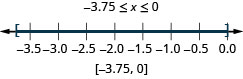
Solve Linear Inequalities
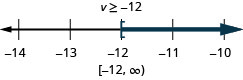
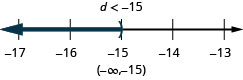
In the following exercises, solve each inequality, graph the solution on the number line, and write the solution in interval notation.
ⓐ
ⓑ
ⓒ
ⓐ
ⓑ
ⓒ
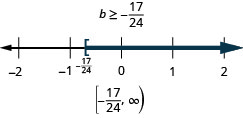
ⓐ 
ⓑ
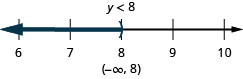
ⓒ
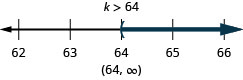
ⓐ
ⓑ
ⓒ
ⓐ
ⓑ
ⓒ
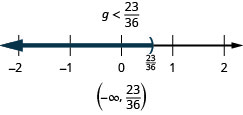
ⓐ 
ⓑ
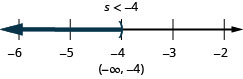
ⓒ
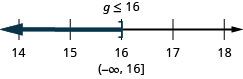
ⓐ
ⓑ
ⓐ
ⓑ
ⓐ 
ⓑ
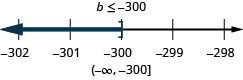
ⓐ
ⓑ
ⓐ
ⓑ
ⓐ 
ⓑ
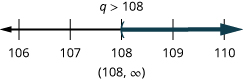
In the following exercises, solve each inequality, graph the solution on the number line, and write the solution in interval notation.
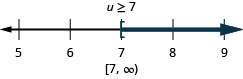
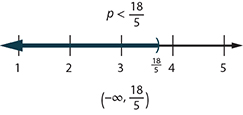
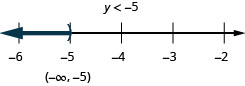
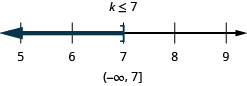
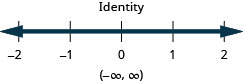
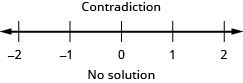
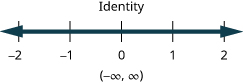
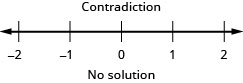
In the following exercises, solve each inequality, graph the solution on the number line, and write the solution in interval notation.
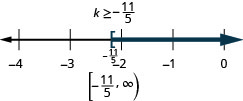
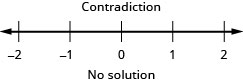
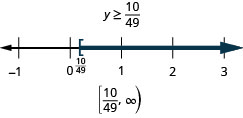
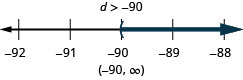
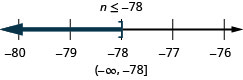
Translate to an Inequality and Solve
In the following exercises, translate and solve. Then graph the solution on the number line and write the solution in interval notation.
Three more than h is no less than 25.
Six more than k exceeds 25.
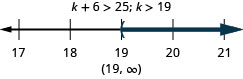
Ten less than w is at least 39.
Twelve less than x is no less than 21.
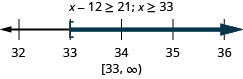
Negative five times r is no more than 95.
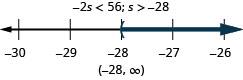
Negative two times s is lower than 56.
Nineteen less than b is at most
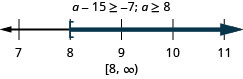
Fifteen less than a is at least
Solve Applications with Linear Inequalities
In the following exercises, solve.
Alan is loading a pallet with boxes that each weighs 45 pounds. The pallet can safely support no more than 900 pounds. How many boxes can he safely load onto the pallet?
The elevator in Yehire’s apartment building has a sign that says the maximum weight is 2100 pounds. If the average weight of one person is 150 pounds, how many people can safely ride the elevator?
A maximum of 14 people can safely ride in the elevator.
Andre is looking at apartments with three of his friends. They want the monthly rent to be no more than $2,360. If the roommates split the rent evenly among the four of them, what is the maximum rent each will pay?
Arleen got a $20 gift card for the coffee shop. Her favorite iced drink costs $3.79. What is the maximum number of drinks she can buy with the gift card?
five drinks
Teegan likes to play golf. He has budgeted $60 next month for the driving range. It costs him $10.55 for a bucket of balls each time he goes. What is the maximum number of times he can go to the driving range next month?
Ryan charges his neighbors $17.50 to wash their car. How many cars must he wash next summer if his goal is to earn at least $1,500?
86 cars
Keshad gets paid $2,400 per month plus 6% of his sales. His brother earns $3,300 per month. For what amount of total sales will Keshad’s monthly pay be higher than his brother’s monthly pay?
Kimuyen needs to earn $4,150 per month in order to pay all her expenses. Her job pays her $3,475 per month plus 4% of her total sales. What is the minimum Kimuyen’s total sales must be in order for her to pay all her expenses?
$16,875
Andre has been offered an entry-level job. The company offered him $48,000 per year plus 3.5% of his total sales. Andre knows that the average pay for this job is $62,000. What would Andre’s total sales need to be for his pay to be at least as high as the average pay for this job?
Nataly is considering two job offers. The first job would pay her $83,000 per year. The second would pay her $66,500 plus 15% of her total sales. What would her total sales need to be for her salary on the second offer be higher than the first?
$110,000
Jake’s water bill is $24.80 per month plus $2.20 per ccf (hundred cubic feet) of water. What is the maximum number of ccf Jake can use if he wants his bill to be no more than $60?
Kiyoshi’s phone plan costs $17.50 per month plus $0.15 per text message. What is the maximum number of text messages Kiyoshi can use so the phone bill is no more than $56.60?
260 messages
Marlon’s TV plan costs $49.99 per month plus $5.49 per first-run movie. How many first-run movies can he watch if he wants to keep his monthly bill to be a maximum of $100?
Kellen wants to rent a banquet room in a restaurant for her cousin’s baby shower. The restaurant charges $350 for the banquet room plus $32.50 per person for lunch. How many people can Kellen have at the shower if she wants the maximum cost to be $1,500?
35 people
Moshde runs a hairstyling business from her house. She charges $45 for a haircut and style. Her monthly expenses are $960. She wants to be able to put at least $1,200 per month into her savings account order to open her own salon. How many “cut & styles” must she do to save at least $1,200 per month?
Noe installs and configures software on home computers. He charges $125 per job. His monthly expenses are $1,600. How many jobs must he work in order to make a profit of at least $2,400?
32 jobs
Katherine is a personal chef. She charges $115 per four-person meal. Her monthly expenses are $3,150. How many four-person meals must she sell in order to make a profit of at least $1,900?
Melissa makes necklaces and sells them online. She charges $88 per necklace. Her monthly expenses are $3,745. How many necklaces must she sell if she wants to make a profit of at least $1,650?
62 necklaces
Five student government officers want to go to the state convention. It will cost them $110 for registration, $375 for transportation and food, and $42 per person for the hotel. There is $450 budgeted for the convention in the student government savings account. They can earn the rest of the money they need by having a car wash. If they charge $5 per car, how many cars must they wash in order to have enough money to pay for the trip?
Cesar is planning a four-day trip to visit his friend at a college in another state. It will cost him $198 for airfare, $56 for local transportation, and $45 per day for food. He has $189 in savings and can earn $35 for each lawn he mows. How many lawns must he mow to have enough money to pay for the trip?
seven lawns
Alonzo works as a car detailer. He charges $175 per car. He is planning to move out of his parents’ house and rent his first apartment. He will need to pay $120 for application fees, $950 for security deposit, and first and last months’ rent at $1,140 per month. He has $1,810 in savings. How many cars must he detail to have enough money to rent the apartment?
Eun-Kyung works as a tutor and earns $60 per hour. She has $792 in savings. She is planning an anniversary party for her parents. She would like to invite 40 guests. The party will cost her $1,520 for food and drinks and $150 for the photographer. She will also have a favor for each of the guests, and each favor will cost $7.50. How many hours must she tutor to have enough money for the party?
20 hours
Everyday Math
Maximum load on a stage In 2014, a high school stage collapsed in Fullerton, California, when 250 students got on stage for the finale of a musical production. Two dozen students were injured. The stage could support a maximum of 12,750 pounds. If the average weight of a student is assumed to be 140 pounds, what is the maximum number of students who could safely be on the stage?
Maximum weight on a boat In 2004, a water taxi sank in Baltimore harbor and five people drowned. The water taxi had a maximum capacity of 3,500 pounds (25 people with average weight 140 pounds). The average weight of the 25 people on the water taxi when it sank was 168 pounds per person. What should the maximum number of people of this weight have been?
20 people
Wedding budget Adele and Walter found the perfect venue for their wedding reception. The cost is $9850 for up to 100 guests, plus $38 for each additional guest. How many guests can attend if Adele and Walter want the total cost to be no more than $12,500?
Shower budget Penny is planning a baby shower for her daughter-in-law. The restaurant charges $950 for up to 25 guests, plus $31.95 for each additional guest. How many guests can attend if Penny wants the total cost to be no more than $1,500?
42 guests
Writing Exercises
Explain why it is necessary to reverse the inequality when solving
Explain why it is necessary to reverse the inequality when solving
Answers will vary.
Find your last month’s phone bill and the hourly salary you are paid at your job. Calculate the number of hours of work it would take you to earn at least enough money to pay your phone bill by writing an appropriate inequality and then solving it. Do you feel this is an appropriate number of hours? Is this the appropriate phone plan for you?
Find out how many units you have left, after this term, to achieve your college goal and estimate the number of units you can take each term in college. Calculate the number of terms it will take you to achieve your college goal by writing an appropriate inequality and then solving it. Is this an acceptable number of terms until you meet your goal? What are some ways you could accelerate this process?
Answers will vary.
Self Check
ⓐ After completing the exercises, use this checklist to evaluate your mastery of the objectives of this section.
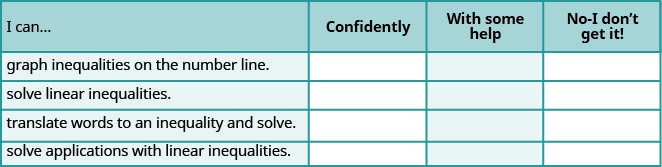
ⓑ After looking at the checklist, do you think you are well-prepared for the next section? Why or why not?
Adapted from Intermediate Algebra 2e by OpenStax (openstax.org), licensed under CC BY-NC-SA 4.0. Changes were made. License: CC-BY-NC-SA-4.0.